Combustion Stoichiometry and Carbon Dioxide Emissions
Students balance fuel-combustion equations and use mole ratios, molar mass, and quantitative evidence to calculate and compare carbon dioxide emissions from different fuels.
Illustrations are auto-generated and may be placeholders. They can be refreshed to match the narration.
Reviewing Complete Combustion
Complete combustion occurs when a fuel reacts with enough oxygen to produce carbon dioxide and water. For a hydrocarbon, which contains only carbon and hydrogen, the general pattern is fuel + oxygen → carbon dioxide + water. The atoms are rearranged, not created or destroyed, so each element must have the same number of atoms before and after the reaction. For example, methane burns according to CH4 + 2 O2 → CO2 + 2 H2O. Both sides contain one carbon atom, four hydrogen atoms, and four oxygen atoms. Complete combustion differs from incomplete combustion, which can form carbon monoxide or solid carbon when oxygen is limited. Emissions calculations usually assume complete combustion unless other conditions are specified.

Balancing Fuel-Combustion Equations
A balanced equation uses coefficients to show the mole ratios among reactants and products. Begin by writing the correct formulas, then balance carbon, hydrogen, and oxygen in that order. For propane, start with C3H8 + O2 → CO2 + H2O. Three carbon atoms require 3 CO2, and eight hydrogen atoms require 4 H2O. The products then contain ten oxygen atoms, so the reactant side needs 5 O2. The balanced equation is C3H8 + 5 O2 → 3 CO2 + 4 H2O. Never change subscripts while balancing because doing so changes the identities of the substances. The coefficients show that one mole of propane reacts with five moles of oxygen and produces three moles of carbon dioxide and four moles of water.

Converting Fuel Mass to Moles
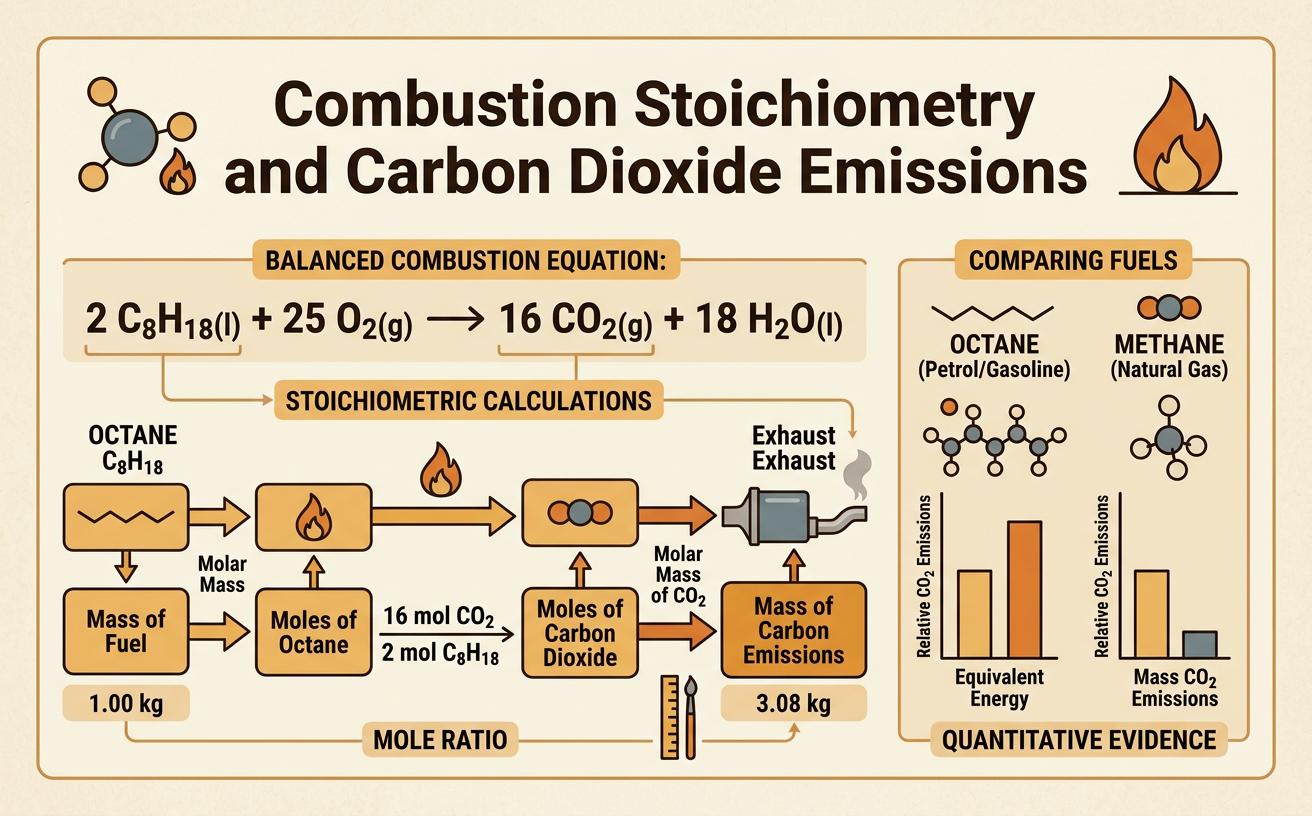
Stoichiometric coefficients compare amounts in moles, so a measured fuel mass must first be converted to moles. Moles equal mass divided by molar mass. Units help organize the calculation and reveal whether the setup is correct. For octane, C8H18, the molar mass is 8(12.01) + 18(1.008) = 114.23 grams per mole. If 1.00 kilogram of octane burns, convert kilograms to grams and calculate: 1.00 kg × 1,000 g/1 kg × 1 mol C8H18/114.23 g = 8.75 mol C8H18. Kilograms and grams cancel, leaving moles as required. This dimensional-analysis method can be used for any fuel when its chemical formula, molar mass, and measured mass are known.

Calculating Carbon Dioxide Emissions
After finding moles of fuel, use the balanced equation to determine moles of carbon dioxide and then convert to mass. Octane combustion is 2 C8H18 + 25 O2 → 16 CO2 + 18 H2O, so one mole of octane produces eight moles of carbon dioxide. From 1.00 kilogram of octane, 8.75 mol C8H18 × 8 mol CO2/1 mol C8H18 = 70.0 mol CO2. Using the carbon dioxide molar mass, 70.0 mol × 44.01 g/mol = 3,081 g, or 3.08 kilograms of CO2. The carbon dioxide mass is greater than the original fuel mass because oxygen atoms from the atmosphere become part of the product. The calculation still follows conservation of mass when the consumed oxygen is included.

Comparing Fuels and Evaluating Claims
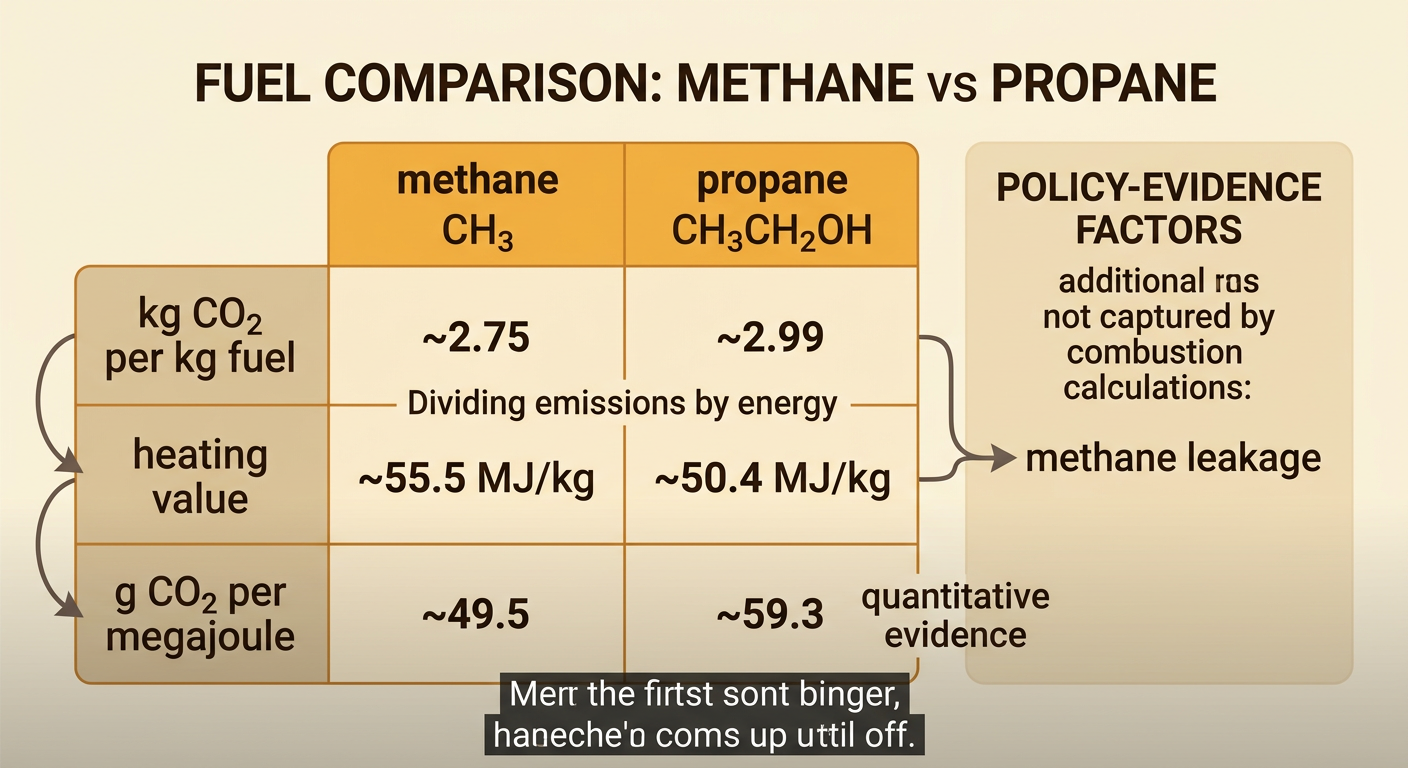
Fair comparisons require a common basis, such as carbon dioxide emitted per kilogram of fuel or per unit of energy delivered. Complete combustion of methane produces about 2.75 kilograms of CO2 per kilogram of methane, while propane produces about 2.99 kilograms of CO2 per kilogram of propane. Using approximate heating values of 55.5 megajoules per kilogram for methane and 50.4 megajoules per kilogram for propane gives about 49.5 grams CO2 per megajoule for methane and 59.3 grams CO2 per megajoule for propane. These results support the limited claim that burning methane releases less carbon dioxide per unit of energy. However, evaluating a fuel policy also requires evidence about methane leakage, extraction, transportation, efficiency, cost, safety, and effects on communities. A scientifically sound policy claim must state its assumptions and acknowledge relevant evidence beyond combustion alone.