Communicating with Patterns of Light and Sound
Students explore how repeating patterns of light or sound can be used to encode, send, and interpret information.
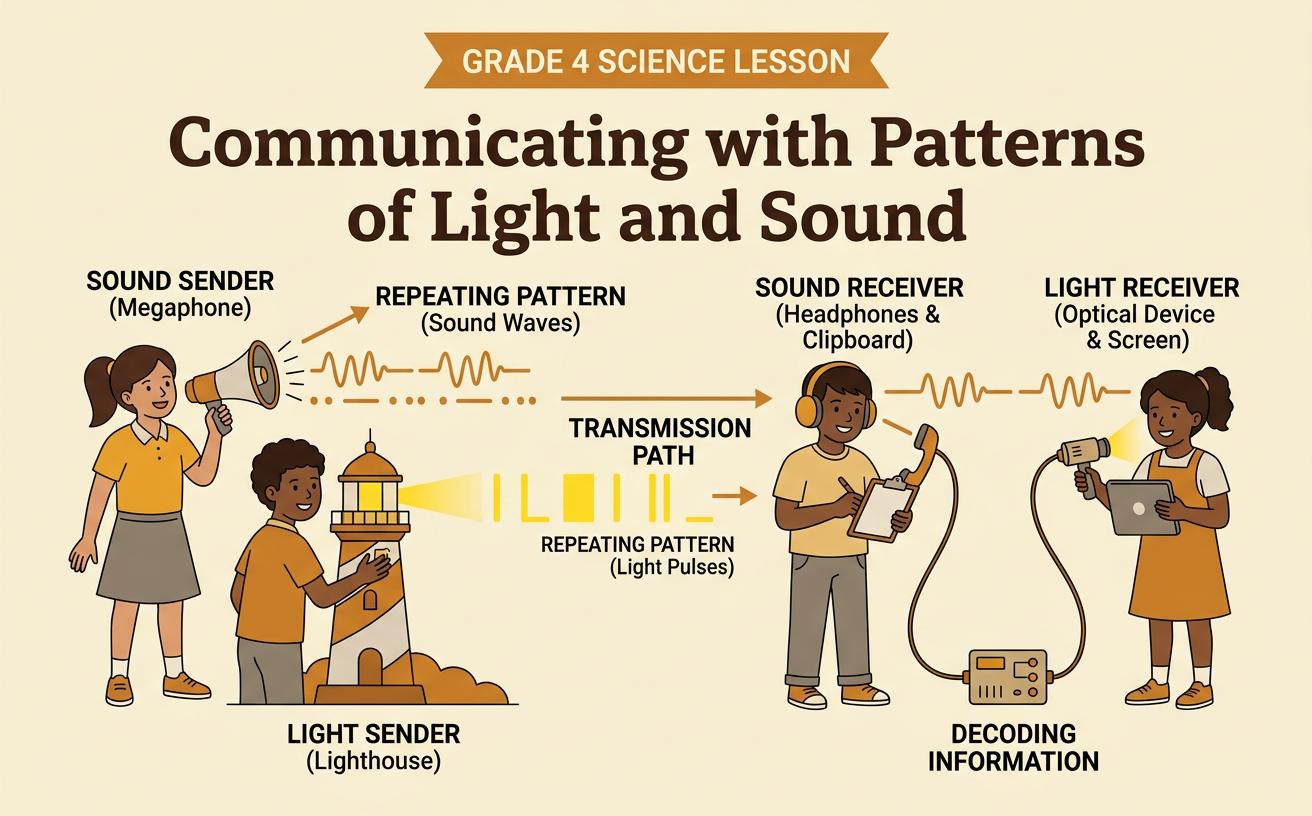
Illustrations are auto-generated and may be placeholders. They can be refreshed to match the narration.
Patterns Carry Information
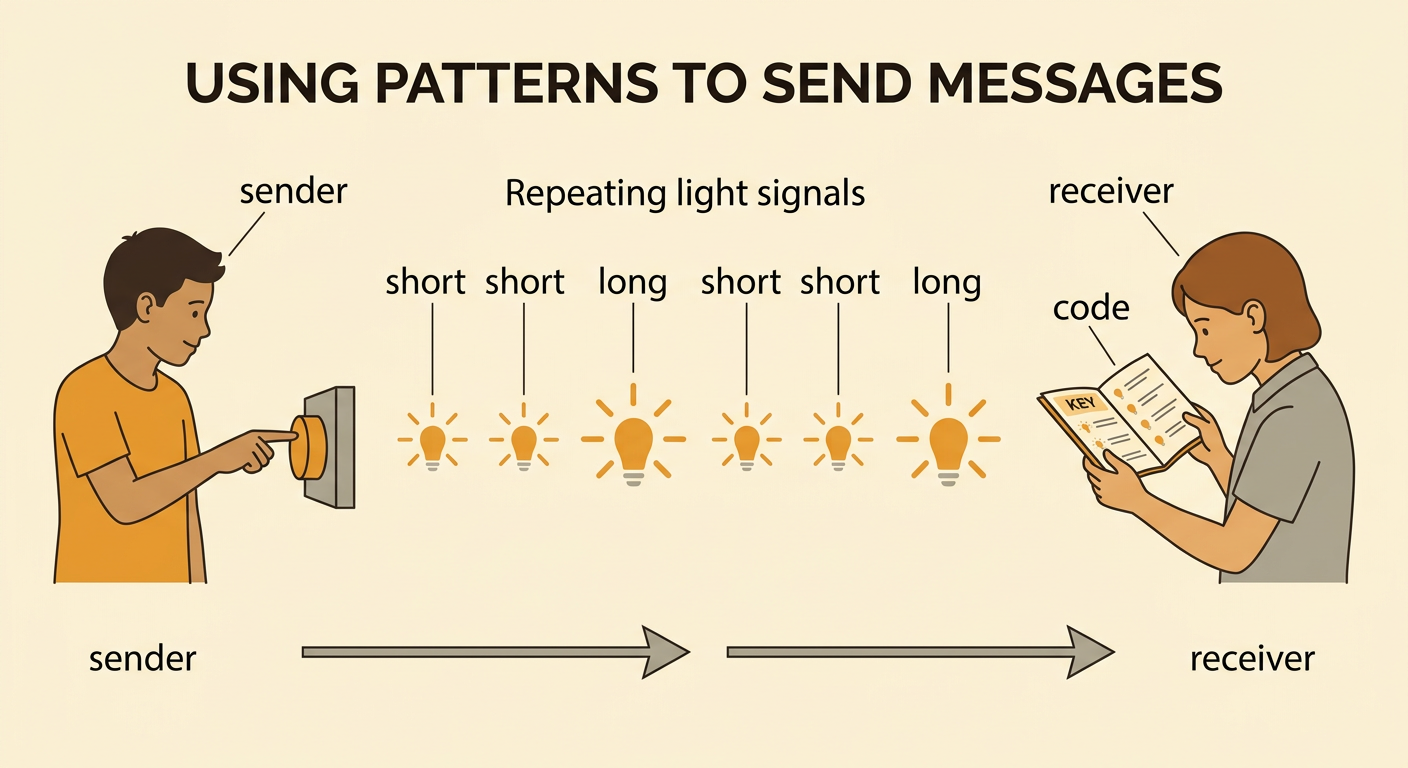
A pattern is an arrangement that follows a rule. When people agree on what parts of a pattern mean, the pattern can carry information. A school bell provides a familiar example. One long ring might mean that school is starting, while three short rings might signal a practice drill. The rings are useful only if everyone knows the code. Patterns can repeat, grow, or change according to a rule. For example, the light pattern short, short, long, short, short, long repeats every three flashes. You can use its rule to predict that the next flash will be short. A sender creates the pattern, a signal carries it, and a receiver observes it. The receiver then uses the shared code to interpret the message.
Light and Sound Signals
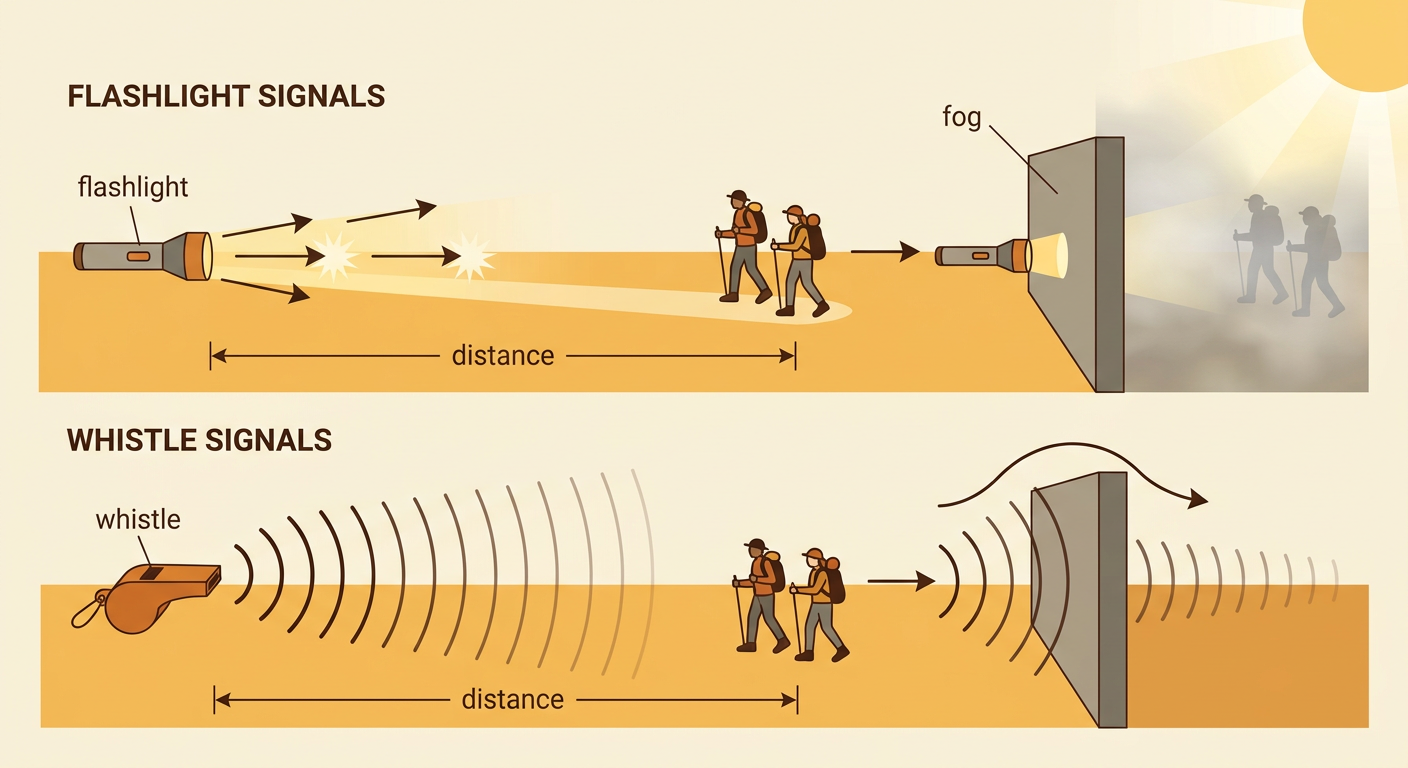
Light and sound can both carry patterned signals. A flashlight can make short and long flashes, while a whistle can make short and long blasts. Light travels very quickly and can be seen from far away when the path is clear. However, a wall, thick fog, or bright sunlight can make a light signal difficult to see. Sound travels through matter and can often be heard without looking toward the sender. However, traffic, wind, or other loud sounds can hide it. Imagine two hikers signaling across a field. At night, three flashlight flashes may work well. During a bright, foggy morning, three whistle blasts may be easier to notice. The best signal depends on the location, weather, distance, and needs of the people communicating.
Encode a Message
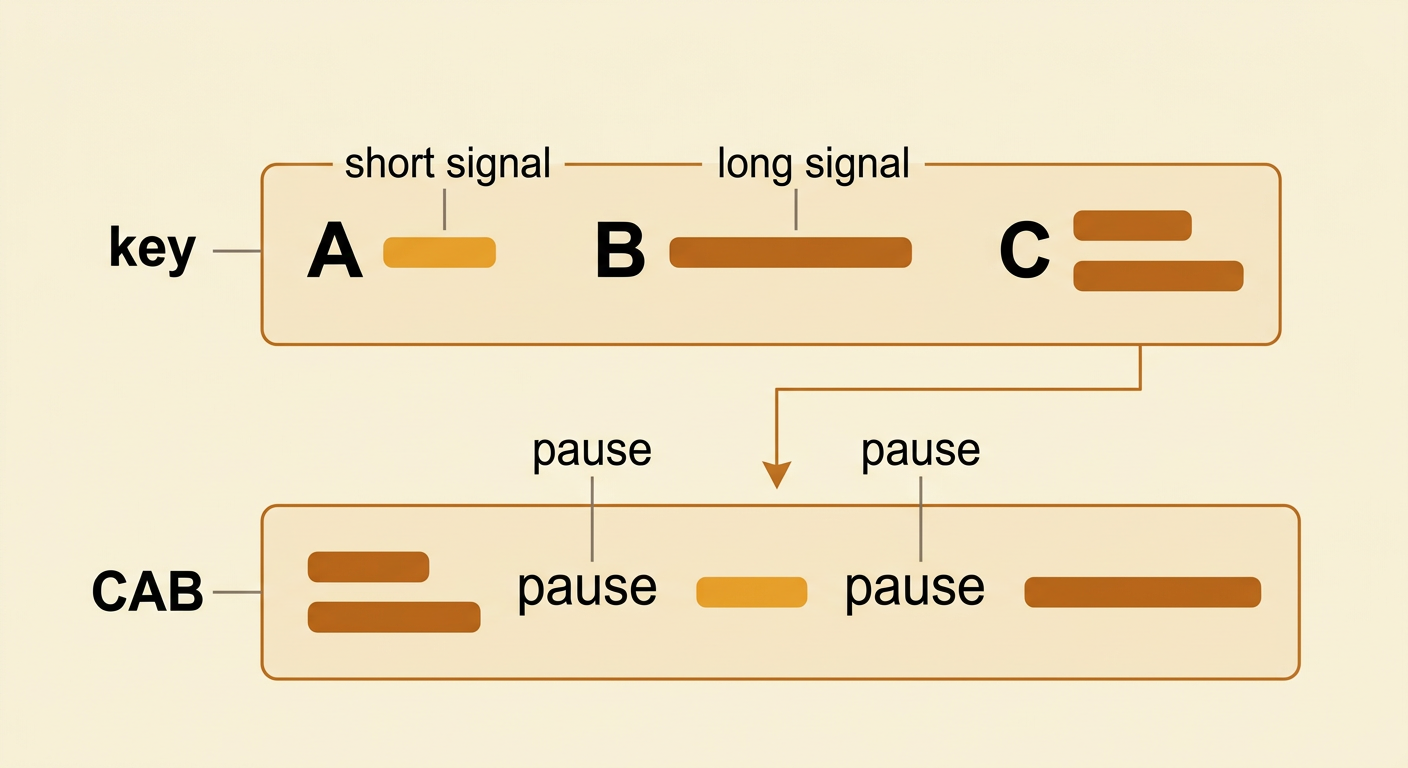
To encode a message, change information into an agreed pattern. First, create a key that gives each letter or idea a signal. For a simple class code, A could be one short signal, B one long signal, and C two short signals. Use a clear pause between letters so the receiver can tell where each letter ends. To send CAB, make two short signals, pause, make one short signal, pause, and make one long signal. Test the code before using it. Ask whether any two entries could be confused and whether the pauses are easy to notice. You can also generate a repeating test pattern, such as short, short, long. Its rule predicts that the fourth and fifth signals will both be short. A reliable code has consistent signals, clear spacing, and a key shared by everyone.
Decode a Classmate’s Message
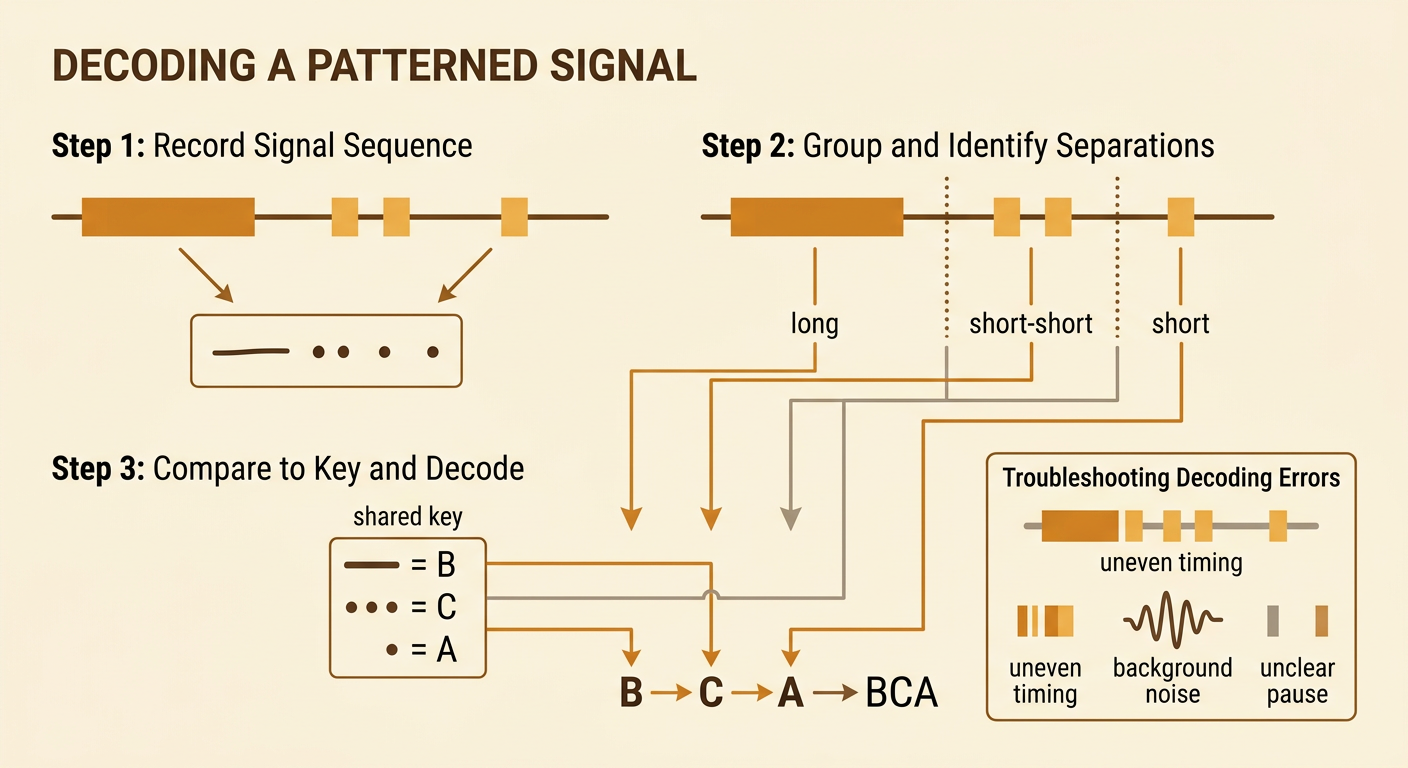
To decode a message, observe the signal and use the shared key to change the pattern back into information. First, record each short and long signal in order. Next, mark the longer pauses that separate letters. Then compare each group with the code key. Suppose a classmate sends long, pause, short-short, pause, short. Using the class code, long means B, short-short means C, and short means A. The decoded message is BCA. Check your answer by asking the sender to repeat the pattern. If the two recordings match, your interpretation is more likely to be correct. If they do not match, look for possible causes such as a missed flash, background noise, uneven timing, or unclear pauses. Careful observation and accurate records help a receiver avoid errors.
Compare Communication Solutions
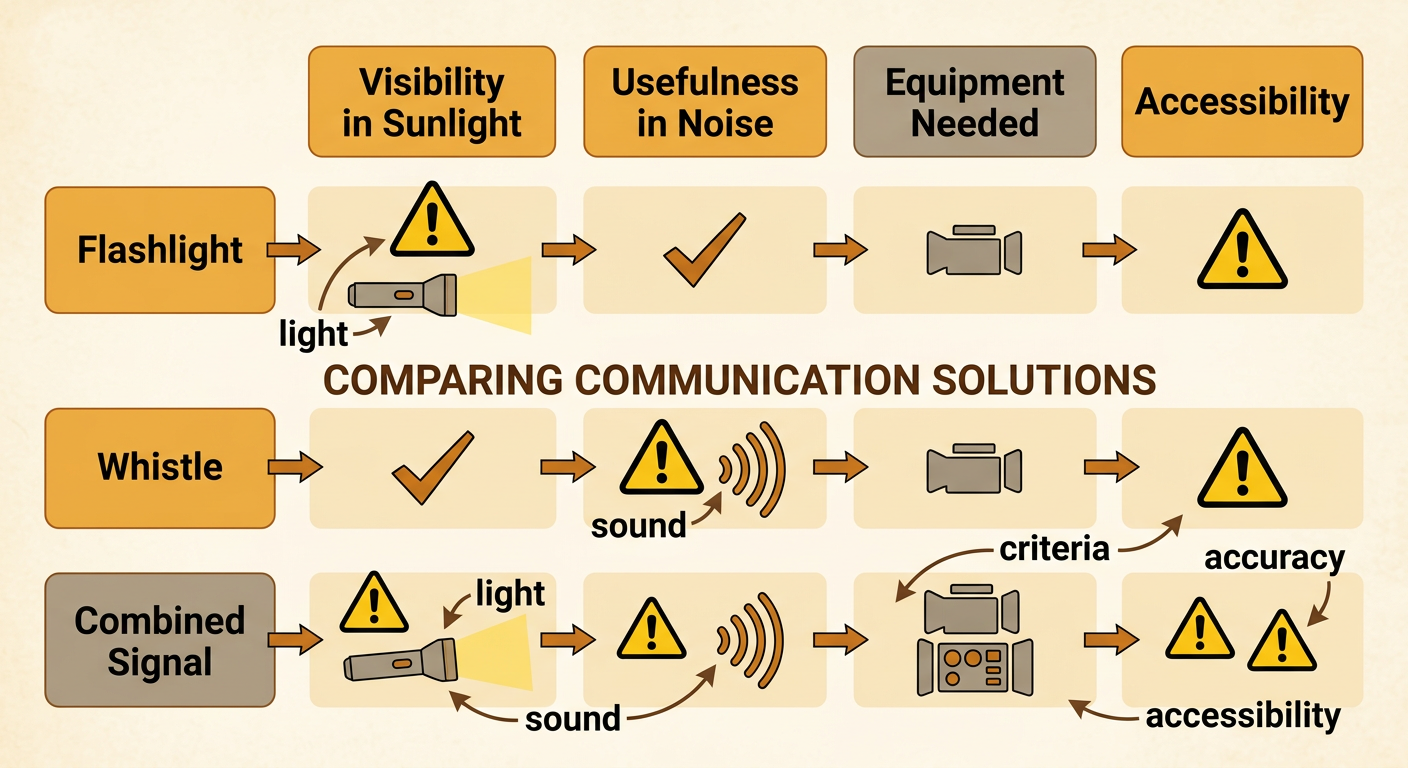
Engineers compare several solutions before choosing how to send information. Important criteria include distance, speed, accuracy, safety, cost, and accessibility. Imagine students must signal when a playground game begins. They could flash a light three times, blow a whistle three times, or use both signals together. A flashlight is quiet, but bright sunlight may make it hard to see. A whistle is easy to hear, but playground noise may cover it. Using both light and sound may be more reliable because receivers have two ways to notice the message, although it requires more equipment. A light-only signal may not work for someone who cannot see it, and a sound-only signal may not work for someone who cannot hear it. The best solution meets the most important criteria under the actual conditions.
Communication Then and Now
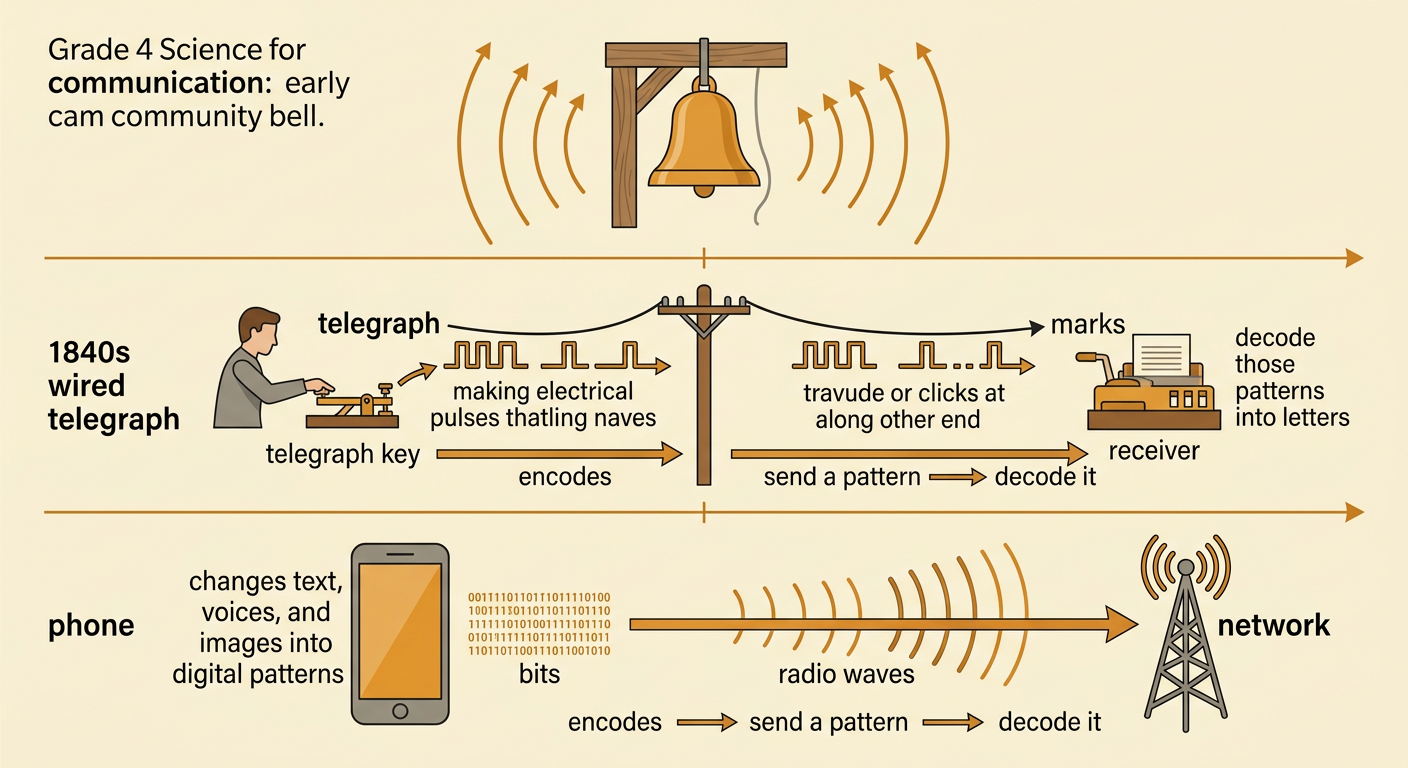
People have long used patterns of light and sound to communicate. Before electronic communication, communities used bells, lanterns, drums, and other signals to share warnings or announcements over limited distances. In the 1840s, the electrical telegraph became widely used in the United States. An operator pressed a key to create patterned electrical pulses that traveled through a wire. At the receiving end, the pulses produced marks or clicks that could be interpreted as coded letters. This allowed news to travel much faster than a person carrying a written message. Today, a phone changes a text, voice, or image into digital patterns of bits. The phone sends the information using radio waves through a network. Both telegraphs and phones encode, send, and decode patterns, but modern systems carry more information more quickly and reach people almost anywhere.