
Community Solutions for Protecting Natural Resources
Students evaluate community actions that reduce resource use and pollution, calculate their potential impact, and recommend an evidence-based solution.
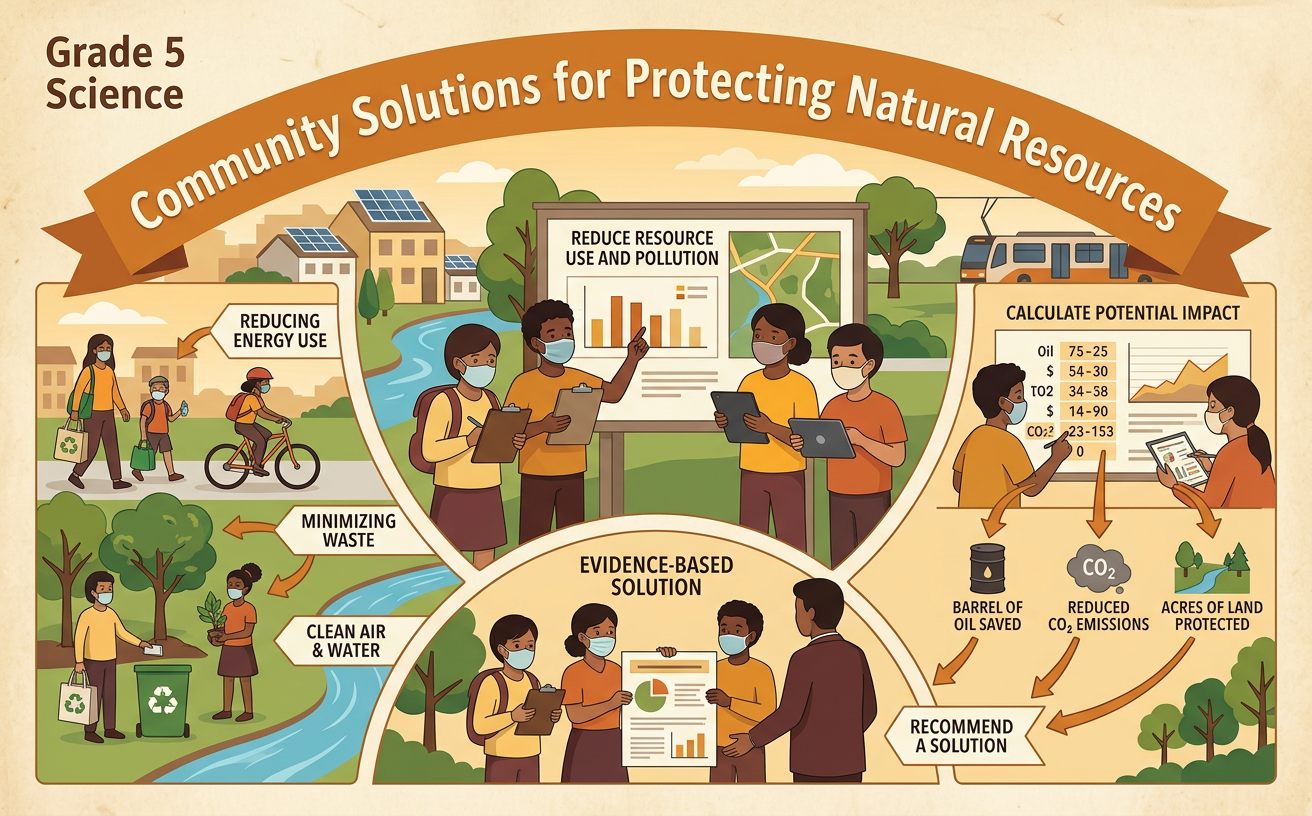
Illustrations are auto-generated and may be placeholders. They can be refreshed to match the narration.
Natural Resources and Human Impacts
Natural resources are materials and features from Earth that people use, such as water, soil, forests, minerals, and clean air. Human activities can change these resources. For example, a town may pump water from a river for homes and businesses. If people use water faster than rainfall replaces it, less water may remain for fish and plants. Trash, fertilizer, and oil can also wash from streets into storm drains and enter the river. Communities study these effects by measuring water use, testing water quality, and observing living things. This scientific information helps people understand a problem before choosing a solution. Protecting resources does not mean never using them. It means using them carefully, reducing pollution, and allowing natural systems enough time and space to stay healthy.
Community Solutions
Communities can use science ideas to reduce resource use and pollution. To conserve water, a town might repair leaking pipes, install low-flow fixtures, or collect rainwater for gardens. To reduce water pollution, it might plant rain gardens near streets. A rain garden is a shallow area filled with plants and soil that absorbs runoff and helps filter pollutants before the water reaches a stream. Communities can also add recycling and composting programs to keep useful materials out of landfills. Each solution has benefits, limits, and costs. For example, rain gardens reduce runoff and provide habitat, but they need space and regular care. Residents can participate by attending public meetings, sharing evidence, joining cleanup events, or contacting local leaders. Responsible participation helps a community choose and maintain solutions that serve the public.

Comparing Evidence from Sources
A strong community decision uses information from several trustworthy sources. Suppose students investigate whether their town should add water-bottle refill stations. A city report may state how many disposable bottles are collected as trash. A school water-use record may show how much drinking water students use. A science article may explain how making and transporting plastic bottles uses energy and resources. Students should identify each source’s main claim, evidence, date, and purpose. They can then look for agreements and differences. If two sources report different bottle totals, the students should check whether the sources studied different places or time periods. Combining information gives a fuller picture than relying on one text. Students should separate measured facts from opinions and note unanswered questions before deciding whether refill stations are likely to reduce waste.

Calculating Resource Savings
Calculations can estimate the impact of a proposed action. Imagine that one leaking school faucet wastes 2.75 gallons of water each day. A second faucet wastes 1.50 gallons each day. Together, they waste 2.75 + 1.50 = 4.25 gallons per day. If repairs stop both leaks for 20 school days, the savings are 4.25 × 20 = 85.00 gallons. Decimal points must be aligned when adding because ones, tenths, and hundredths represent different place values. Students can check the result by estimating: 2.75 is about 3 and 1.50 is about 1.5, so the daily total should be near 4.5 gallons. The exact answer, 4.25 gallons, is reasonable. Actual savings may vary if the leak rate changes, so communities should measure again after repairs and compare the new data with the estimate.
Recommending an Effective Action
An evidence-based recommendation clearly names an action and supports it with facts, calculations, and reasoning. Suppose students compare fixing two leaking faucets with placing reminder signs near sinks. They might recommend repairing the faucets first because measurements show that repairs could save 85.00 gallons in 20 school days. Signs may also encourage careful water use, but their savings are harder to predict without before-and-after data. A complete recommendation should explain environmental benefits, cost, fairness, and possible limits. It should also describe how success will be measured, such as recording water use for one month after the repair. Students can present their recommendation to the principal, school board, or town council and respectfully answer questions. Participating in meetings, writing letters, and helping collect data are ways individuals contribute to democratic community decisions about shared natural resources.