Community Work: Then and Now
Students compare how community members did common jobs in the past and today, focusing on how tools and technology changed their work.
Illustrations are auto-generated and may be placeholders. They can be refreshed to match the narration.
Jobs in Our Community
A community is a place where people live, work, and help one another. Community workers meet needs and solve problems. Teachers help children learn. Firefighters respond to fires and other emergencies. Farmers grow food, and construction workers build and repair structures. Mail carriers deliver letters and packages. Each worker uses tools to complete important tasks. For example, a mail carrier may use a delivery truck, a handheld scanner, and a large bag. The truck carries mail over long distances. The scanner records when a package is delivered. The bag helps the carrier bring mail from the truck to each door. Tools make some work safer, faster, or easier, but workers still need knowledge, training, and teamwork to do their jobs well.

Looking at Work in the Past
People in the past did many of the same kinds of work that people do today. However, their tools and working conditions were often different. To learn about past work, historians study photographs, letters, diaries, newspapers, tools, and stories from people who remember earlier times. Imagine a mail carrier in a small town more than 100 years ago. The carrier might have walked or used a horse-drawn wagon to deliver letters. Mail was sorted by hand, and travel could be slow on muddy or snowy roads. A historical photograph could show the wagon, clothing, mailbags, and street. These details provide evidence about work at that time. Historians ask questions such as, “What tools did this worker use?” and “How long might this task have taken?”

Comparing Old and New Tools
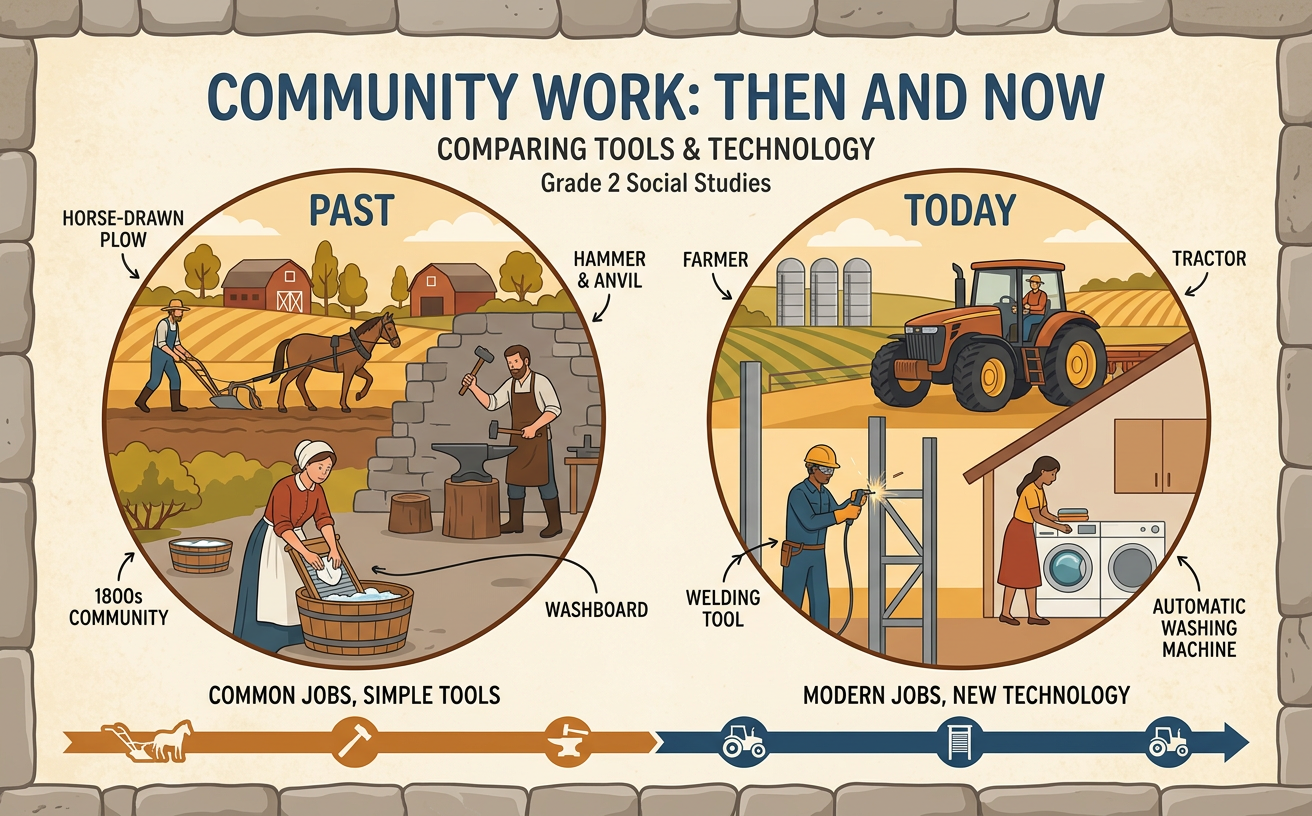
Comparing means noticing what is alike and what is different. Old and new tools may serve the same purpose even when they work in different ways. In the past, many farmers guided horse-drawn plows to turn soil before planting. Today, many farmers use tractors that pull larger plows. Both tools prepare soil for crops. The horse-drawn plow depended on animal power and usually covered less land in a day. A tractor uses an engine and can pull heavy equipment across a larger area more quickly. However, tractors need fuel, maintenance, and trained operators. Not every farmer in the past or today uses the same tools. A useful comparison considers the task, the power source, the speed, and the worker’s effort. These details show how technology can change a job over time.

How Tools Solve Problems
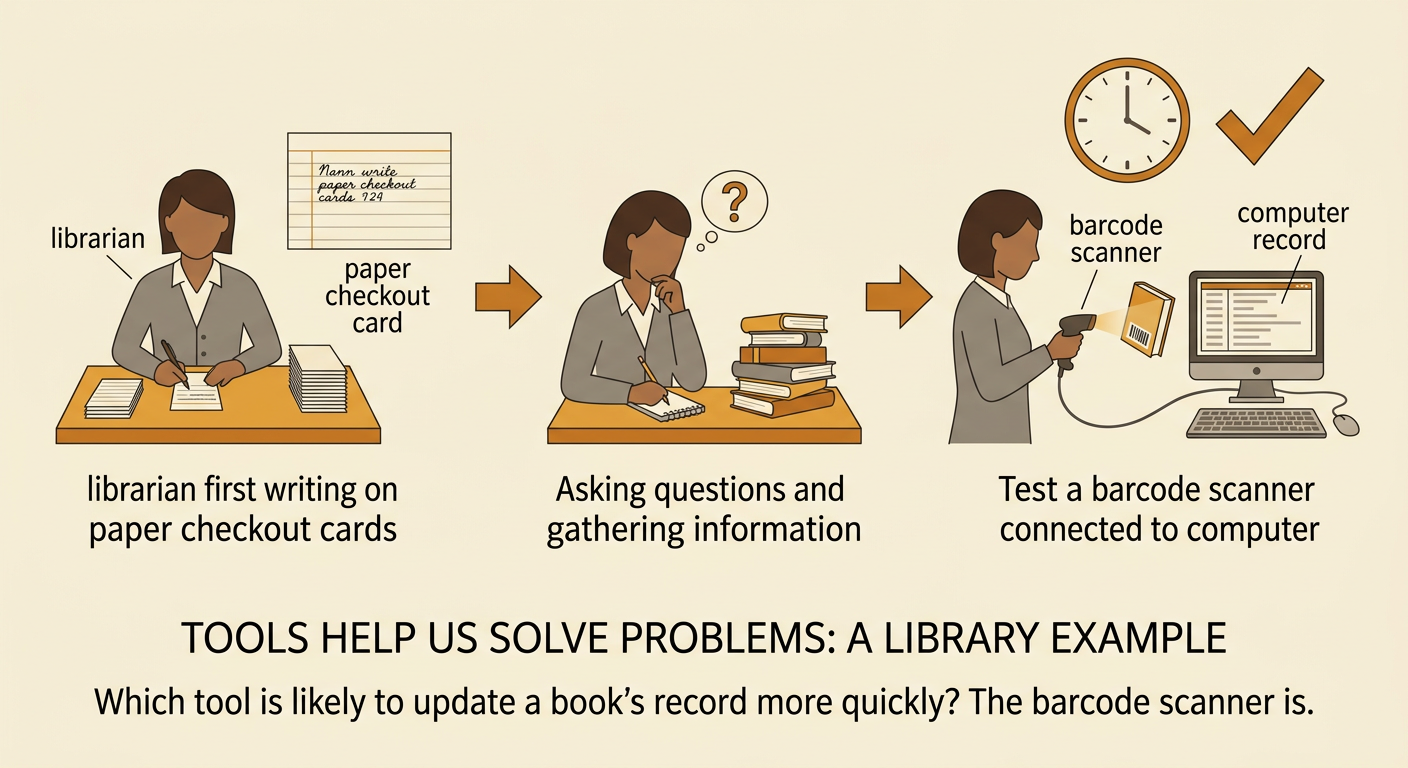
Tools are designed to help people solve problems. A worker can begin by asking what is difficult, slow, or unsafe about a task. Then the worker can gather information by observing the task and asking questions. For example, a librarian must keep track of many books. A paper checkout card can record who borrowed a book, but writing every entry may take time and lead to mistakes. A barcode scanner connected to a computer can read a book’s code quickly and update its record. Before choosing the tool, the library might ask, “Will it save time?” “Is it easy to use?” and “How much will it cost?” People can test the tool and improve the system if problems remain. A useful new tool should meet a real need and help the worker complete the task.
Then-and-Now Reflection
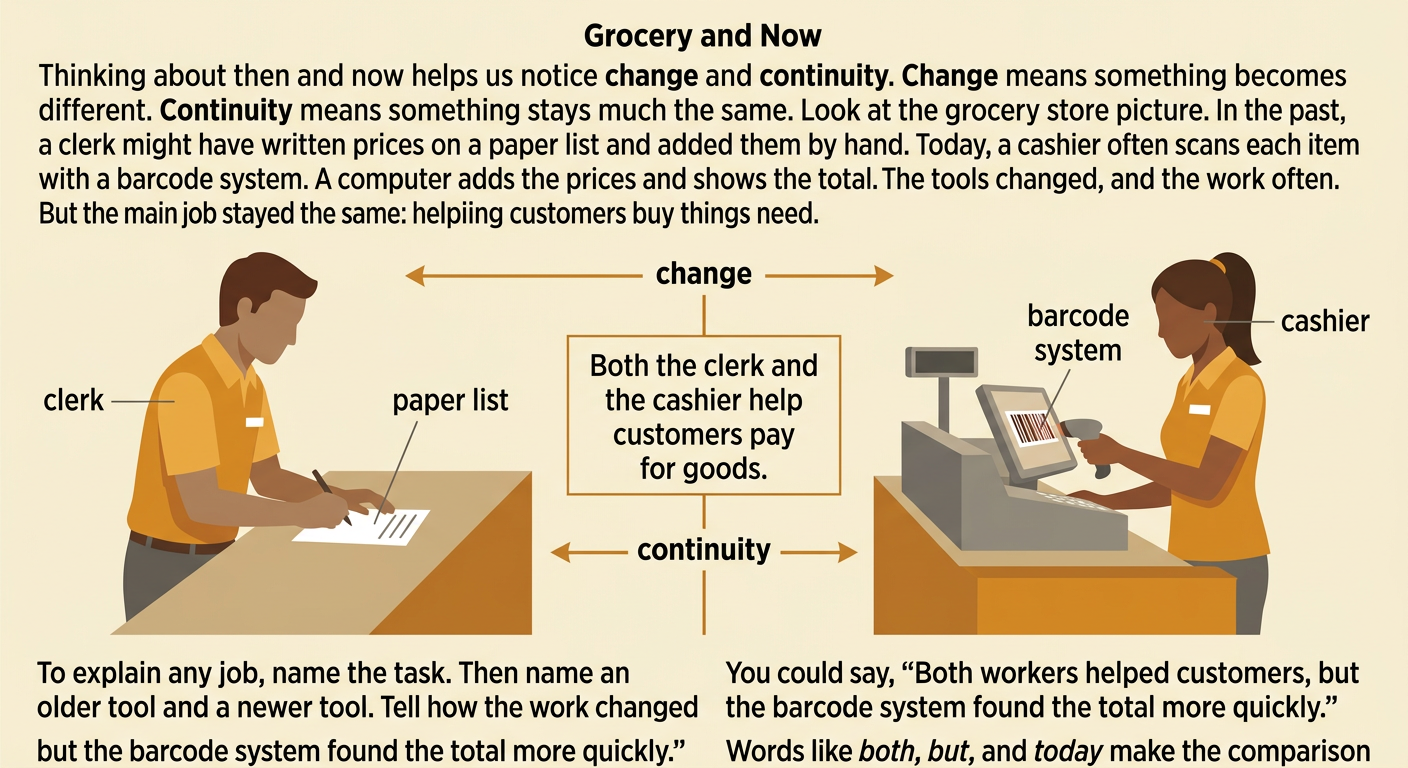
Thinking about then and now helps us understand both change and continuity. Change means that something becomes different. Continuity means that something stays much the same. Consider a grocery store worker. In the past, a clerk might have written prices on a paper list and added them by hand. Today, a cashier often scans barcodes, and a computer adds the prices. The tools and speed have changed, but the main purpose remains: helping customers buy needed goods. To reflect on any community job, name the task, identify an older tool and a newer tool, and explain how the work changed. Then ask what stayed the same. You might say, “Both clerks helped customers, but the barcode system calculated the total more quickly.” Evidence and clear comparison words support a strong explanation.