Compare Fractions Using Benchmarks
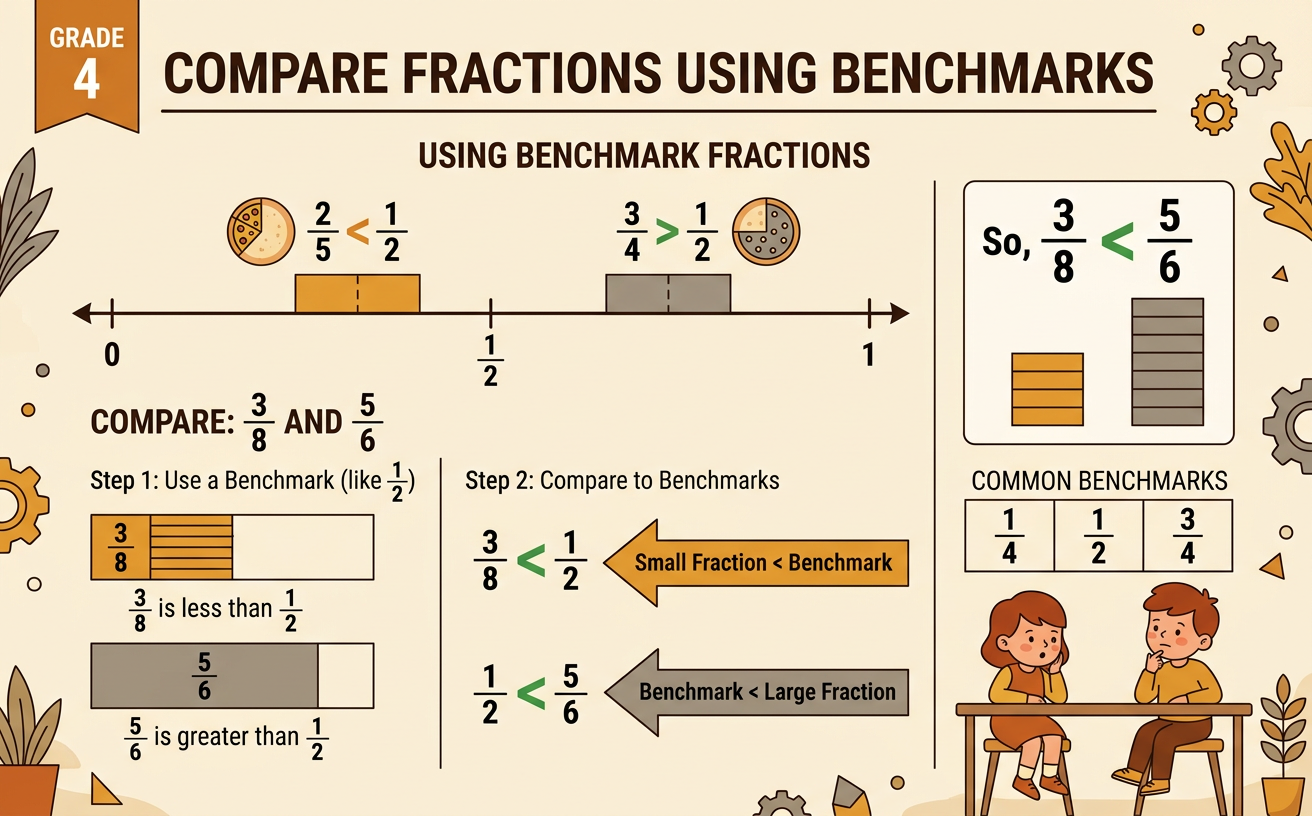
Students compare fractions with different numerators and denominators by using benchmark fractions, visual models, and comparison symbols.
Illustrations are auto-generated and may be placeholders. They can be refreshed to match the narration.
Review Comparison Symbols
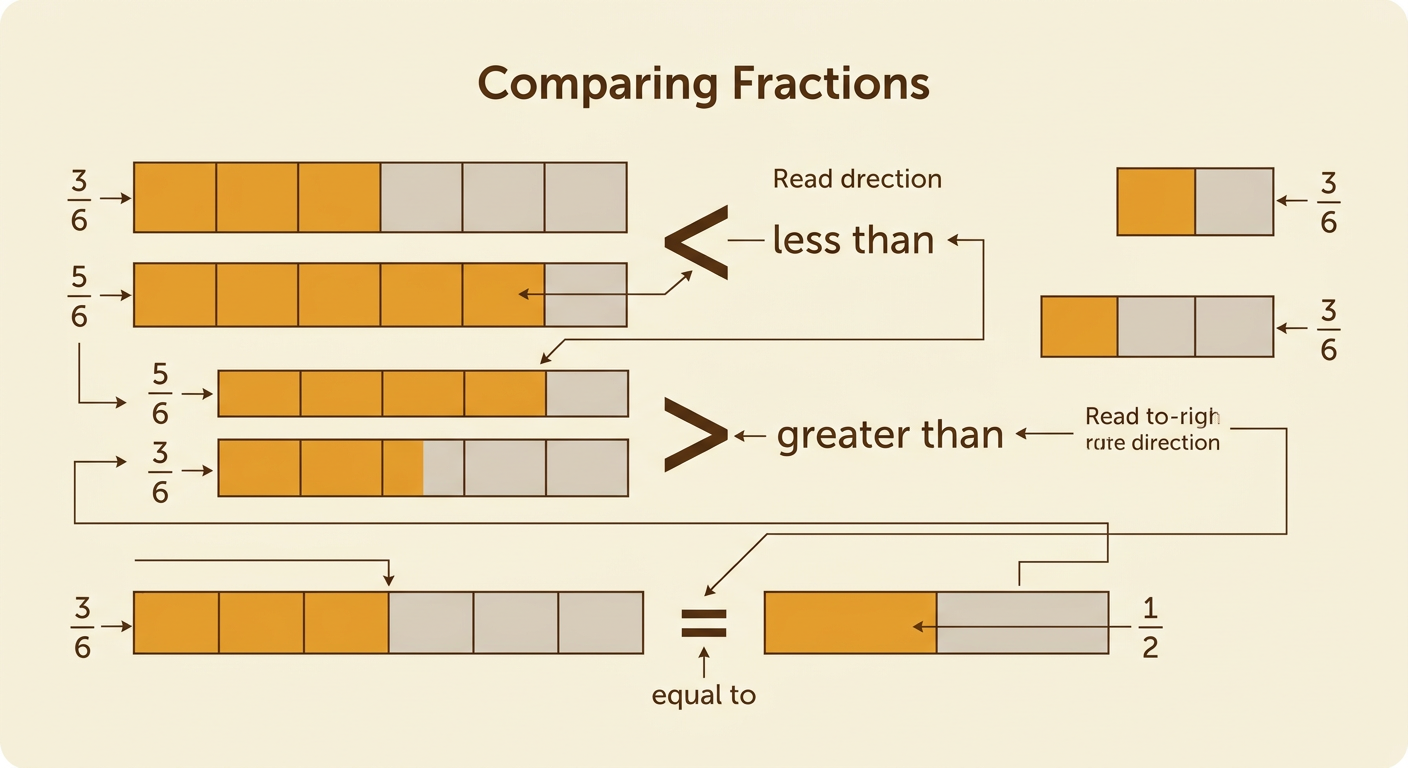
Comparison symbols show how two numbers are related. The symbol > means greater than, the symbol < means less than, and the symbol = means equal to. The open side of > or < always faces the greater number. You can also imagine that the pointed end points toward the smaller number. These symbols work for whole numbers and fractions. For example, compare 3/6 and 5/6. Both fractions describe sixths, so compare their numerators. Since 3 is less than 5, 3/6 < 5/6. The fraction 3/6 is also equal to 1/2, so 3/6 = 1/2. Always read a comparison from left to right. The statement 5/6 > 3/6 is read, “Five-sixths is greater than three-sixths.”
Introduce Benchmark Fractions
Benchmark fractions are familiar numbers that help you estimate and compare other fractions. Three useful benchmarks are 0, 1/2, and 1. A fraction close to 0 has only a small part of the whole. A fraction close to 1 has almost the entire whole. One-half is exactly midway between 0 and 1. For example, compare 2/10 and 7/10. The fraction 2/10 is near 0 because only two of ten equal parts are included. The fraction 7/10 is greater than 1/2 because half of ten parts is five parts. Therefore, 2/10 < 7/10. Benchmarks help you compare fractions without immediately finding common denominators. First decide where each fraction is located in relation to 0, 1/2, and 1.

Model Comparisons on Number Lines
A number line shows a fraction’s distance from 0. Fractions farther to the right are greater. To compare 2/3 and 3/4, draw two number lines of the same length from 0 to 1. Divide the first line into three equal intervals and mark 2/3. Divide the second line into four equal intervals and mark 3/4. Keep 0 and 1 vertically aligned so the distances can be compared fairly. The point for 3/4 is slightly to the right of the point for 2/3. Therefore, 2/3 < 3/4. The benchmark 1/2 also confirms that both fractions are greater than one-half, although that benchmark alone does not tell which one is greater. The exact positions on the aligned number lines complete the comparison.

Compare Fractions to One-Half
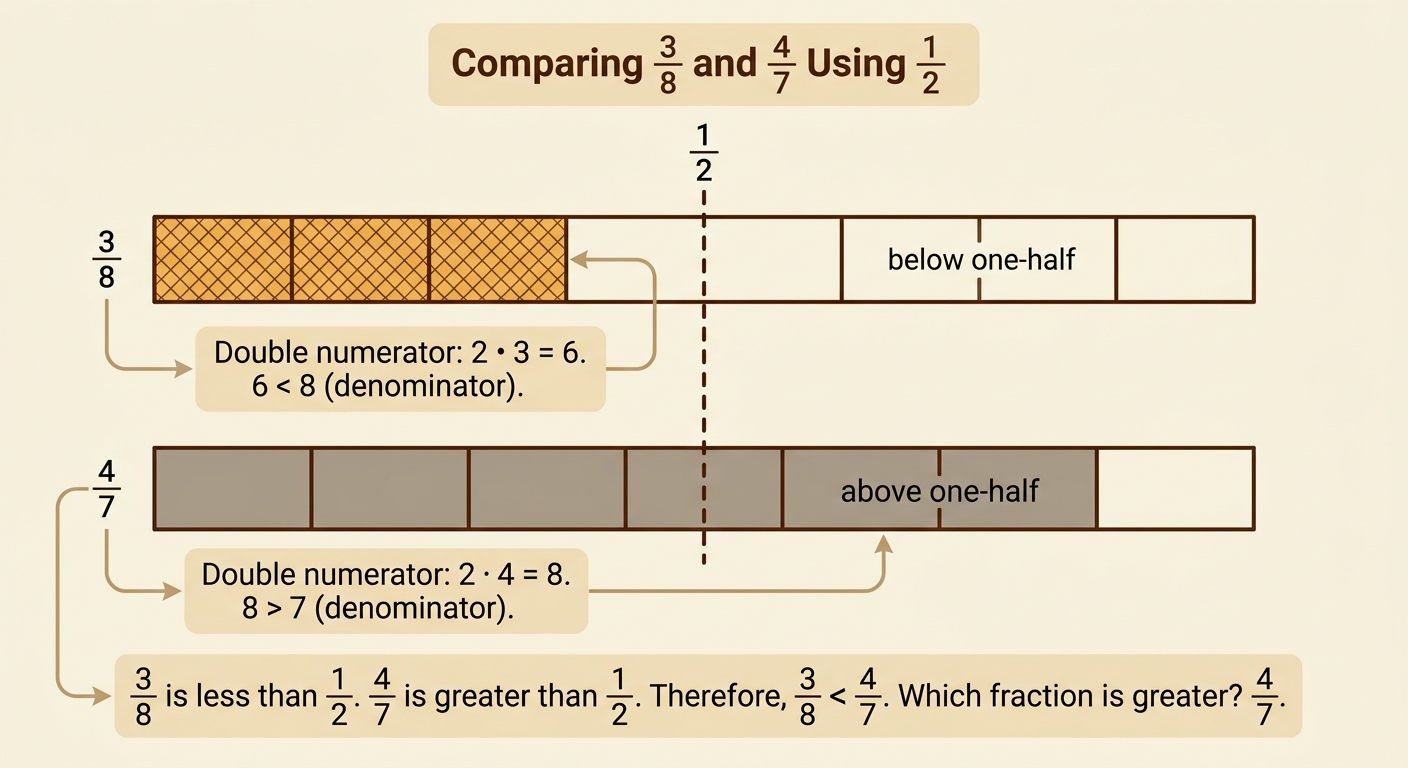
One-half is a helpful benchmark for fractions with different denominators. To decide whether a fraction is less than or greater than 1/2, think about how many pieces make half of the whole. For 3/8, half of eight equal pieces is four pieces. Because three pieces are fewer than four, 3/8 < 1/2. For 4/7, half of seven pieces is three and one-half pieces. Because four pieces are more than three and one-half, 4/7 > 1/2. One fraction is below one-half, and the other is above one-half. This proves that 3/8 < 4/7. You can also double each numerator: 3 × 2 = 6, which is less than 8, while 4 × 2 = 8, which is greater than 7.
Explain and Record Comparisons
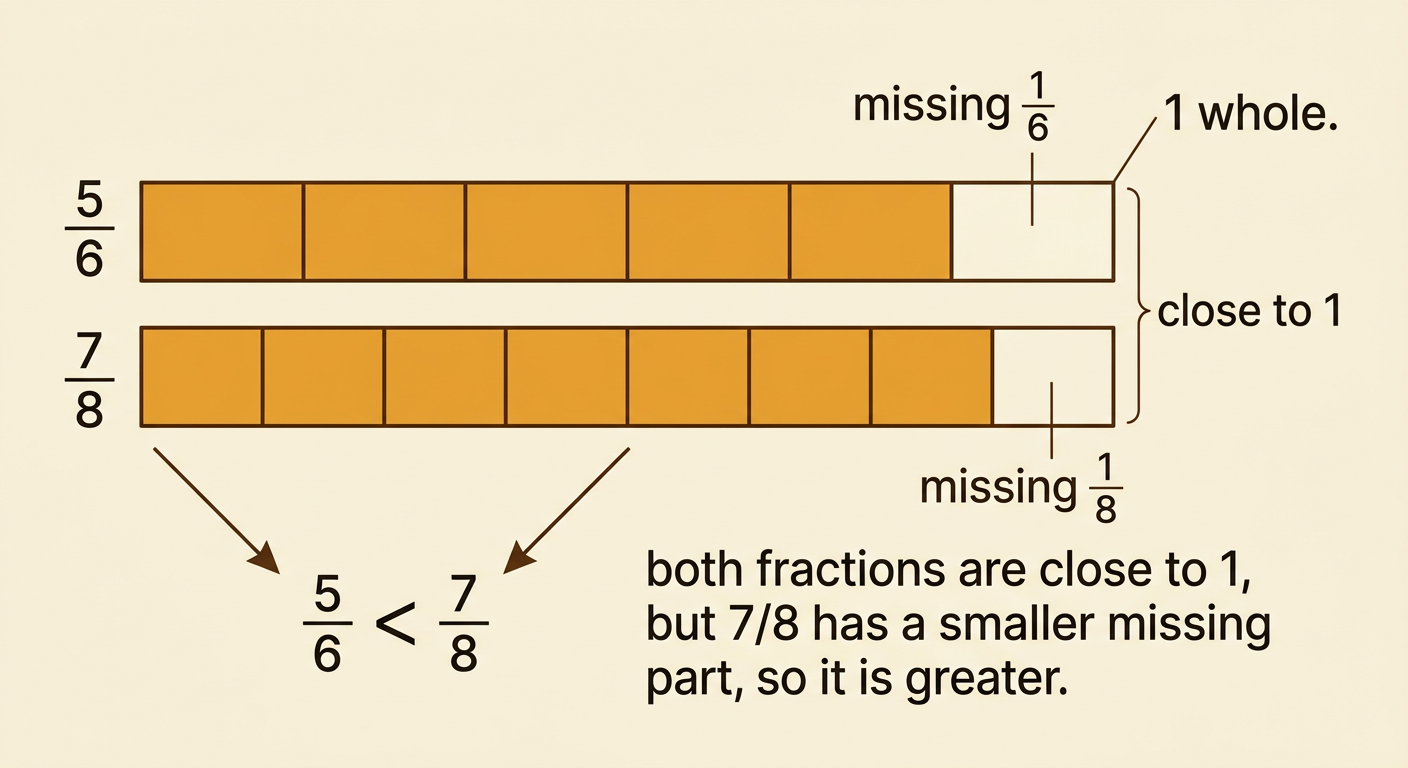
A complete fraction comparison includes a correct symbol and a clear reason. Sometimes both fractions are on the same side of 1/2, so another benchmark can help. Compare 5/6 and 7/8. Both fractions are greater than 1/2 and close to 1. Measure how far each is from 1. The fraction 5/6 is missing 1/6 of a whole, while 7/8 is missing only 1/8. Because 1/8 is less than 1/6, 7/8 is closer to 1 and is greater. Record the comparison as 5/6 < 7/8. You might explain, “Both fractions are close to 1, but 7/8 has a smaller missing part, so it is greater.” Always check that your comparison symbol agrees with your words and visual model.