
Compare Three-Digit Numbers
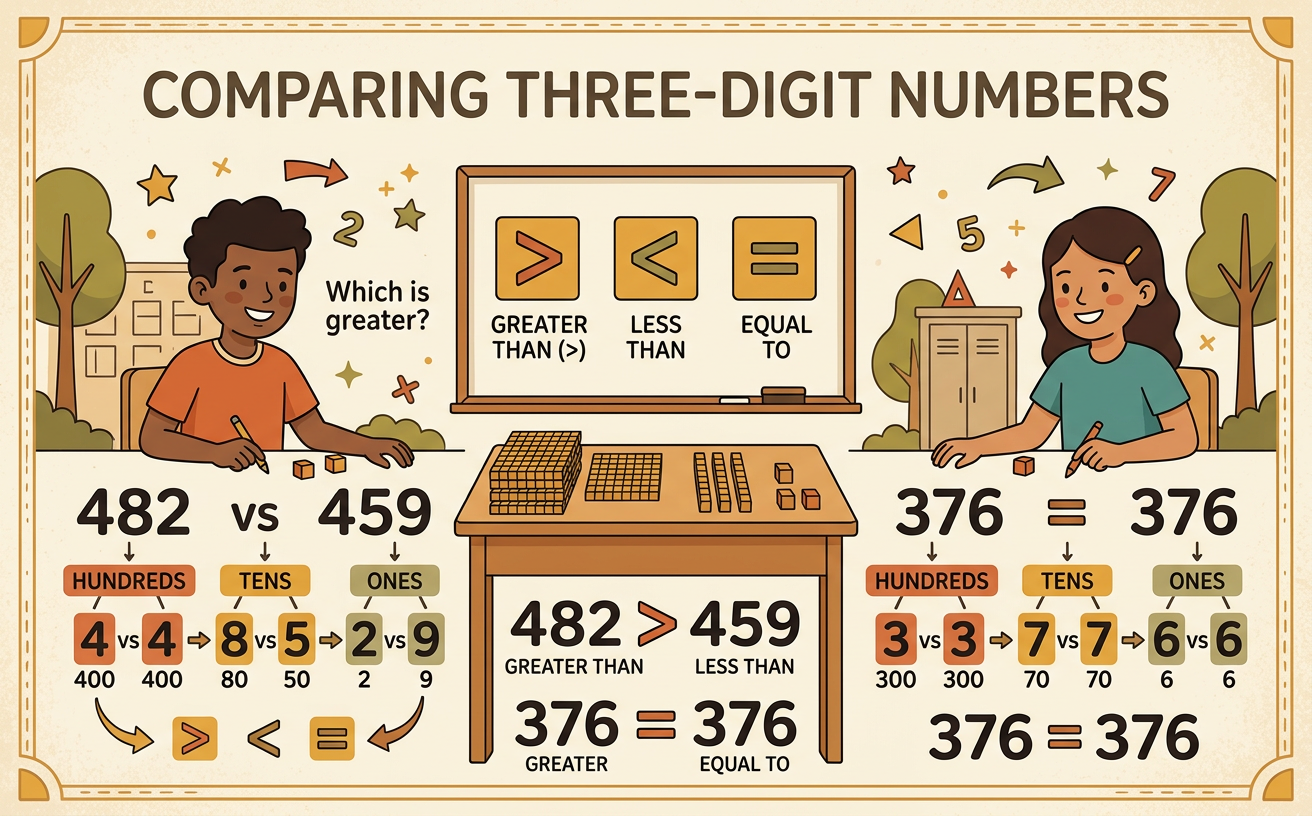
Students compare three-digit numbers by examining hundreds, tens, and ones and using the symbols >, <, and =.
Illustrations are auto-generated and may be placeholders. They can be refreshed to match the narration.
Review Hundreds, Tens, and Ones
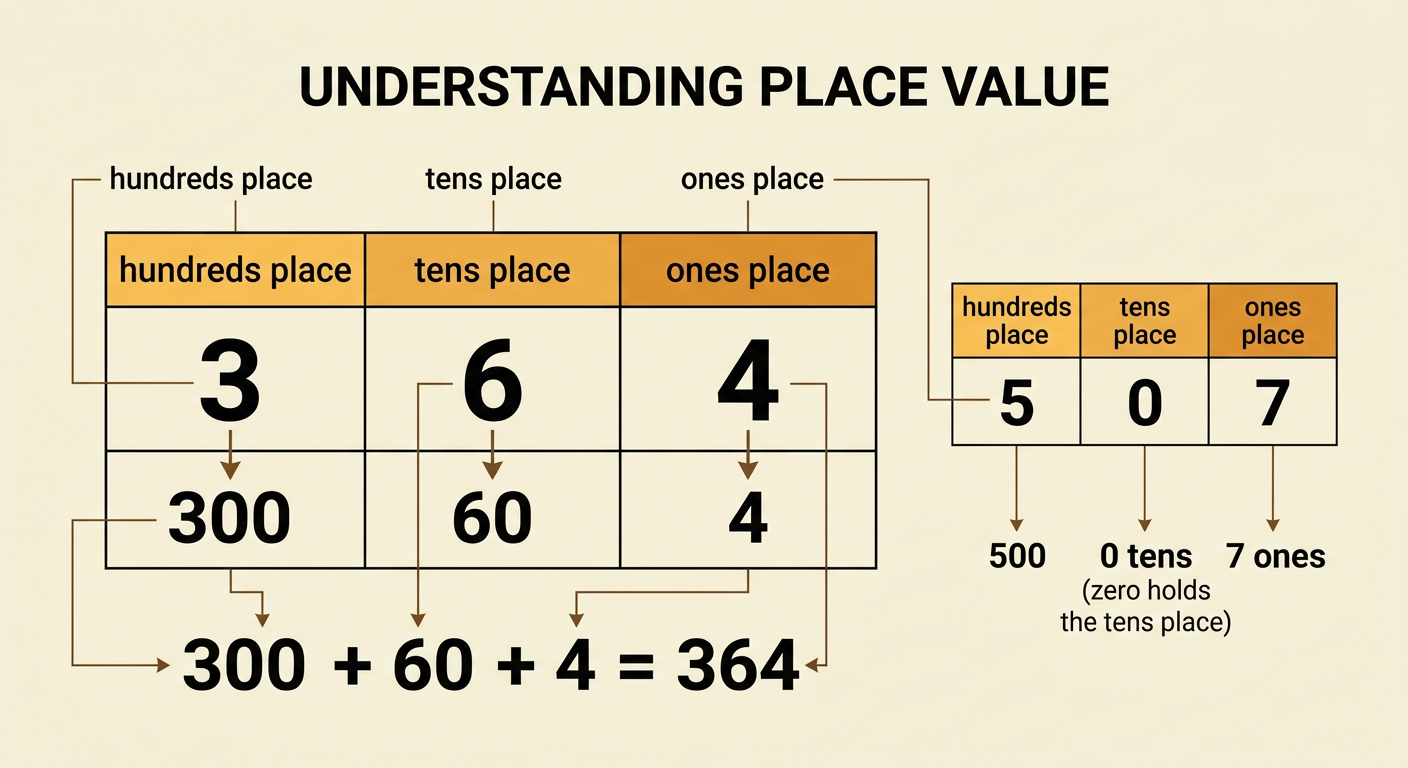
Every three-digit number has a hundreds place, a tens place, and a ones place. The position of a digit tells its value. In 364, the 3 is in the hundreds place, so its value is 300. The 6 is in the tens place, so its value is 60. The 4 is in the ones place, so its value is 4. Together, 300 + 60 + 4 equals 364. A zero can also hold a place. In 507, the 5 means 500, the 0 means there are no tens, and the 7 means 7 ones. Knowing each digit’s place and value will help you compare three-digit numbers correctly.
Build Numbers with Place-Value Models
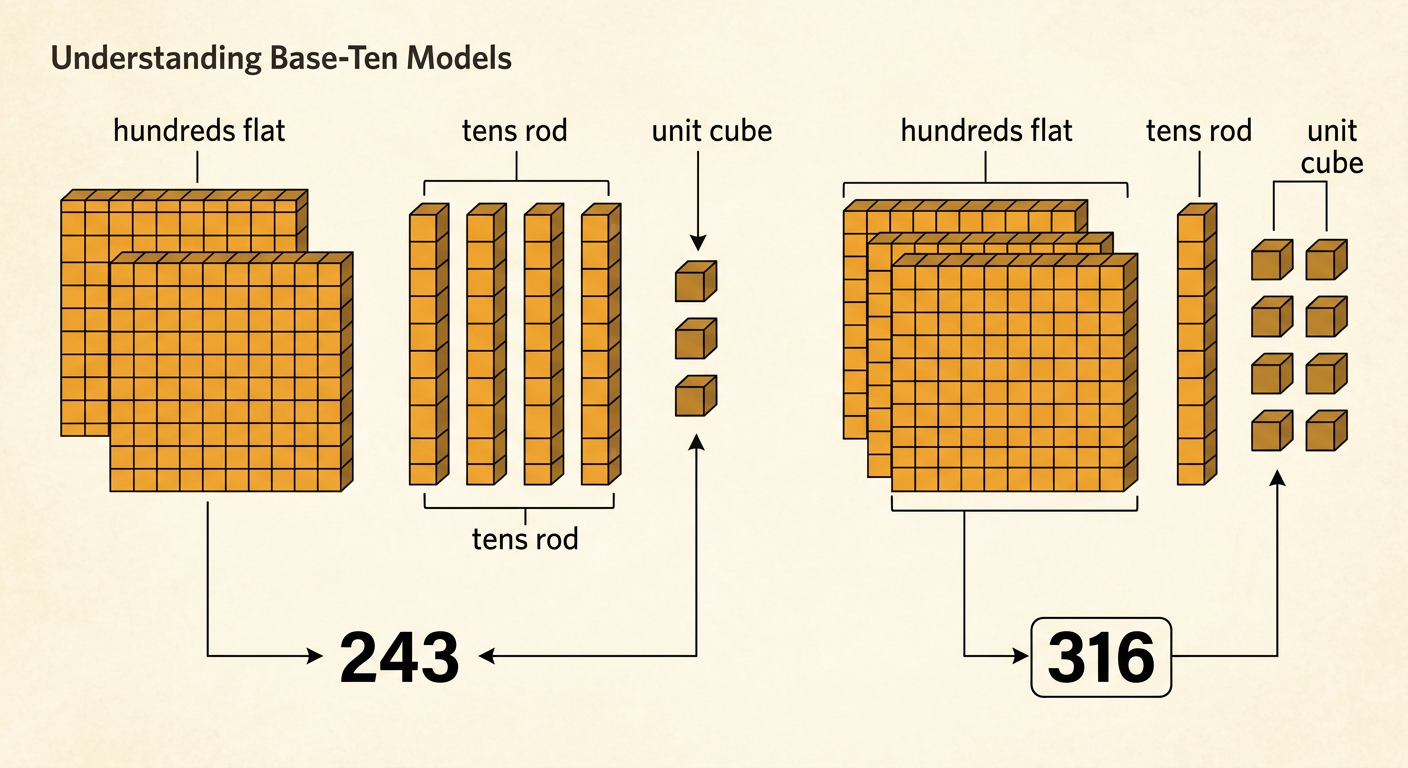
Base-ten blocks can show the value of each digit in a number. A hundreds flat represents 100, a tens rod represents 10, and a small unit cube represents 1. To build 243, use 2 hundreds flats, 4 tens rods, and 3 ones cubes. The flats show 200, the rods show 40, and the cubes show 3. Their total is 243. Look at each group of blocks and connect it to the matching digit. Place-value models make numbers easier to see and compare. For example, a model with 3 hundreds flats, 1 tens rod, and 6 ones cubes represents 316 because 300 + 10 + 6 equals 316.
Compare Digits from Left to Right
To compare two three-digit numbers, begin with the hundreds digits because hundreds have the greatest value. If the hundreds digits are different, the number with more hundreds is greater. If they are the same, compare the tens digits. If the tens digits are also the same, compare the ones digits. For example, compare 472 and 458. Both numbers have 4 hundreds, so move to the tens place. The number 472 has 7 tens, while 458 has 5 tens. Since 7 tens is greater than 5 tens, 472 is greater than 458. You do not need to compare the ones after finding the first place where the digits are different.

Choose the Correct Comparison Symbol
Comparison symbols show how two numbers are related. The symbol > means greater than, the symbol < means less than, and the symbol = means equal to. The open side of > or < faces the greater number, while the pointed side faces the smaller number. Compare 681 and 619. Both numbers have 6 hundreds. In the tens place, 8 tens is greater than 1 ten, so 681 is greater than 619. Write 681 > 619. You can also read the comparison in the other direction: 619 < 681. If two numbers have the same hundreds, tens, and ones, use the equal sign. For example, 425 = 425.

Practice and Explain Comparisons
When you compare numbers, explain which place helped you decide. First, compare the hundreds. Then compare the tens if needed, followed by the ones if needed. Consider 325 and 352. Both numbers have 3 hundreds, so compare the tens. The number 325 has 2 tens, and 352 has 5 tens. Because 2 tens is less than 5 tens, 325 < 352. A clear explanation is, “The hundreds are equal, but 2 tens is less than 5 tens, so 325 is less than 352.” Now compare 407 and 407. Every digit matches: 4 hundreds, 0 tens, and 7 ones. Therefore, 407 = 407. Always check the digits from left to right and use >, <, or = to record your result.
