
Compare Two-Digit Numbers
Students compare two-digit numbers by examining tens and ones and use the symbols greater than, less than, and equal to record their comparisons.

Illustrations are auto-generated and may be placeholders. They can be refreshed to match the narration.
Review Tens and Ones
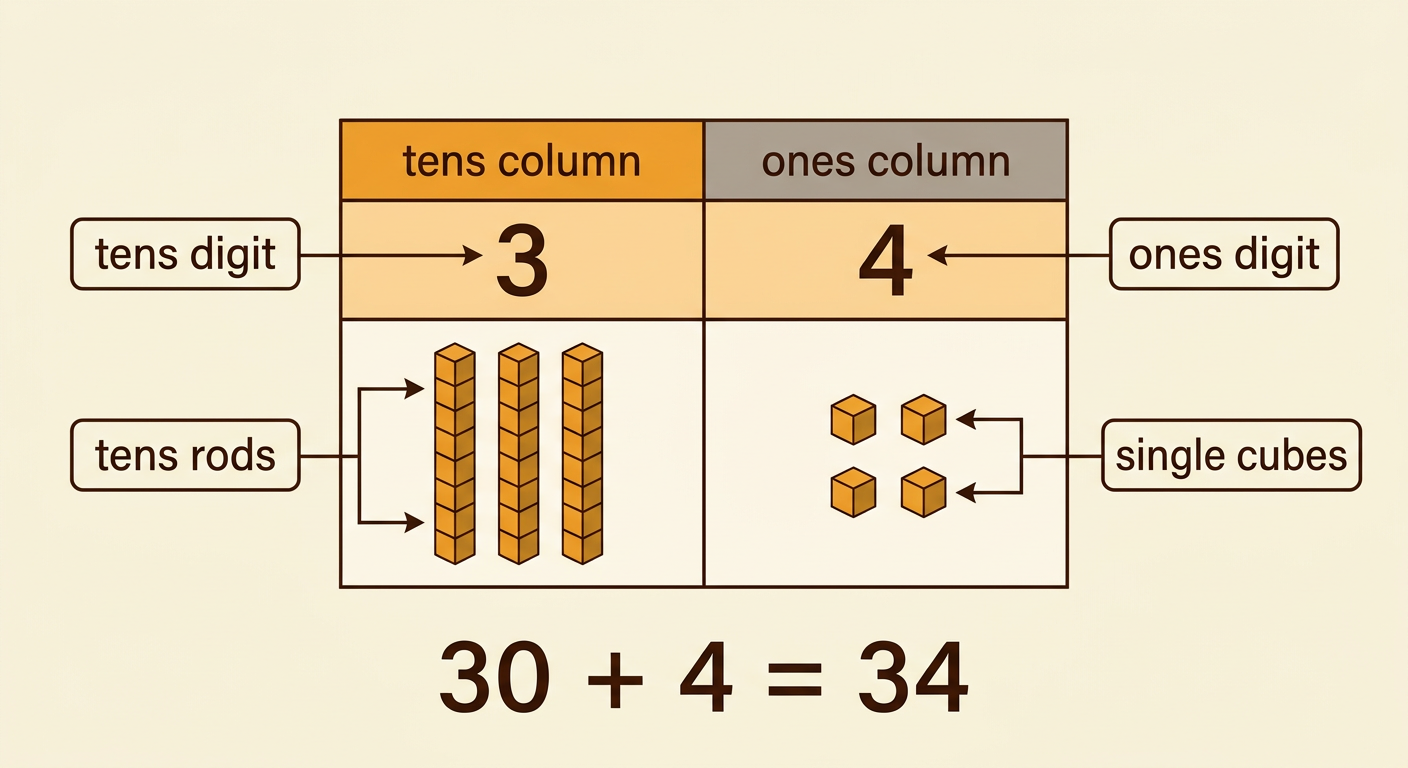
A two-digit number has a tens digit and a ones digit. The tens digit is on the left. It tells how many groups of ten are in the number. The ones digit is on the right. It tells how many extra ones are in the number. Look at 34. The digit 3 means 3 tens, which is 30. The digit 4 means 4 ones. Three tens and four ones make 34. You can build 34 with three tens rods and four single cubes. Breaking numbers into tens and ones helps us understand their value. Try 27. It has 2 tens and 7 ones, so its value is 20 plus 7.
Compare the Tens Digits
To compare two two-digit numbers, look at the tens digits first. The number with more tens is the greater number. Compare 52 and 37. The number 52 has 5 tens, while 37 has 3 tens. Five tens are more than three tens, so 52 is greater than 37. We do not need to compare the ones because the tens digits are different. Even though 37 has more ones than 52, its 3 tens are not enough to make it greater. Think of the numbers as groups of ten: 52 has two more full groups of ten than 37. Always begin a comparison by checking the tens place.

Compare the Ones When Tens Match
Sometimes two numbers have the same tens digit. When that happens, compare the ones digits. Look at 46 and 42. Both numbers have 4 tens, so the tens are equal. Next, compare 6 ones with 2 ones. Six ones are more than two ones, so 46 is greater than 42. The extra ones decide which number is greater. Now compare 71 and 78. Both numbers have 7 tens. One has 1 one, and the other has 8 ones. Because 1 one is less than 8 ones, 71 is less than 78. Remember the order: compare tens first, and compare ones only when the tens match.

Introduce Comparison Symbols
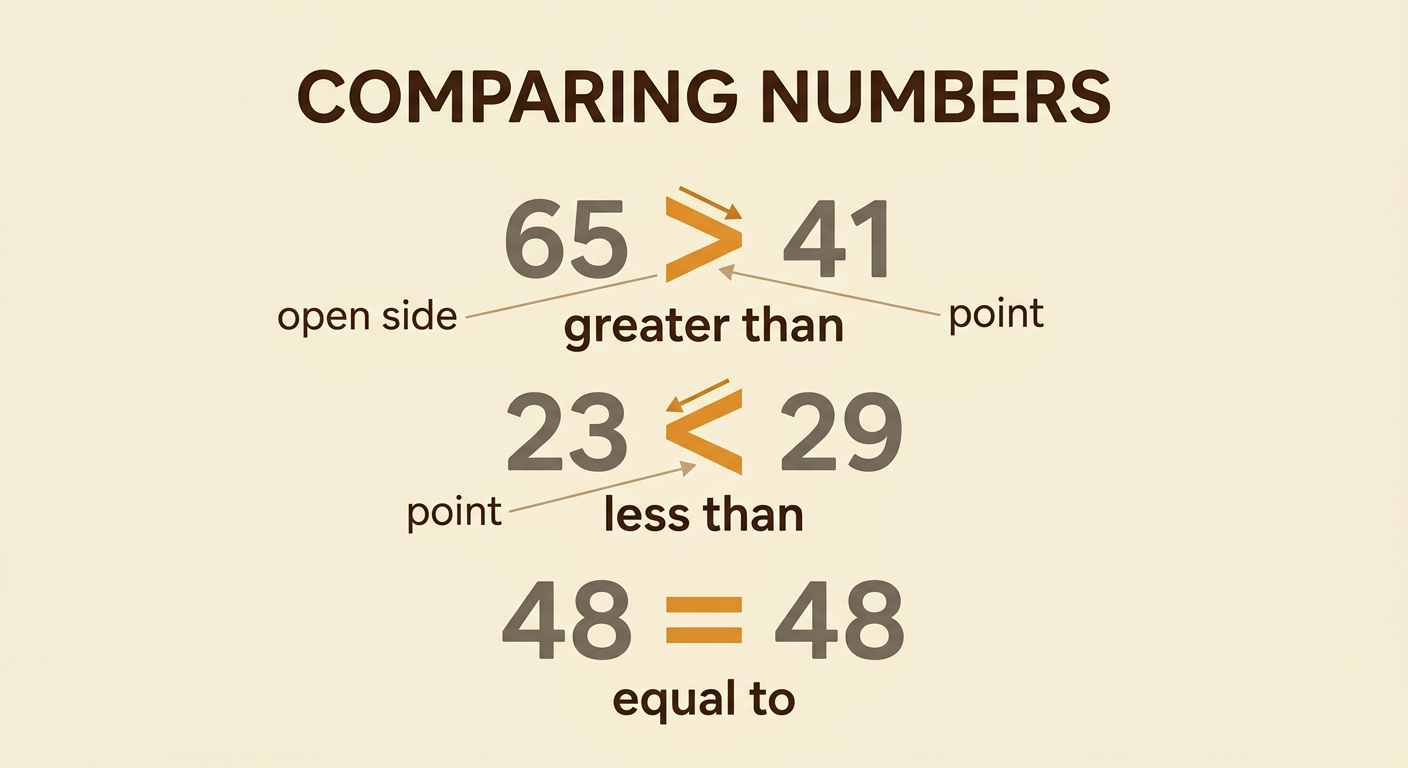
We can record number comparisons with three symbols. The greater-than symbol is >. Its wide, open side faces the greater number, and its point faces the smaller number. For example, 65 > 41 means 65 is greater than 41. The less-than symbol is <. In 23 < 29, the point faces 23 because 23 is the smaller number. The equal sign is =. We use it when both numbers have the same value, as in 48 = 48. Always read a comparison from left to right. Read 65 > 41 as “65 is greater than 41.” Read 23 < 29 as “23 is less than 29.”
Practice Comparing Numbers
Use the same steps each time you compare. First, look at the tens digits. If they are different, the number with more tens is greater. Compare 28 and 53. Two tens are fewer than five tens, so 28 < 53. Next, compare 64 and 61. Both numbers have 6 tens, so compare the ones. Four ones are more than one one, so 64 > 61. Finally, compare 75 and 75. The tens digits match, and the ones digits match, so 75 = 75. After choosing a symbol, read the full comparison aloud. This helps you check whether the symbol and your thinking agree.

Explain the Comparison
A strong math explanation tells how the tens and ones prove the comparison. Start by naming the numbers and the symbol. Then explain which place you compared. For example, 83 > 79. You can say, “83 is greater than 79 because 83 has 8 tens and 79 has 7 tens. Eight tens are more than seven tens.” For 56 < 59, explain that both numbers have 5 tens, but 6 ones are fewer than 9 ones. For 32 = 32, explain that both numbers have 3 tens and 2 ones. Use place-value words such as tens, ones, greater than, less than, and equal to. Your explanation should match the symbol you chose.
