
Compare Two-Digit Numbers
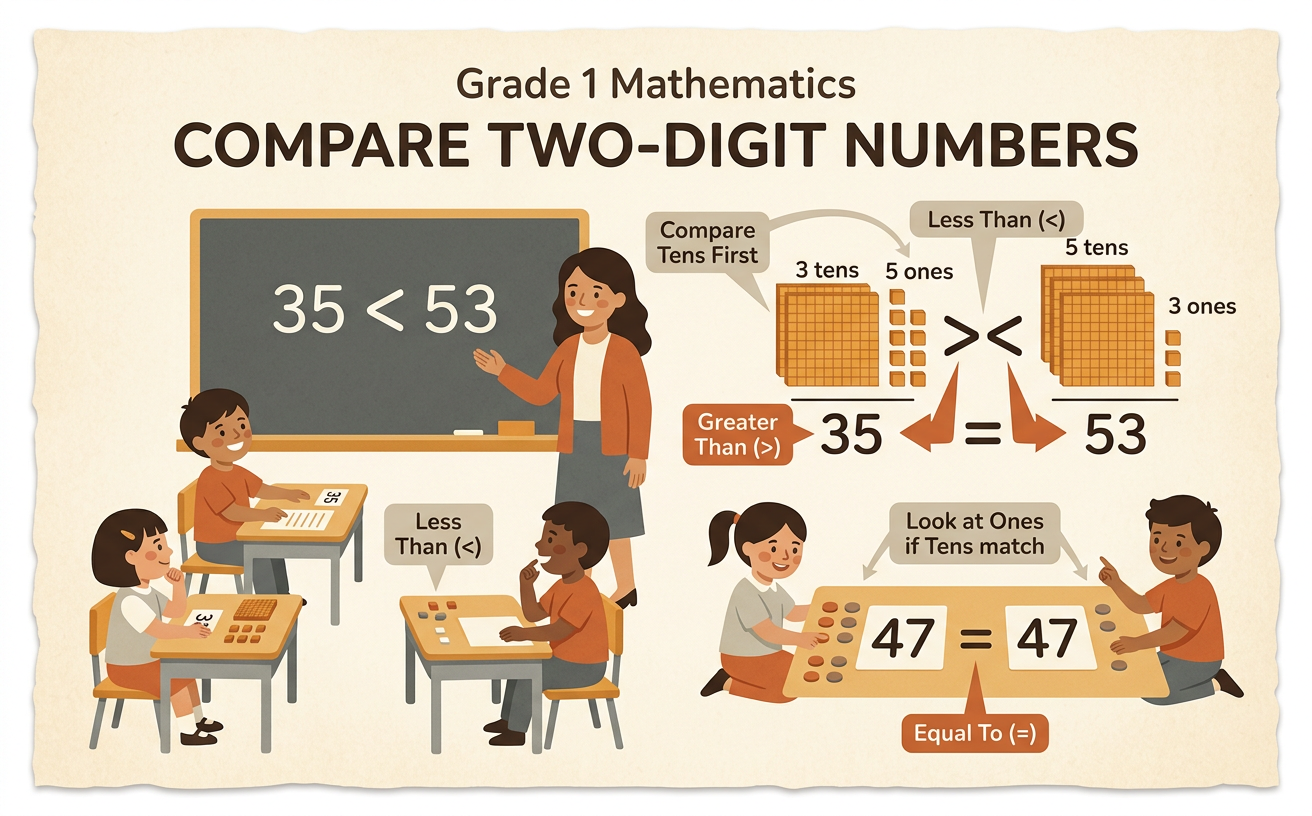
Students compare pairs of two-digit numbers by examining tens and ones and using the symbols greater than, less than, and equal to.
Illustrations are auto-generated and may be placeholders. They can be refreshed to match the narration.
Review Tens and Ones
A two-digit number has a tens digit and a ones digit. The digit on the left tells how many groups of ten there are. The digit on the right tells how many ones there are. Look at 34. The 3 means 3 tens, which is 30. The 4 means 4 ones. Three tens and four ones make 34. You can build 34 with three tens rods and four single cubes. Knowing the value of each digit helps you compare numbers. Always read a two-digit number from left to right: tens first, then ones. Remember that a digit has a value because of its place in the number.

Compare the Tens Digits
To compare two two-digit numbers, look at the tens digits first. The number with more tens is greater. Compare 47 and 32. The number 47 has 4 tens, while 32 has 3 tens. Four tens are greater than three tens, so 47 is greater than 32. You do not need to compare the ones because the tens already show which number is greater. Even though 32 has 2 ones and 47 has 7 ones, the tens decide this comparison first. Start every comparison at the tens place. If the tens digits are different, the number with the larger tens digit is the larger number.

Compare the Ones When Tens Match
Sometimes two numbers have the same number of tens. When the tens digits match, compare the ones digits. Compare 54 and 58. Both numbers have 5 tens, so the tens do not tell which number is greater. Next, look at the ones. The number 54 has 4 ones, and 58 has 8 ones. Eight ones are more than four ones, so 58 is greater than 54. We can also say that 54 is less than 58. Follow two steps: compare the tens first, and then compare the ones only when the tens are equal. This place-value order helps you compare correctly every time.

Use Greater Than, Less Than, and Equal To Symbols
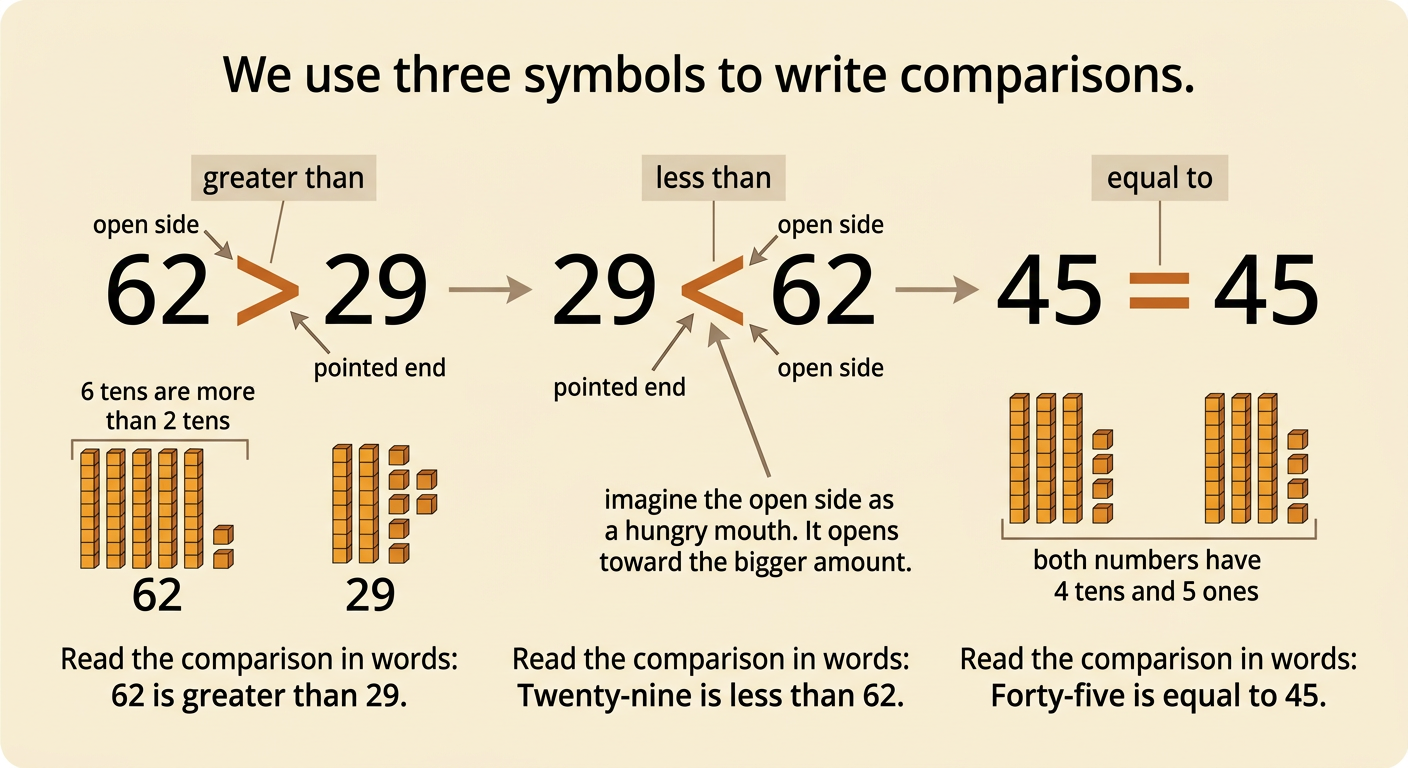
We use symbols to record comparisons. The symbol > means greater than. The symbol < means less than. The symbol = means equal to, or the same value. The wide, open side of > or < faces the greater number, and the pointed end faces the smaller number. For example, 62 > 29 because 6 tens are greater than 2 tens. If we reverse the order, we write 29 < 62. We write 45 = 45 because both numbers have 4 tens and 5 ones. Read each number sentence aloud: “62 is greater than 29,” “29 is less than 62,” and “45 is equal to 45.”
Practice and Explain Comparisons
Compare each pair by thinking about tens and ones. For 73 and 69, compare the tens first. The number 73 has 7 tens, and 69 has 6 tens. Since 7 tens are greater than 6 tens, 73 > 69. A clear explanation is, “73 is greater than 69 because 7 tens are more than 6 tens.” Now compare 81 and 86. Both have 8 tens, so compare the ones. One one is less than 6 ones, so 81 < 86. Finally, 42 = 42 because both numbers have the same tens and ones. When you explain a comparison, name the place you compared and tell why one number is greater, less, or equal.
