Compare Written Numbers Within 10
Students compare two written numerals from 1 to 10 and explain which number represents more or less.

Illustrations are auto-generated and may be placeholders. They can be refreshed to match the narration.
Review Numerals 1–10
A numeral is a written mark that names a number. We use numerals to show how many. Read these numerals in order: 1, 2, 3, 4, 5, 6, 7, 8, 9, 10. As the numerals move forward in this counting order, each one represents one more. For example, the numeral 4 means four objects. The numeral 5 comes next and means five objects. Five is one more than four. Point to each numeral and say its name. Then try counting backward from 10 to 1. Knowing the counting order will help you decide which of two written numerals represents more and which represents less.

Match Numerals to Quantities
A written numeral tells how many objects are in a group. To understand a numeral, count a matching group of objects. Touch each object once and say one number for each object. The last number you say tells how many objects are in the whole group. For example, count six stars: one, two, three, four, five, six. The group has six stars, so it matches the numeral 6. A group of three stars matches the numeral 3. Since six stars are more than three stars, 6 represents more than 3. Matching numerals to objects helps you see the quantity each numeral represents, even when the objects are not shown.

Compare Two Numerals
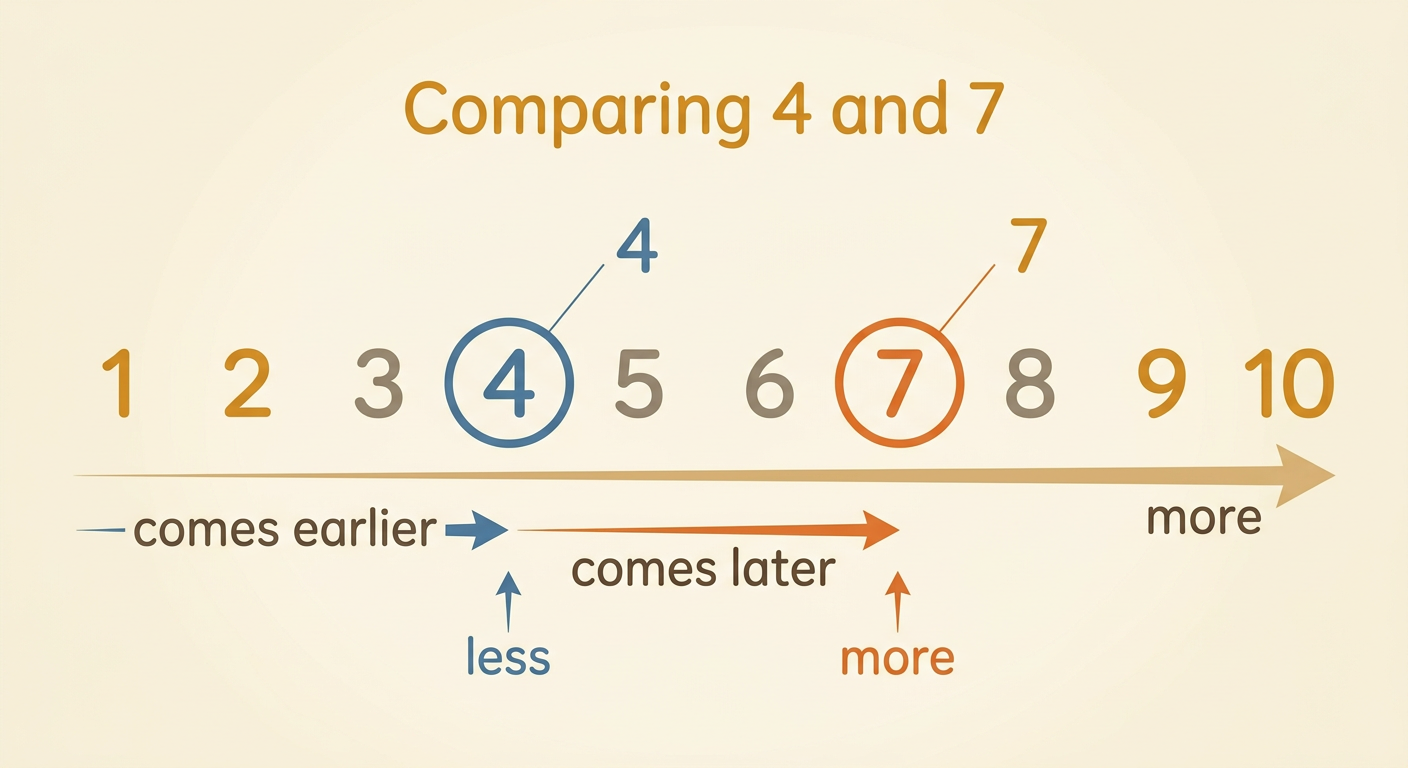
To compare two written numerals, decide which one represents more and which one represents less. Think about where each numeral appears when you count from 1 to 10. The numeral that comes later in the counting order represents more. The numeral that comes earlier represents less. Compare 4 and 7. Count: 1, 2, 3, 4, 5, 6, 7. Seven comes after four, so 7 represents more than 4. Four comes before seven, so 4 represents less than 7. You can use a number path to check. Find both numerals. The numeral farther to the right on this number path represents the greater quantity.
Explain More and Less
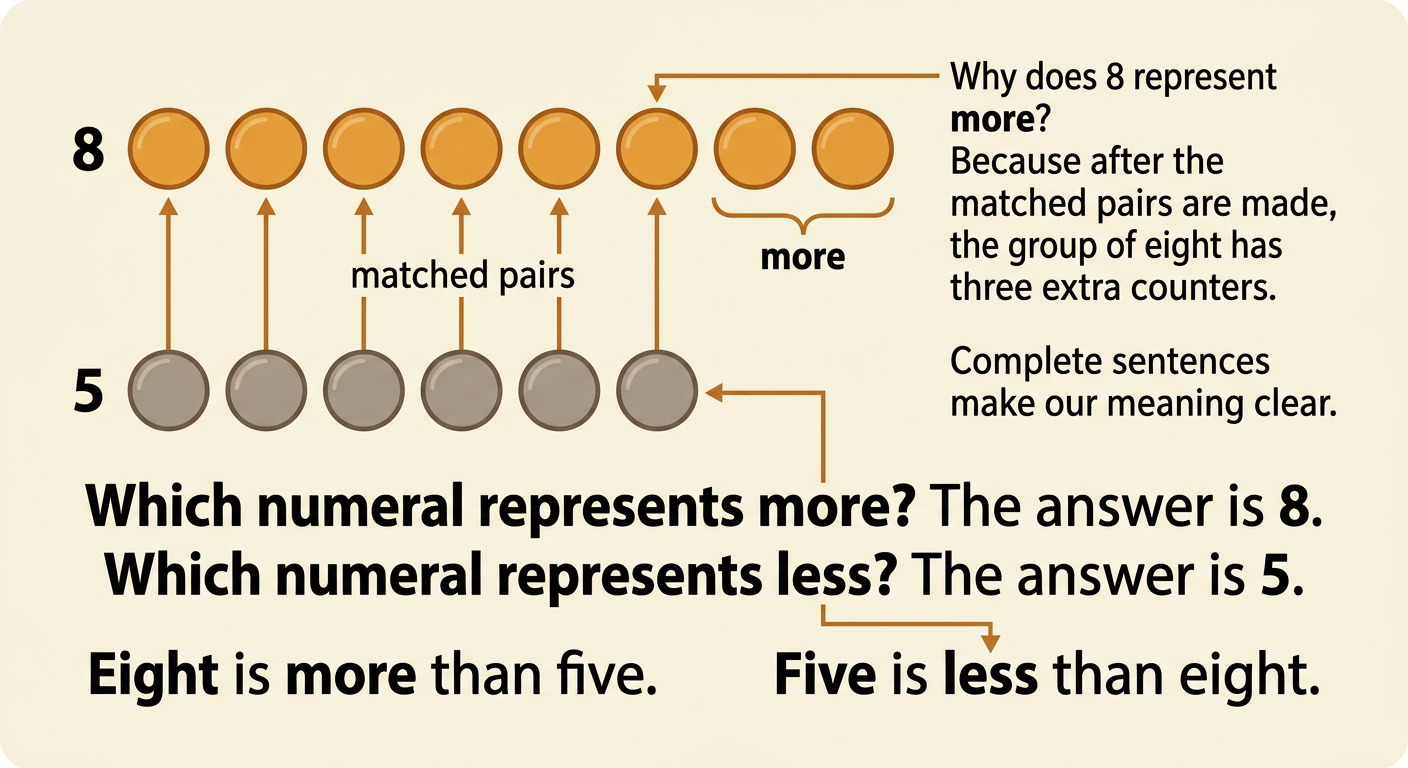
When you compare numerals, explain your thinking with the words more and less. More means a greater number of objects. Less means a smaller number of objects. Compare the written numerals 8 and 5. You can imagine eight counters beside 8 and five counters beside 5. The group of eight has three counters left after five counters are matched in pairs. This shows that 8 represents more than 5. It also shows that 5 represents less than 8. Say both comparison sentences: “Eight is more than five.” “Five is less than eight.” Using complete sentences tells which numeral represents the greater quantity and which numeral represents the smaller quantity.
Independent Number Comparison
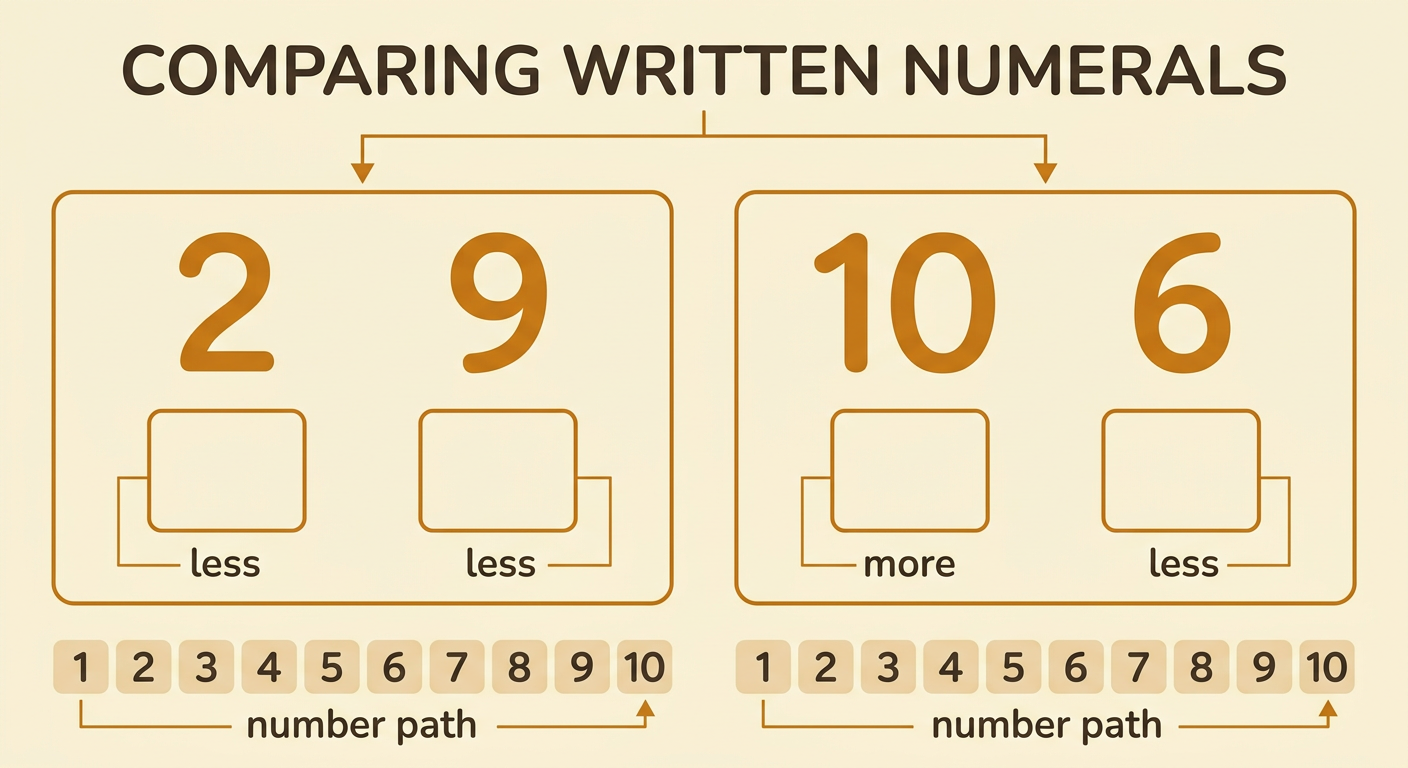
Now compare written numerals on your own. Look carefully at each pair and think about the counting order. First compare 2 and 9. Nine comes later when you count, so 9 represents more and 2 represents less. Next compare 10 and 6. Ten comes later, so 10 represents more and 6 represents less. For each new pair, point to the numeral that represents more. Then point to the numeral that represents less. Explain your answer in a complete sentence, such as, “Ten is more than six.” You may picture objects or use a number path if you need help. Always check that both numerals are between 1 and 10.