
Comparing and Contrasting Story Characters
Students compare and contrast two characters by analyzing their traits, motivations, actions, and interactions using specific details from a literary text.
Illustrations are auto-generated and may be placeholders. They can be refreshed to match the narration.
Identify the Characters
Begin by choosing two characters from the same story or drama. A character may be a person, an animal, or another figure that thinks and acts. Identify each character’s role and relationship to the story’s main problem. In the fictional story “The Stormy Crossing,” Maya and Leo are siblings trying to bring medicine to their grandmother before a storm closes the bridge. Maya is the older sibling who plans their trip, while Leo is the younger sibling who notices changes in the weather. Both are important because their choices affect whether they reach their grandmother safely. As you read, record basic facts about each character, but do not confuse appearance with personality. A red coat describes how Maya looks; it does not prove she is brave. Focus on what the text clearly tells you about who the characters are and what roles they play.

Examine Traits and Motivations
A trait is a quality that describes a character, such as patient, cautious, determined, or curious. A motivation is the reason a character acts. Authors may state traits and motivations directly, but readers often infer them from words, thoughts, and actions. In “The Stormy Crossing,” Maya checks the map twice and packs a flashlight before leaving. These actions suggest that she is prepared and cautious. Her motivation is to deliver the medicine while keeping both siblings safe. Leo keeps looking at the dark clouds and urges Maya to take a shorter trail. This suggests that he is observant and concerned. His motivation is also to help their grandmother, but he is especially focused on beating the storm. Two characters can share a goal while having different traits or reasons for choosing particular actions. Ask, “What does the character want, and what details reveal why?”

Gather Text Evidence
Text evidence is a specific detail from the story that supports an idea about a character. Evidence may be a quotation, an action, a thought, or an interaction with another character. Record the detail and explain what it shows instead of listing it by itself. For example, Maya says, “We should follow the marked path, even if it takes longer.” This quotation supports the idea that she is cautious and responsible. Later, Leo points to the bending trees and says the storm is moving faster. That detail supports the idea that he is alert and practical. You can organize evidence in a chart with one row for each character. Include the character’s name, the detail, and your explanation. Strong evidence directly matches your claim. A detail about Maya’s coat color would not support a claim that she makes careful decisions unless the coat affects her actions in the story.

Compare and Contrast
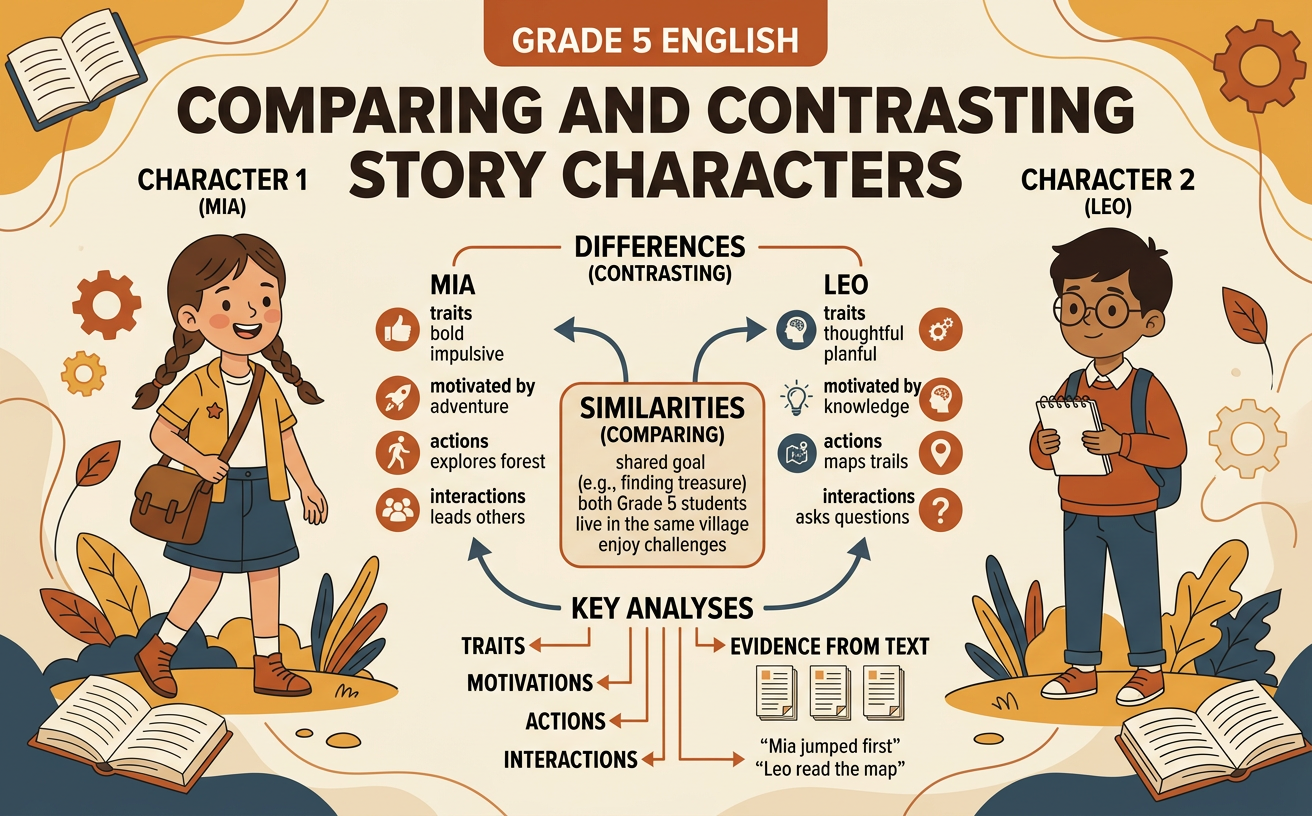
To compare characters, explain how they are alike. To contrast them, explain how they are different. Compare the same categories, such as traits, motivations, actions, and interactions. In “The Stormy Crossing,” both Maya and Leo are caring because they work to bring medicine to their grandmother. They also cooperate by sharing information and supplies. However, Maya responds to danger by following the planned route, while Leo responds by suggesting a quicker trail. Maya is more cautious and methodical; Leo is more flexible and willing to change plans. Their interaction reveals another difference: Maya relies on the map, but Leo relies on what he observes around them. A Venn diagram can help organize these ideas. Place similarities in the overlapping center and differences in the outer sections. Then return to the text to make sure every comparison is supported by a specific detail rather than a guess.

Write an Evidence-Based Response
An evidence-based response states a clear comparison, supports it with details, and explains how the details prove the point. Begin with a topic sentence naming both characters and the main similarity or difference. Then include evidence about each character. Use linking words such as similarly, both, however, unlike, and while. End by explaining what the comparison reveals. For example: Maya and Leo are both determined to help their grandmother, but they handle danger differently. Maya chooses the marked path because she values careful planning, saying they should follow it “even if it takes longer.” In contrast, Leo studies the storm and suggests a shortcut because he believes speed will keep them safe. These details show that Maya relies on preparation, while Leo adapts to changing conditions. After writing, check that you discussed both characters, included accurate details, and explained each detail. Evidence should support your claim, not simply retell the entire plot.
