
Comparing Groups: Greater Than, Less Than, and Equal To
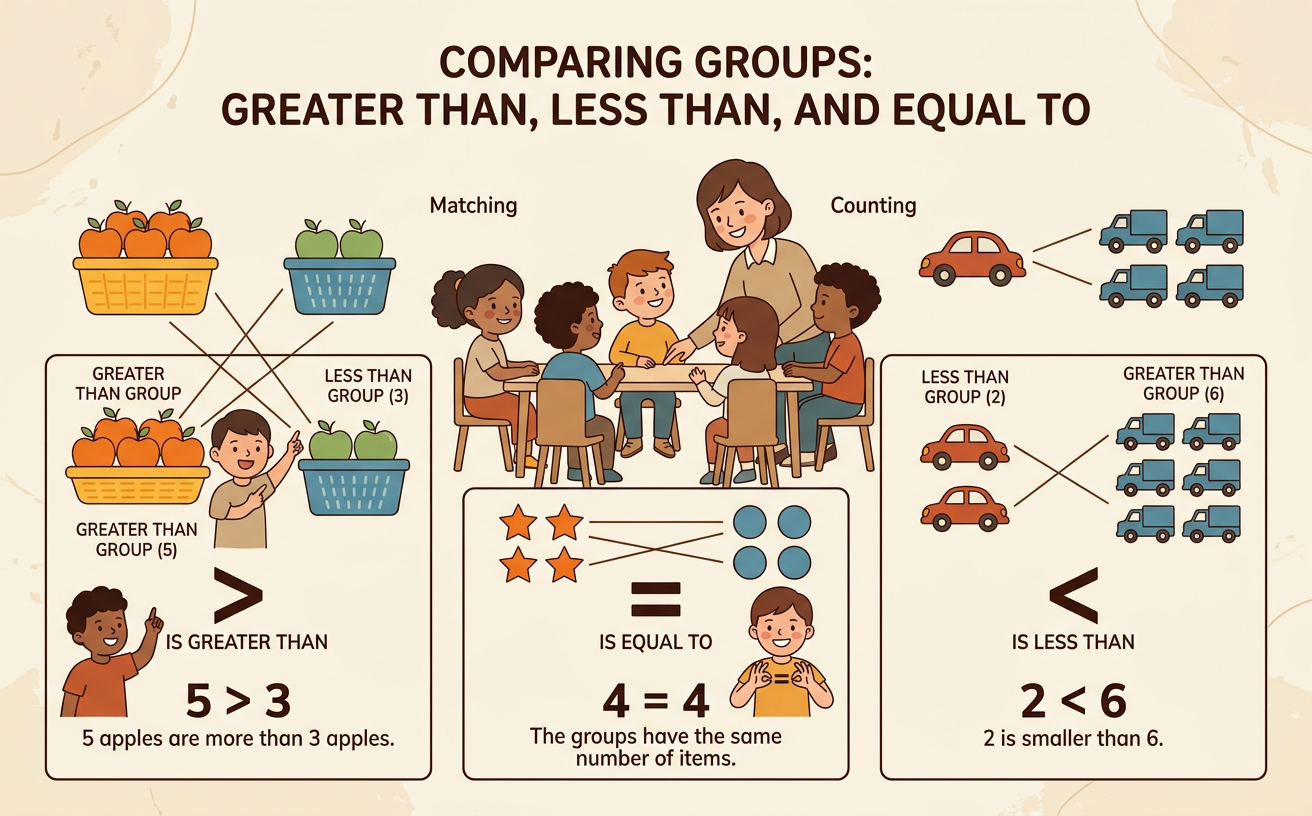
Students compare two groups of objects by matching and counting, then describe one group as greater than, less than, or equal to the other.
Illustrations are auto-generated and may be placeholders. They can be refreshed to match the narration.
Matching Objects to Compare
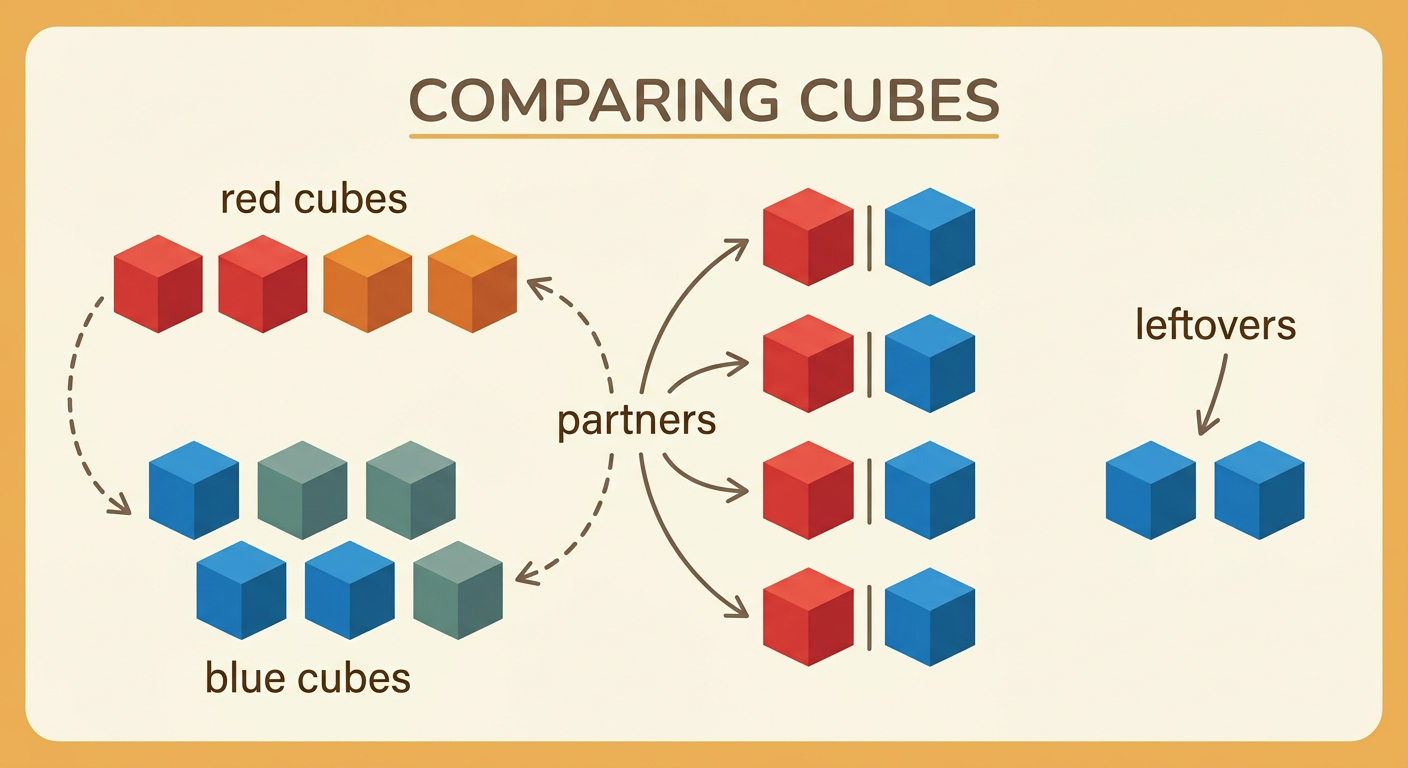
We can compare two groups by matching one object from the first group with one object from the second group. Place four red cubes and six blue cubes on a table. Pair each red cube with one blue cube. After all four red cubes have partners, two blue cubes remain. This shows that the blue group has more objects and the red group has fewer objects. Matching is helpful because it lets us compare without being fooled by how the objects are arranged. A spread-out group may look larger even when it is not. Make one-to-one pairs first, then look for objects that do not have partners. The group with leftovers is the greater group.
Using Greater Than and Less Than
The words greater than and less than describe how two amounts compare. Greater than means more, and less than means fewer. Count five apples in one picture and three apples in another picture. Five is greater than three because the group of five has more apples. Three is less than five because the group of three has fewer apples. Say both comparison sentences aloud: “Five is greater than three” and “Three is less than five.” The order of the numbers matters. Always name the first group, compare it with the second group, and choose the word that makes the statement true. Counters, drawings, and fingers can help show which amount is greater or less.

Recognizing Equal Groups
Two groups are equal when they contain the same number of objects. Place five buttons in one group and five counters in another group. Match each button with one counter. If every object has a partner and nothing is left over, the groups are equal. The objects do not need to be the same color, shape, size, or type. Only the number of objects matters. For example, two toy bears and two crayons make equal groups because each group contains two objects. Rearrange one group so its objects are farther apart. The groups are still equal because moving objects does not change the total. Count and match whenever equal groups look different.

Solving Comparison Stories
Comparison words help us talk about everyday situations. Imagine that Ana has seven stickers and Ben has five stickers. Count each set or draw a mark for every sticker. Match five of Ana’s stickers with Ben’s five stickers. Ana has two stickers left without partners, so seven is greater than five. Ana has more stickers, and Ben has fewer stickers. Now imagine that both children have six blocks. Their groups are equal because each block can be matched with a partner. When solving a comparison story, identify the two groups, count or match them, and describe the result with greater than, less than, or equal to. Explain the answer by telling which group has leftovers or whether every object has a partner.