
Comparing Length, Weight, Capacity, and Temperature
Students directly compare measurable features of familiar objects and use precise words such as longer, heavier, holds more, warmer, and cooler.
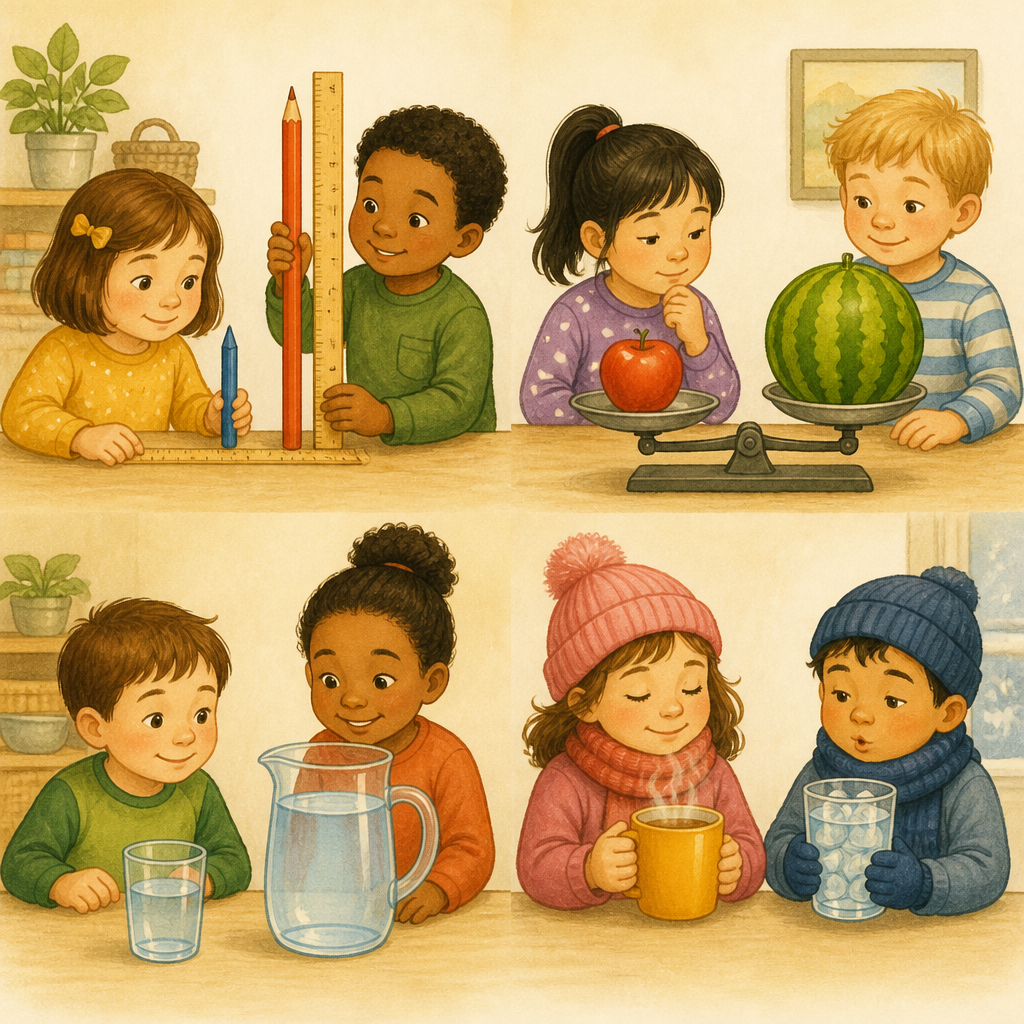
Illustrations are auto-generated and may be placeholders. They can be refreshed to match the narration.
Comparing Length and Height
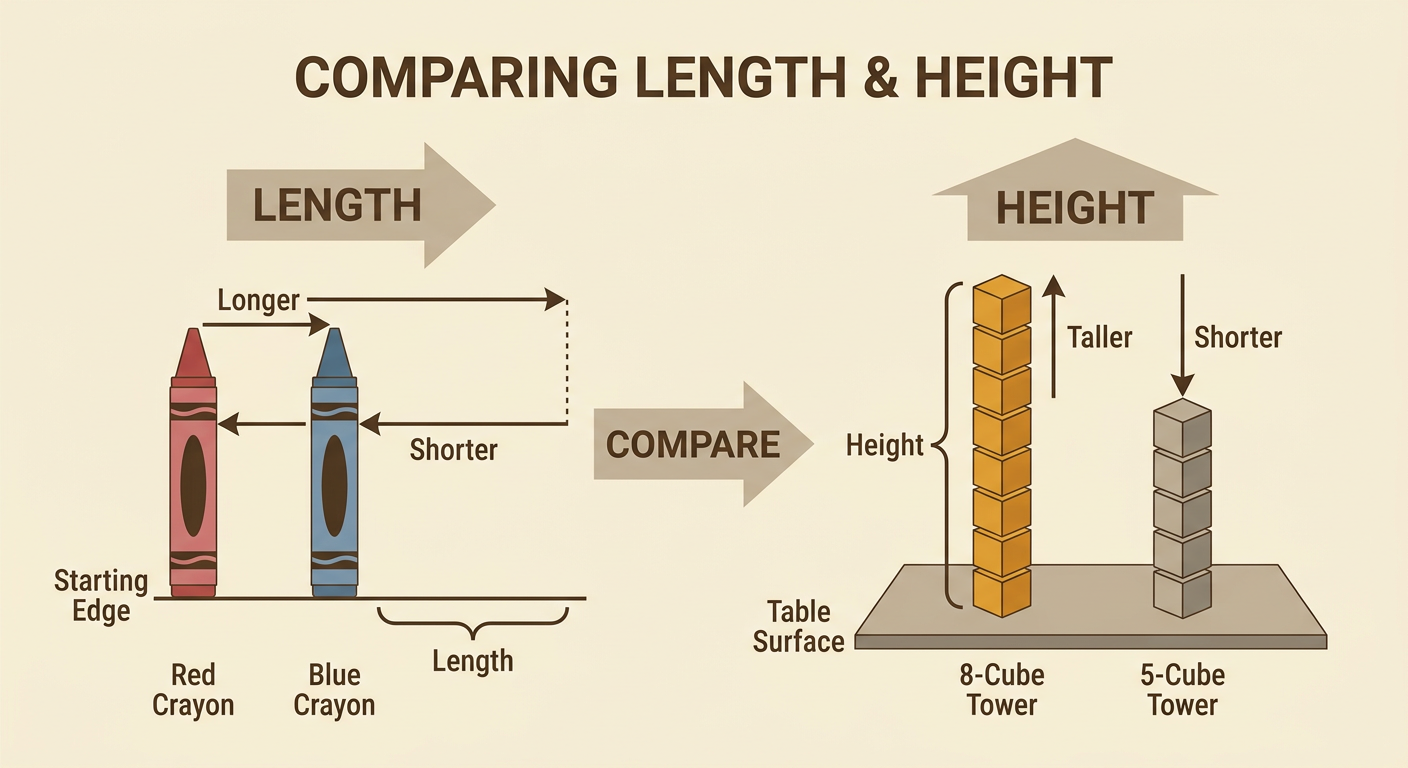
Length tells how long an object is, and height tells how tall it is. To compare two objects fairly, line up their endpoints on the same edge. Place a red crayon and a blue crayon with their bottom ends even. If the blue crayon reaches farther, it is longer and the red crayon is shorter. For height, stand two block towers on the same table. A tower of eight cubes is taller than a tower of five cubes. Students should not judge from uneven starting places because that can make a shorter object look longer. Use complete comparison sentences, such as, “The blue ribbon is longer than the yellow ribbon.”
Comparing Weight
Weight describes how heavy or light something is. Students can hold one safe object in each hand and notice which hand feels pulled down more. A balance scale gives clearer evidence. Place an eraser in one pan and a toy car in the other. If the toy car’s pan moves down, the car is heavier and the eraser is lighter. Sometimes objects that look large are light, while smaller objects are heavy. For example, a large empty box may be lighter than a small rock. Students should make a prediction, test the objects, and then describe the result. The words heavier and lighter compare two objects rather than naming an exact weight.

Comparing Capacity
Capacity tells how much a container can hold. Compare capacity by filling one container and pouring its contents into another container. Use dry rice, sand, or water with teacher guidance. For example, fill a small cup and pour it into a pitcher. If the pitcher is not full, the pitcher holds more than the cup. If a pitcher fills three identical cups, its capacity is about three cupfuls. A tall container does not always hold more than a short, wide container, so students need to test rather than guess only by appearance. Use comparison sentences such as, “The bowl holds more than the mug,” or, “The mug holds less than the bowl.”

Comparing Temperature
Temperature describes how warm or cool something is. Students can safely compare objects that are clearly different but not dangerously hot or cold. For example, touch a room-temperature spoon and a spoon that has rested in cool water. The spoon from the water feels cooler, while the other spoon feels warmer. A teacher may also display two cups, one with cool water and one with slightly warm water, and let students observe a classroom thermometer. Discuss that warm and cool are comparison words. An object can be warmer than one object but cooler than another. Students can say, “The water in the blue cup is cooler than the water in the red cup.”
