Comparing Literary Texts with Stage and Film Interpretations
Students compare a key scene from a literary work with stage or film interpretations to evaluate how each version interprets the source text.

Illustrations are auto-generated and may be placeholders. They can be refreshed to match the narration.
Read and Annotate the Source Scene
Begin with the source scene before viewing any adaptation. Read once for plot, then reread to mark words, stage directions, imagery, conflicts, and changes in tone. Separate what the text clearly establishes from what a performer or director must decide. For example, in Hamlet’s “To be, or not to be” soliloquy, the repeated questions reveal uncertainty, while images such as “slings and arrows” present suffering as an attack. However, the text does not require Hamlet to whisper, shout, stand still, or move around the setting. Annotate those open possibilities in the margins. Also note the scene’s context: Hamlet is considering suffering, death, and action while other characters are secretly observing him. Careful annotation creates a reliable baseline for deciding whether an adaptation emphasizes, changes, or omits important elements.

Observe Performance Choices
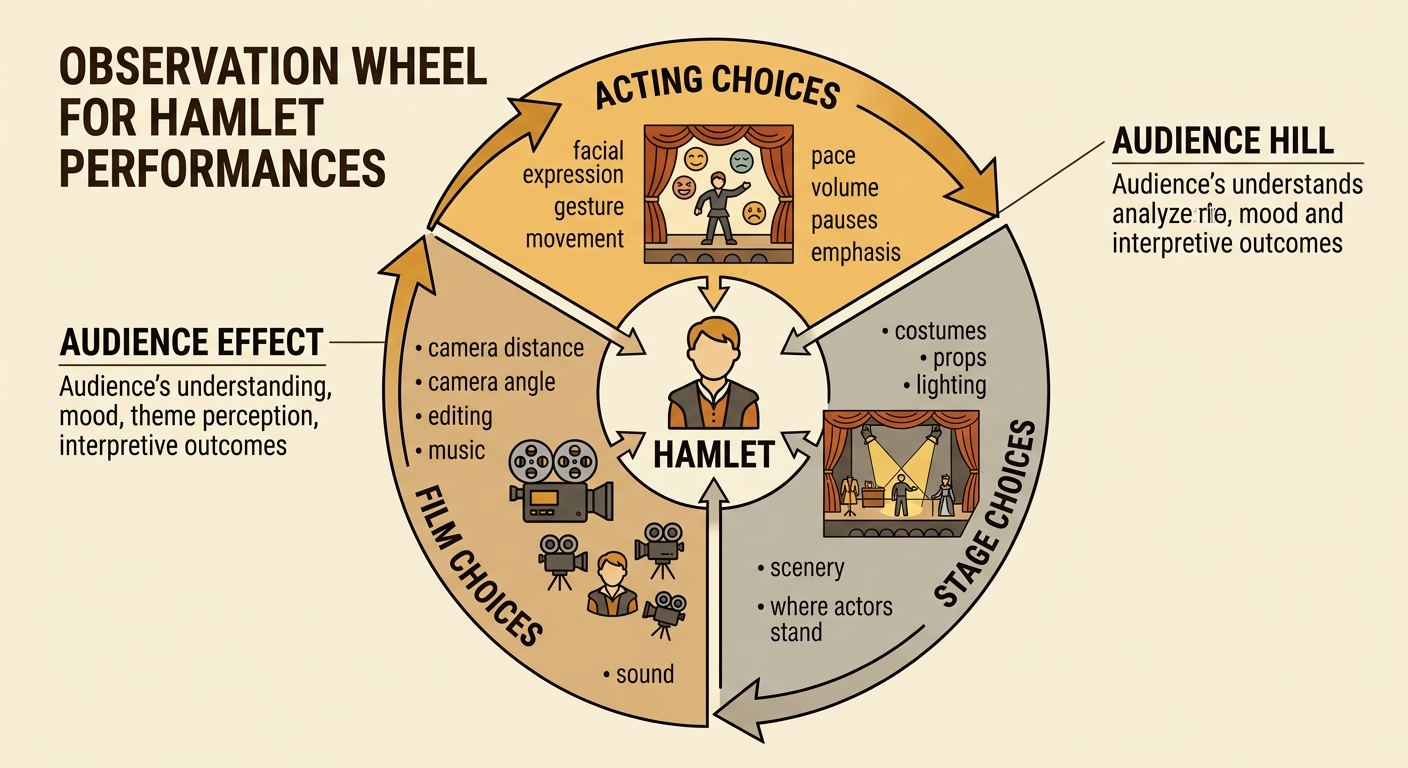
Watch each interpretation more than once. During the first viewing, follow the scene’s overall effect. During the second, record specific acting, staging, and film choices. Acting choices include facial expression, gesture, movement, pace, volume, pauses, and emphasis. Stage choices include costumes, props, lighting, scenery, and the actors’ positions. Film choices also include camera distance, angle, editing, music, and sound. For example, one actor might deliver Hamlet’s soliloquy slowly under a single light, creating a private and sorrowful mood. Another interpretation might place Hamlet before a mirror, use close-ups, and reveal hidden observers, emphasizing self-examination and surveillance. Do not record only what happens. Explain how each choice shapes the audience’s understanding of Hamlet, the conflict, and the scene’s emotional atmosphere.
Compare Text and Adaptations
Organize similarities and differences by category rather than simply listing them. Compare characterization, tone, setting, pacing, conflict, sequence, and included or omitted language. For every observation, connect the adaptation to evidence from the source. Suppose the text presents Hamlet’s speech as a series of questions. A stage version may preserve every line but use long pauses, making Hamlet seem paralyzed by doubt. A film version may shorten the speech and cut rapidly between Hamlet and hidden listeners, making political danger more prominent. Both versions use the source, but they emphasize different meanings. A useful comparison explains what remains consistent, what changes, and what effect the change creates. Avoid calling a version “better” merely because it follows the text closely; accuracy is one criterion, but interpretive insight and artistic coherence also matter.

Evaluate Interpretive Decisions
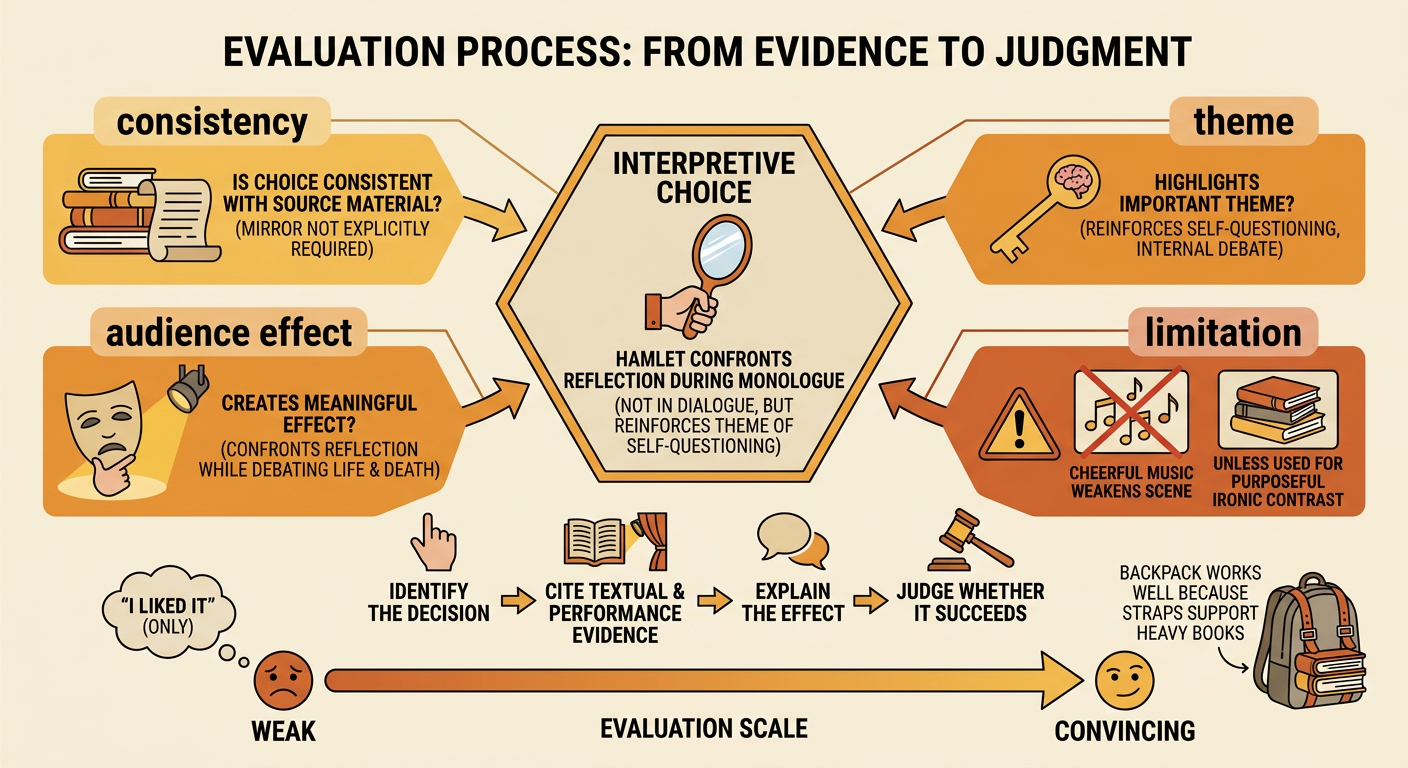
Evaluation requires a judgment supported by clear criteria and evidence. Ask whether each decision is consistent with the text, highlights an important theme, develops a character, and produces a meaningful effect for the audience. An adaptation may change a detail yet still offer a persuasive interpretation. For example, placing Hamlet before a mirror is not required by the dialogue, but it can reinforce his self-questioning and divided state of mind. In contrast, cheerful music during the speech might weaken the scene unless the director establishes a purposeful ironic contrast. State the decision, identify relevant textual and performance evidence, and explain why the choice succeeds or fails. Consider limitations as well as strengths. A close-up may reveal subtle fear, while reducing the audience’s awareness of the larger setting or nearby observers.
Write an Evidence-Based Comparison
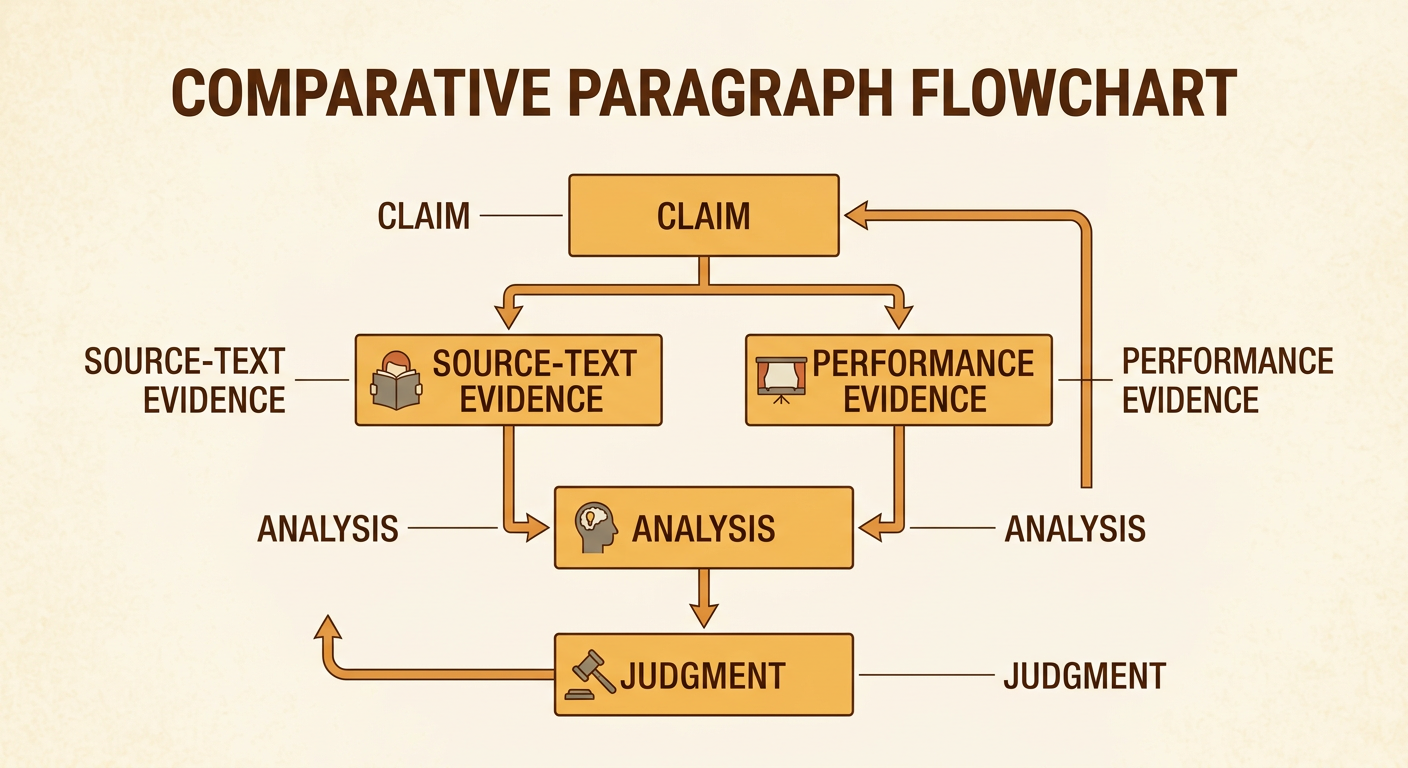
Write a focused claim that identifies the versions and states your evaluation of their interpretations. Then organize body paragraphs around meaningful points of comparison, not separate plot summaries. Each paragraph should include source-text evidence, performance evidence, analysis of the relationship between them, and a judgment. For example: “Although both versions present Hamlet as uncertain, the mirror-centered film interpretation more effectively emphasizes self-conflict because Hamlet confronts his own reflection while asking whether he should continue living.” Support this claim with a brief quotation from the speech and a precise description of camera framing, expression, or pacing. Use transitions such as “similarly,” “in contrast,” and “whereas” to clarify relationships. Conclude by explaining what each adaptation helps the audience notice about the source rather than merely repeating the thesis.