
Comparing Two-Dimensional and Three-Dimensional Shapes
Students observe, describe, and compare flat and solid shapes by discussing sides, corners, faces, curved surfaces, and how the shapes can move.
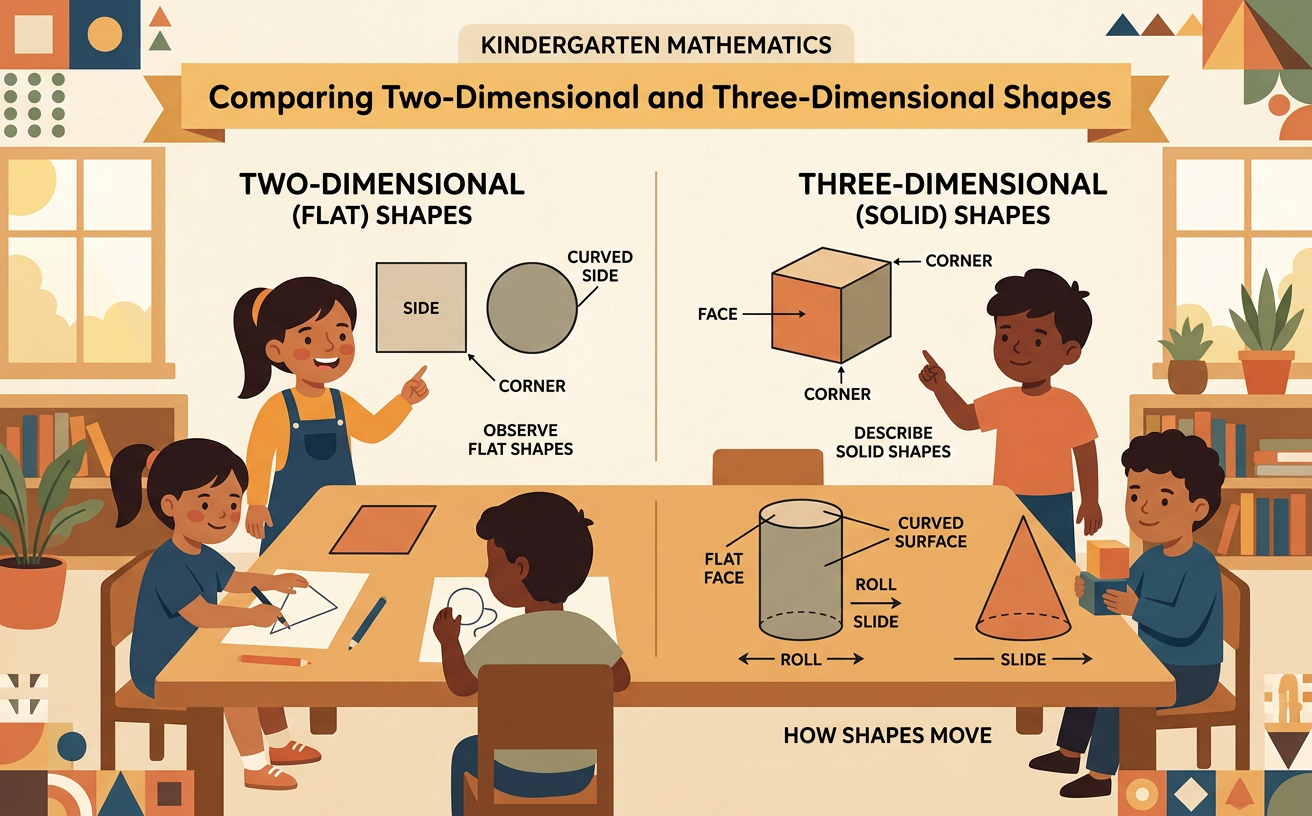
Illustrations are auto-generated and may be placeholders. They can be refreshed to match the narration.
Exploring Flat Shapes
Two-dimensional shapes are flat. They can be drawn on paper and have length and width. Common flat shapes include circles, triangles, squares, and rectangles. Look at a paper triangle and trace its boundary. It has three straight sides and three corners. A square has four straight sides and four corners, while a circle has one curved boundary and no corners. Turn a square so that one corner points upward. It is still a square because turning it does not change its sides or corners. Find examples around the classroom, such as a rectangular book cover or a circular clock face. Describe each shape by what you notice instead of relying only on its name.
Exploring Solid Shapes
Three-dimensional shapes are solid objects that take up space. They have length, width, and height. Common solid shapes include cubes, spheres, cylinders, and cones. Hold a cube and notice its flat faces, straight edges, and corners. A ball is shaped like a sphere and has a curved surface with no corners. A can is shaped like a cylinder and has two flat circular faces plus a curved surface. A party hat may be shaped like a cone, with one flat circular face and a point. Turn each object in your hands and look at it from different directions. The shape keeps its attributes even when its position changes.

Comparing Shape Attributes
Shapes can be alike in some ways and different in other ways. Compare a square and a rectangle. Both have four straight sides and four corners, but a square has four sides of the same length. Next, compare a cube and a sphere. Both are solid shapes, but the cube has flat faces and corners while the sphere has a curved surface and no corners. Use clear comparison sentences such as, “Both shapes have flat parts,” or, “Only the triangle has three corners.” Size and color do not decide a shape’s name. A small blue triangle and a large red triangle are both triangles because each has three straight sides and three corners.

Rolling, Sliding, and Stacking
A solid shape’s surfaces affect how it moves and stacks. Test a sphere, cube, cylinder, and cone on a tray. A sphere rolls easily because its surface is curved. A cube slides and stacks well because it has flat faces. A cylinder can roll when placed on its curved side, but it can stack or slide when resting on a flat circular face. A cone may roll in a curved path and can stand on its flat face. Before testing each shape, predict what it will do and explain why. For example, say, “I think the cube will stack because its top and bottom are flat.” Observing movement helps us compare curved surfaces, flat faces, edges, and corners.