
Compass-and-Straightedge Constructions
Students use a compass and straightedge to construct perpendicular bisectors, angle bisectors, and lines parallel or perpendicular to a given line while explaining why each construction works.

Illustrations are auto-generated and may be placeholders. They can be refreshed to match the narration.
Construction Tools and Rules
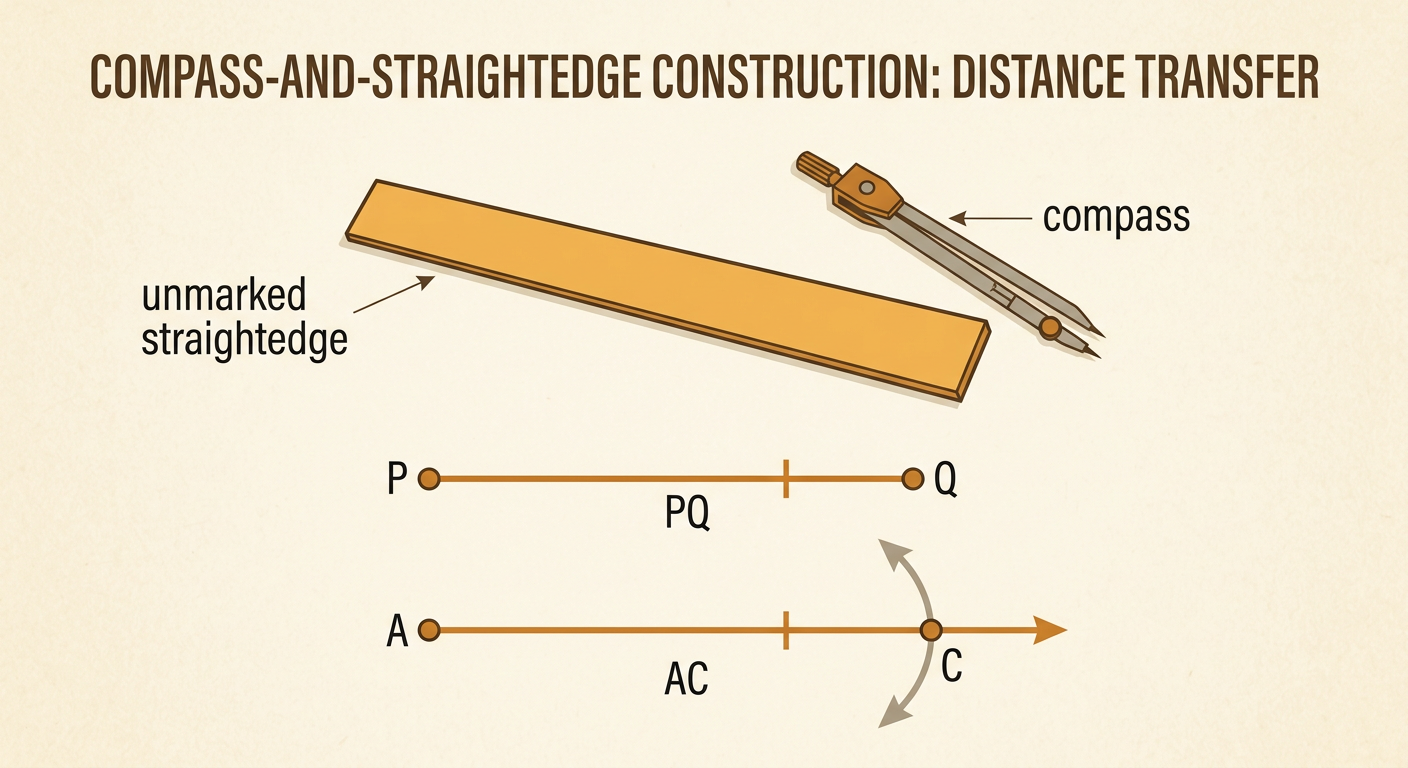
A compass-and-straightedge construction uses two ideal tools. An unmarked straightedge draws a line through two known points but does not measure length. A compass draws circles and transfers distances. Construction marks, such as arcs and intersection points, must remain visible because they show how the result was created. Begin with given points, lines, segments, or angles, and create each new point from intersections of lines or circles. For example, to mark a point C so that AC equals a given segment PQ, open the compass to the distance PQ. Without changing the opening, place the compass point at A and draw an arc. Choose C where the arc meets the intended ray from A. The equal compass radius guarantees that AC and PQ have the same length.
Copying Segments and Angles
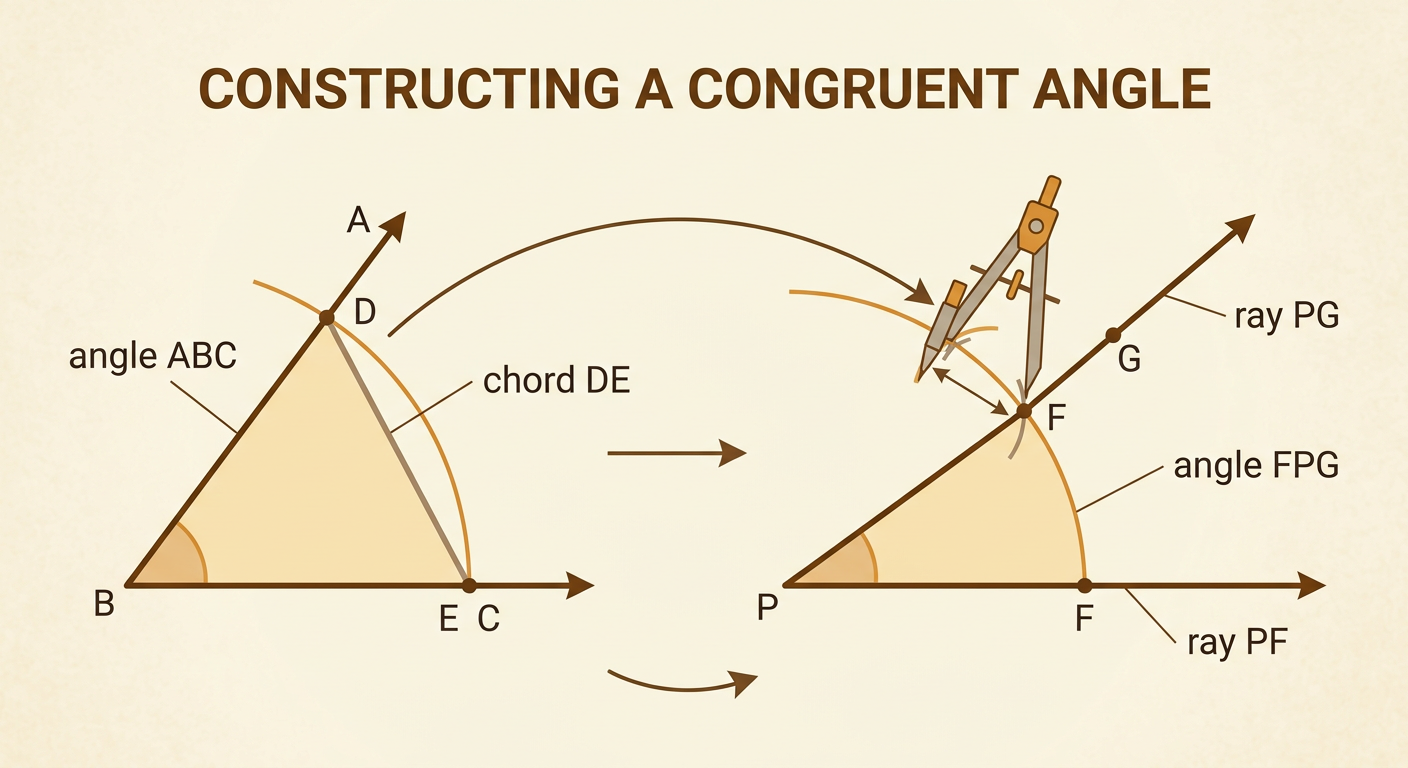
To copy a segment, set the compass width to the distance between its endpoints, then draw an arc from the new starting point to locate the copied endpoint. To copy angle ABC, first draw a new ray with endpoint P. Center the compass at B and draw an arc crossing the sides of the original angle at D and E. Without changing that radius, draw an arc centered at P that crosses the new ray at F. Set the compass to distance DE. With center F, mark point G on the new arc. Draw ray PG. For example, if angle ABC is copied at P, angle FPG has the same measure as angle ABC. The first pair of arcs copies equal distances from the vertices, and the transferred chord DE fixes the opening between the two sides.
Bisecting a Segment
A perpendicular bisector passes through a segment’s midpoint and forms right angles with the segment. To construct the perpendicular bisector of segment AB, open the compass to more than half the length of AB. With center A, draw arcs above and below the segment. Without changing the compass width, repeat from center B. Label the two arc intersections C and D, then draw line CD. This line crosses AB at M. For example, if AB is 8 centimeters long, the construction places M so that AM and MB are each 4 centimeters, even though no ruler measurement is needed. Points C and D are equally distant from A and B, so the line through them is the perpendicular bisector of AB.

Bisecting an Angle
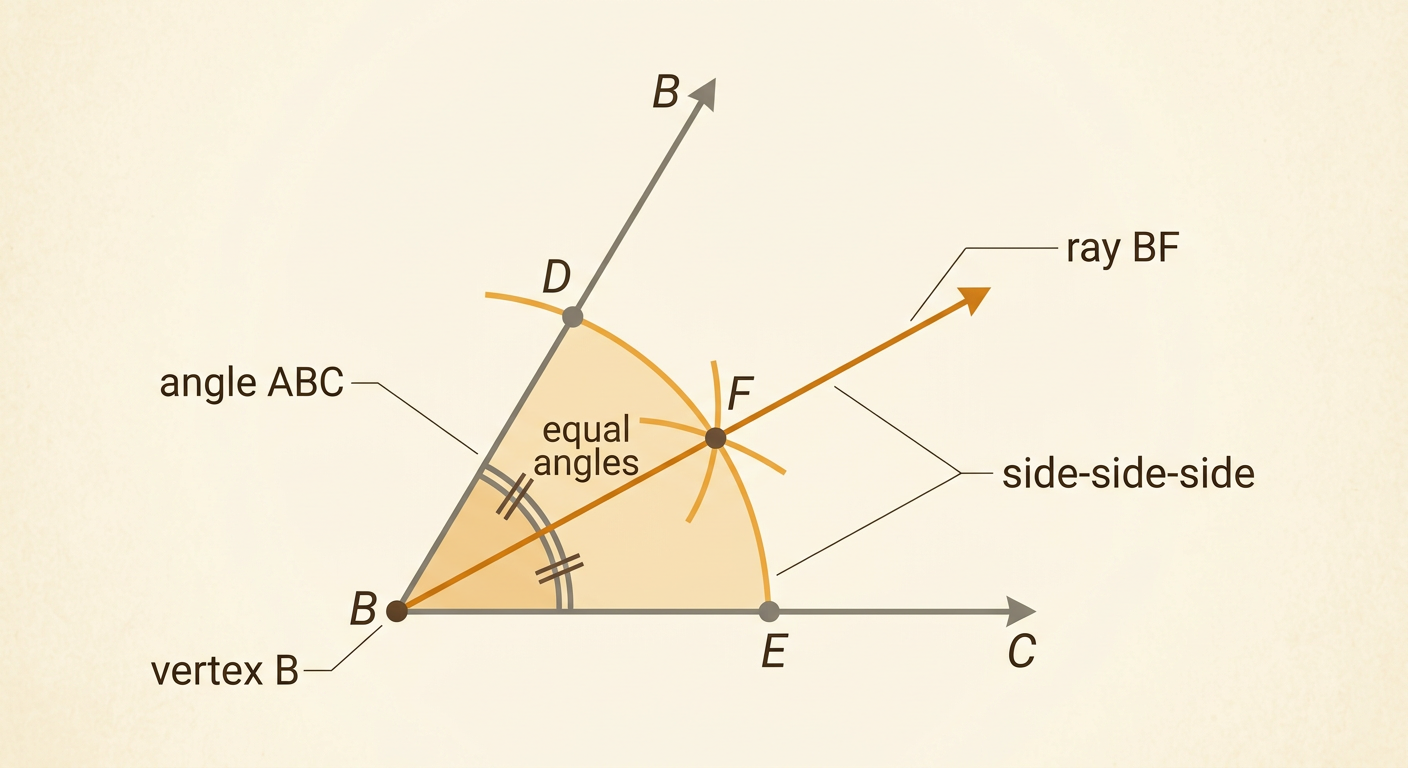
An angle bisector is a ray that divides an angle into two angles of equal measure. To bisect angle ABC, place the compass point at vertex B and draw an arc that crosses ray BA at D and ray BC at E. Use one compass width to draw an arc centered at D inside the angle. Without changing the width, draw another arc centered at E. Label their intersection F, then draw ray BF. For example, if angle ABC measures 70 degrees, ray BF creates two 35-degree angles. This works without measuring the angle. Since BD equals BE, DF equals EF, and BF is shared, triangles BDF and BEF are congruent by side-side-side. Therefore, angles DBF and FBE are equal.
Constructing Perpendicular and Parallel Lines
To construct a perpendicular through point P on line l, mark two points A and B on l that are equally distant from P. Draw equal-radius arcs centered at A and B so they intersect at C, then draw line PC. Line PC is perpendicular to l. If P is not on l, draw a circle centered at P that intersects l at A and B, then use the same perpendicular-bisector idea. To construct a parallel line through P, first construct line m through P perpendicular to l. Next, construct line n through P perpendicular to m. Because l and n are both perpendicular to m, they are parallel. For example, if l is the horizontal edge of a diagram and P lies above it, the double-perpendicular construction produces a horizontal line through P that never meets l.

Justifying Each Construction
A formal construction should include a reason that the result must have the required property. Equal compass radii create congruent segments, while a straightedge connects established points. In a segment-bisector construction, the arc intersections C and D are each equidistant from endpoints A and B. By the converse of the perpendicular bisector theorem, both points lie on the perpendicular bisector of AB, so line CD is that bisector. In an angle-bisector construction, three matching side pairs prove two triangles congruent by side-side-side, making the two smaller angles equal. A copied angle uses the same reasoning with equal radii and an equal transferred chord. Finally, if two lines are perpendicular to the same line in a plane, they are parallel. For example, these facts prove that a double-perpendicular construction through P produces exactly one line through P parallel to the given line.
