Complex Numbers and Quadratic Solutions
Students use the imaginary unit and complex-number operations to represent and calculate nonreal solutions of quadratic equations.

Illustrations are auto-generated and may be placeholders. They can be refreshed to match the narration.
Why Complex Numbers Are Needed
Some quadratic equations cannot be solved using only real numbers. For a quadratic equation ax² + bx + c = 0, the discriminant b² − 4ac indicates the kind of solutions it has. A positive discriminant gives two real solutions, zero gives one repeated real solution, and a negative discriminant gives two nonreal solutions. For example, x² + 4 = 0 leads to x² = −4. No real number has a square of −4 because the square of every nonzero real number is positive. On a graph, the parabola y = x² + 4 never crosses the x-axis, confirming that there are no real zeros. Complex numbers extend the real number system so that equations such as this one still have solutions.

The Imaginary Unit
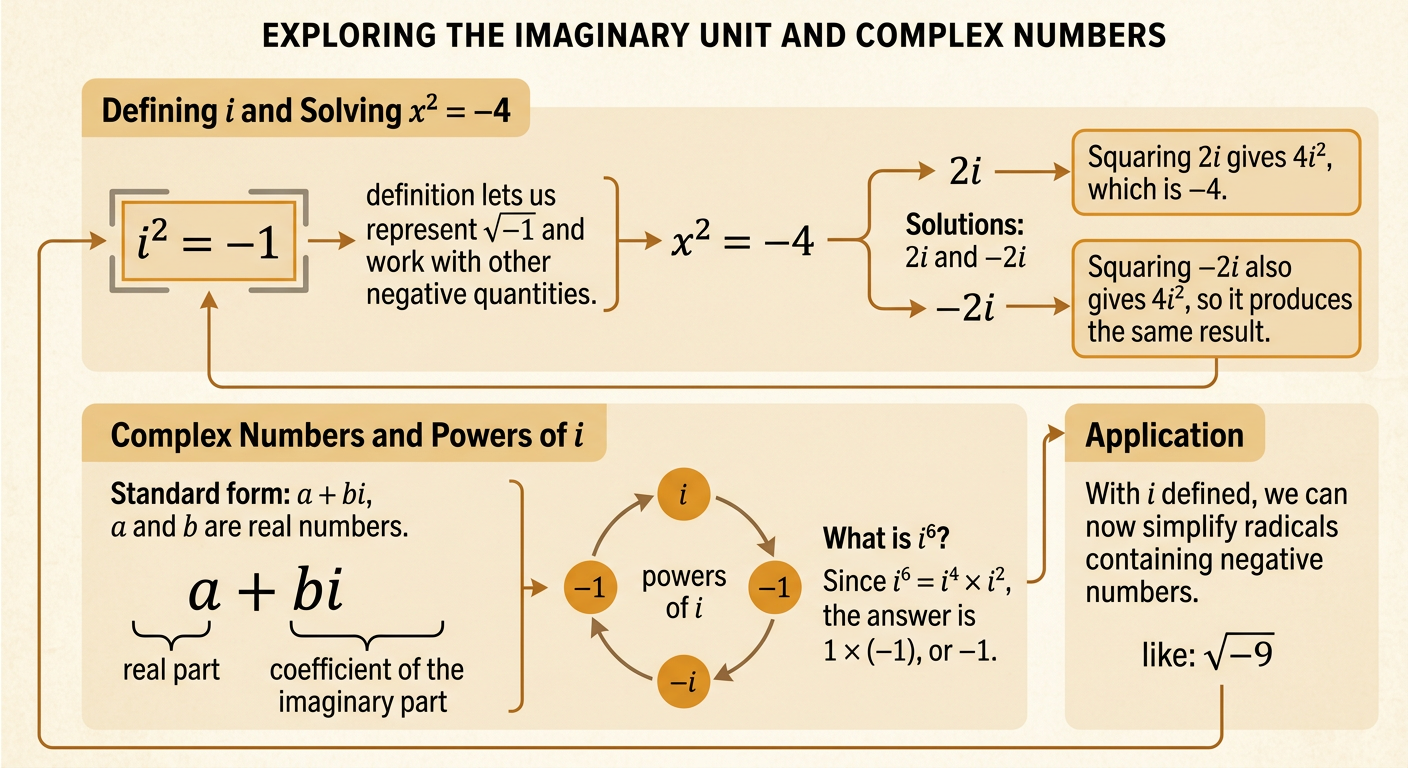
The imaginary unit, written i, is defined by i² = −1. Therefore, i can represent the square root of −1, and square roots of other negative numbers can be expressed using i. For example, x² = −4 has the solutions x = 2i and x = −2i because (2i)² = 4i² = −4 and (−2i)² = 4i² = −4. A complex number has the form a + bi, where a and b are real numbers. The number a is the real part, and b is the coefficient of the imaginary part. Powers of i repeat in a cycle: i, −1, −i, 1. For instance, i⁶ = i⁴ · i² = 1 · (−1) = −1.
Simplifying Square Roots
To simplify the square root of a negative number, first factor out −1 and replace √−1 with i. Then simplify the remaining positive square root. For example, √−72 = √(−1 · 72) = i√72. Because 72 = 36 · 2, this becomes i√(36 · 2) = 6i√2. Thus, the principal square root of −72 is 6i√2. Be careful about the difference between simplifying a radical and solving an equation. The expression √−72 refers to one principal square root, but the equation x² = −72 has two solutions: x = ±6i√2. To check, squaring either value gives 36 · i² · 2 = 72(−1) = −72.

Operations with Complex Numbers
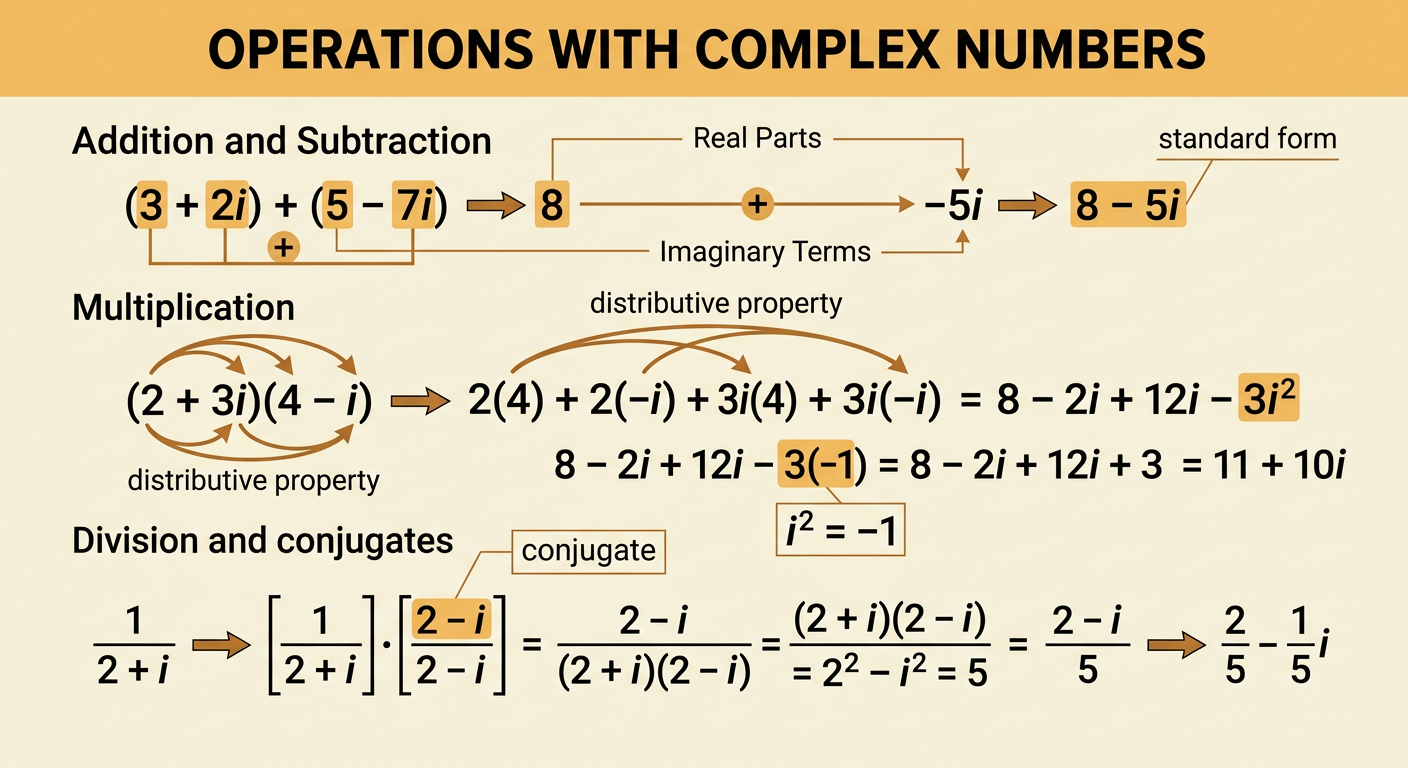
Complex numbers are added and subtracted by combining real parts with real parts and imaginary terms with imaginary terms. For example, (3 + 2i) + (5 − 7i) = 8 − 5i. To multiply, use the distributive property and replace i² with −1. Thus, (2 + 3i)(4 − i) = 8 − 2i + 12i − 3i² = 11 + 10i. Division often uses a conjugate. The conjugate of a + bi is a − bi, and their product is the real number a² + b². For example, 1/(2 + i) is multiplied by (2 − i)/(2 − i), giving (2 − i)/5. After any operation, write the result in standard form a + bi and simplify all powers of i.
Nonreal Quadratic Solutions
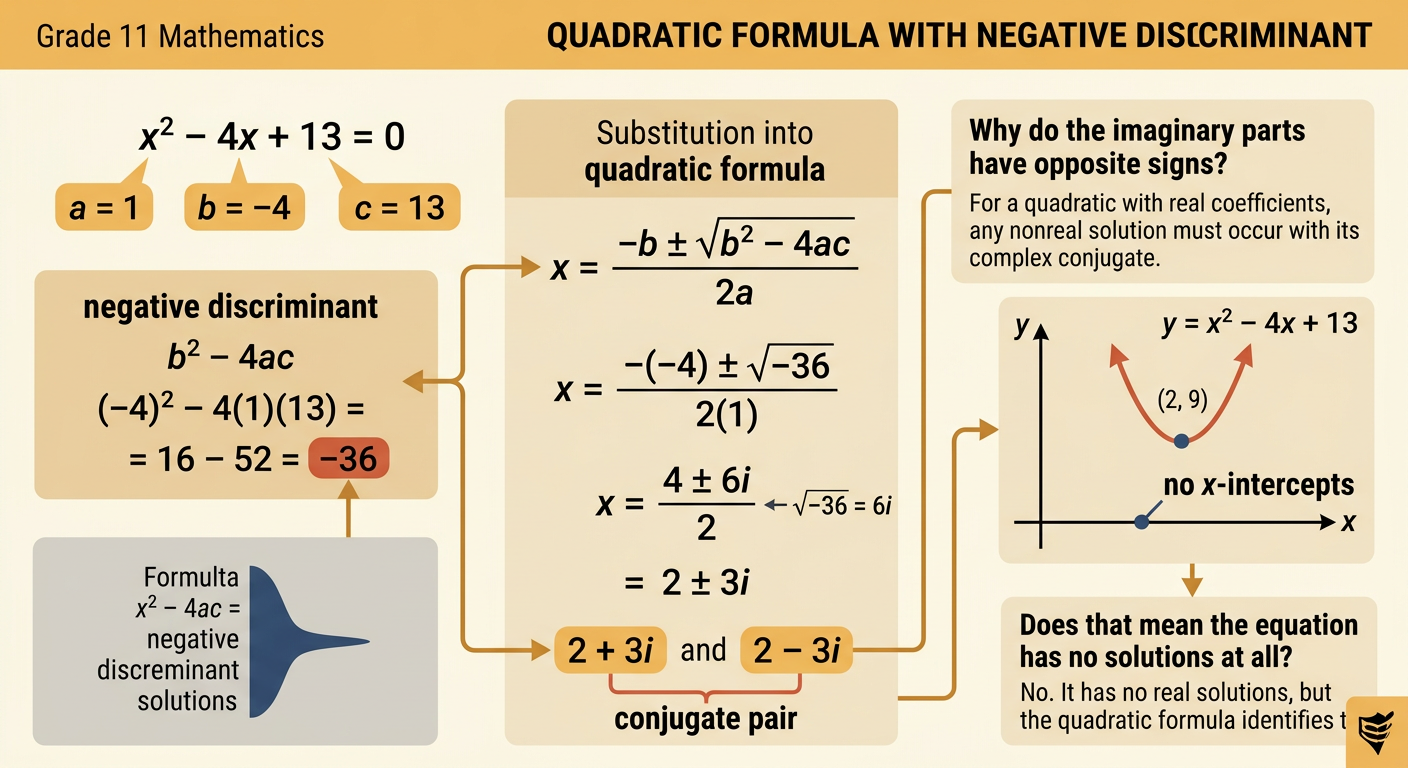
The quadratic formula solves equations with real coefficients even when the discriminant is negative. Consider x² − 4x + 13 = 0, where a = 1, b = −4, and c = 13. The discriminant is b² − 4ac = 16 − 52 = −36. Substitution into the formula gives x = (4 ± √−36)/2. Since √−36 = 6i, the solutions are x = (4 ± 6i)/2 = 2 ± 3i. These two answers, 2 + 3i and 2 − 3i, are complex conjugates. Nonreal solutions of a quadratic with real coefficients always occur as a conjugate pair. The graph y = x² − 4x + 13 has no x-intercepts, but the quadratic formula still identifies its two complex zeros.