
Congruence Through Rigid Motions
Students determine whether two figures are congruent by identifying a sequence of translations, rotations, and reflections that maps one figure onto the other.
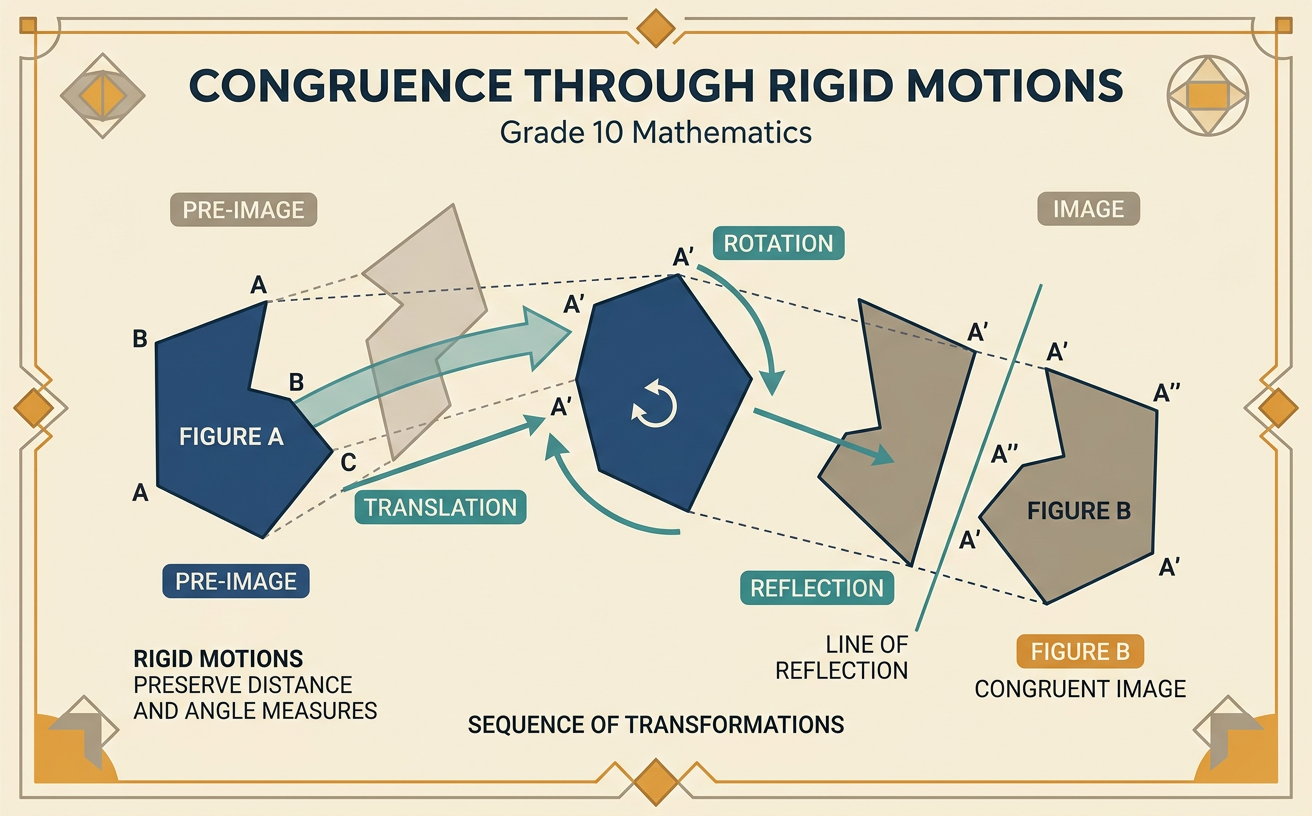
Illustrations are auto-generated and may be placeholders. They can be refreshed to match the narration.
Meaning of Congruence
Two figures are congruent when one can be mapped exactly onto the other by rigid motions. Rigid motions include translations, rotations, and reflections. These motions preserve every distance and angle measure, so the image has the same size and shape as the original figure. For example, triangle ABC with A(1, 1), B(4, 1), and C(2, 3) can be translated 5 units right and 2 units up. Its image has vertices A′(6, 3), B′(9, 3), and C′(7, 5). Because the translation maps each original vertex to its corresponding image vertex without changing side lengths or angle measures, triangle ABC is congruent to triangle A′B′C′. A reflection may reverse orientation, but it still produces a congruent figure because distances and angles remain unchanged.
Mapping Corresponding Parts
A rigid motion pairs each point of the original figure with one point of the image. These paired points are corresponding points, and their names should follow the same order. Suppose quadrilateral ABCD is translated to quadrilateral WXYZ so that A maps to W, B maps to X, C maps to Y, and D maps to Z. Then side AB corresponds to side WX, side BC corresponds to side XY, and angle C corresponds to angle Y. The congruence statement must be written as ABCD ≅ WXYZ. Writing ABCD ≅ XYZW would be incorrect because the listed vertices would not match the stated mapping. To identify corresponding parts, follow the boundary of each figure in the same direction and use distinctive features, such as the longest side or the largest angle, to check the pairing.
Sequences of Rigid Motions
Sometimes a single rigid motion does not map a figure onto its image, so two or more motions must be performed in sequence. Order matters because changing the order can produce a different final position. Consider triangle ABC with A(1, 1), B(4, 1), and C(2, 3). First rotate the triangle 90 degrees counterclockwise about the origin. The vertices become A′(−1, 1), B′(−1, 4), and C′(−3, 2). Next translate the rotated triangle by the vector ⟨6, 1⟩. The final vertices are A″(5, 2), B″(5, 5), and C″(3, 3). Both steps are rigid motions, so their composition preserves all lengths and angles. Therefore, triangle ABC is congruent to triangle A″B″C″ even though its final position and orientation differ from the original.
Testing Congruence
To test whether two figures are congruent, look for a rigid-motion mapping rather than relying only on appearance. First compare corresponding side lengths and angle measures. If any pair differs, no sequence of rigid motions can make the figures coincide. If the measurements agree, use coordinates or geometric features to identify a possible translation, rotation, or reflection. For example, triangle PQR has P(0, 0), Q(3, 0), and R(0, 4). Triangle XYZ has X(2, 1), Y(5, 1), and Z(2, 5). Each vertex of triangle PQR moves 2 units right and 1 unit up to reach the corresponding vertex of triangle XYZ. Thus, translation by vector ⟨2, 1⟩ maps P to X, Q to Y, and R to Z. This mapping proves that the triangles are congruent.
Explaining a Mapping
A complete congruence explanation names each rigid motion, gives its defining information, states the correct order, and identifies the resulting correspondence. For example, begin with triangle JKL where J(1, 1), K(4, 1), and L(2, 3). First reflect the triangle across the y-axis. The reflected vertices are (−1, 1), (−4, 1), and (−2, 3). Then translate the reflected triangle 6 units right and 2 units up. The final vertices are J′(5, 3), K′(2, 3), and L′(4, 5). This sequence maps J to J′, K to K′, and L to L′. Therefore, triangle JKL ≅ triangle J′K′L′ by a reflection across the y-axis followed by a translation by vector ⟨6, 2⟩. Including the line of reflection and translation vector makes the explanation precise and reproducible.