
Connect Letters to Their Most Common Sounds
Students identify letters and say the most common sound for each one using pictures and familiar words.

Illustrations are auto-generated and may be placeholders. They can be refreshed to match the narration.
Warm-Up with Letter Cards
Look at one letter card at a time. First, say the letter’s name. Then say its most common sound. The letter name and the letter sound are different. For example, this is the letter m. Its name is “m,” and its sound is /m/, as in “moon.” Put your lips together and hum /m/. Try the same steps with s, t, and b. Say, “The letter is s. The sound is /s/.” Listen carefully as each sound is made. Some sounds can be stretched, such as /m/ and /s/. Other sounds are quick, such as /t/ and /b/. Hold up the correct card whenever you hear its letter name. Then make the sound that goes with it.

Hear and Repeat Each Sound
Listen to one sound and repeat it clearly. Watch how your mouth moves. For /m/, close your lips and let your voice hum. For /s/, keep your teeth close and let air slide out. For /t/, touch your tongue behind your top teeth and release it quickly. For /b/, press your lips together and open them with a quick voiced sound. Try not to add “uh” after a sound. Say /t/, not “tuh.” Here is a listening game: the teacher says /m/, /s/, and /m/. Repeat the sounds in the same order. Next, point to the letter that matches each sound. Hearing, repeating, and seeing the letter together help you remember the letter-sound connection.

Connect Sounds to Picture Words
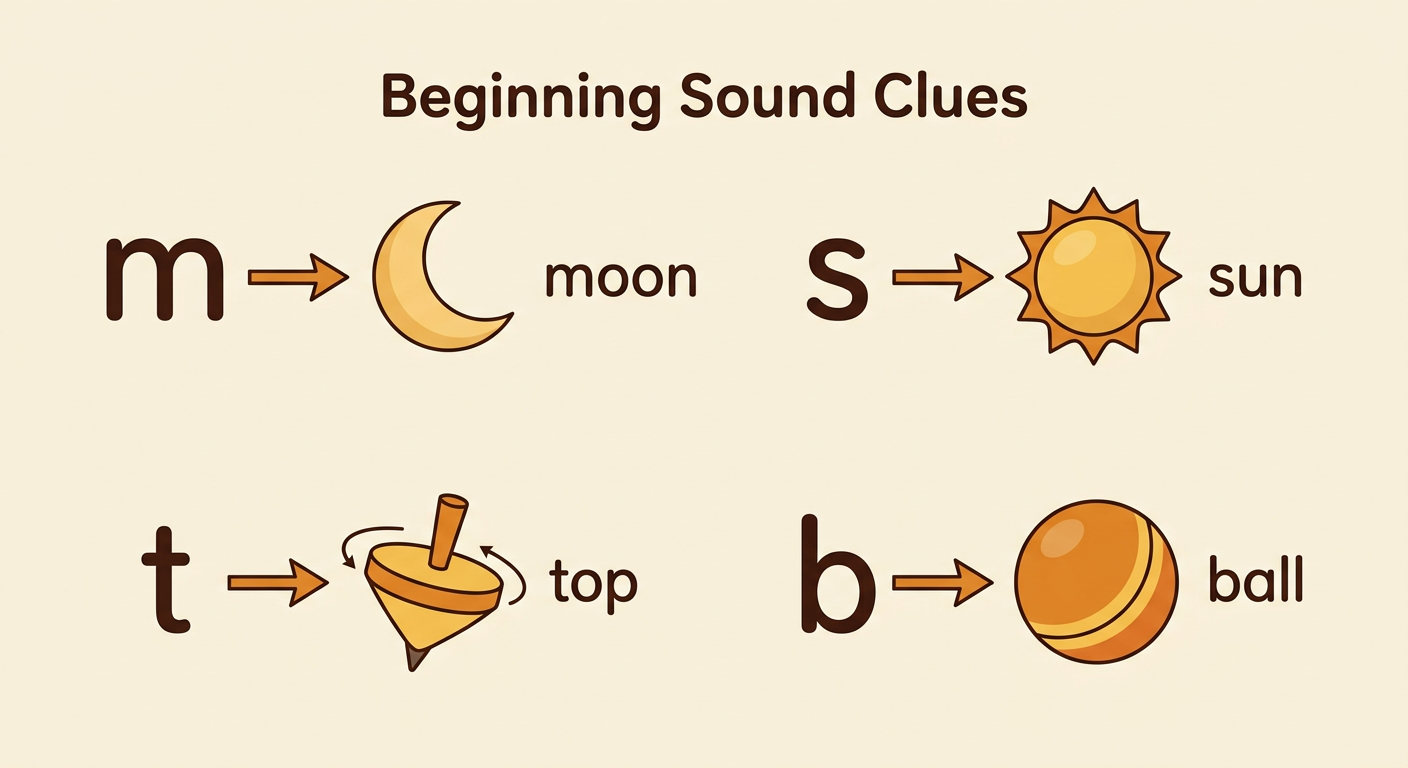
A picture word can help you remember a letter sound. Look at the picture, name it, and listen to the first sound. Moon begins with /m/, so moon matches the letter m. Sun begins with /s/, so sun matches s. Top begins with /t/, so top matches t. Ball begins with /b/, so ball matches b. Stretch or repeat the first sound when you can: /mmm/ moon, /sss/ sun, /t/ top, and /b/ ball. Then say the letter name. For example, say, “Ball begins with /b/. The letter is b.” Be sure to listen to the beginning of the word, not just look at the picture. The first sound tells you which letter to choose.
Practice Letter-Sound Matches
Now practice matching letters, sounds, and pictures. Place the letter cards m, s, t, and b on the table. Choose a picture card and say its name slowly. If you choose “sock,” listen to the beginning: /sss/ sock. Find the letter s and place the sock picture beside it. If you choose “map,” say /mmm/ map and match it to m. Match “tent” to t and “bus” to b. After every match, explain your thinking in a full sentence: “Sock starts with /s/, so it matches s.” If a match does not sound right, say the word again and listen closely to its first sound. Move the card when you find the sound that matches.

Quick Sound Check
Show what you know with a quick sound check. Look at a letter, say its name, and make its most common sound. If you see b, say, “b, /b/.” Next, listen to a sound and point to the matching letter. When you hear /t/, point to t. Finally, look at two pictures and choose the one that begins with the target sound. For the sound /m/, choose milk instead of sun. Use this helpful routine: look, think, say, and check. Look at the letter or picture. Think about the sound. Say your answer. Check by saying the picture word slowly. It is okay to try again. A careful second try helps your brain learn the letter and sound.
