
Connecting Multiplication and Division with Fact Families
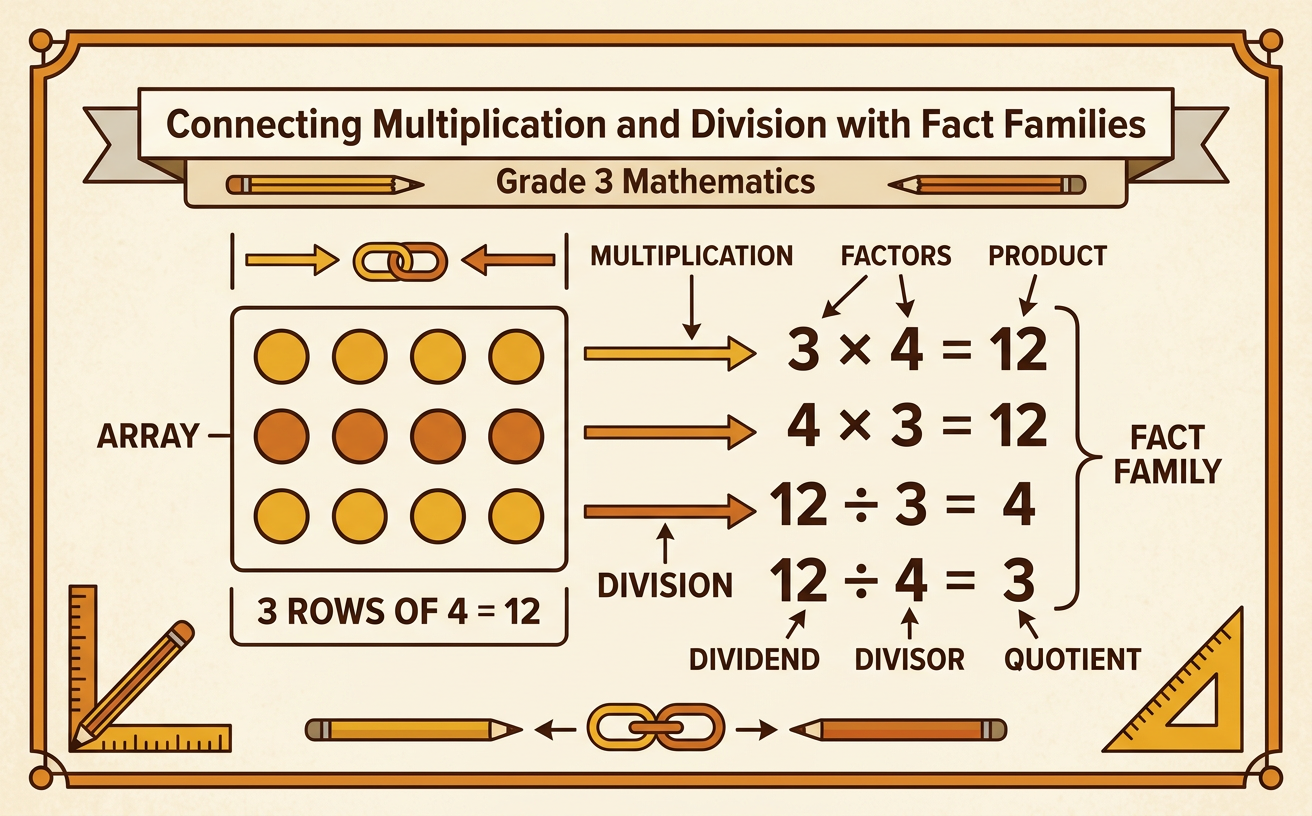
Students use arrays and related equations to explain how multiplication and division are inverse operations within fact families.
Illustrations are auto-generated and may be placeholders. They can be refreshed to match the narration.
Review Multiplication Facts
Multiplication combines equal groups. In 3 × 4 = 12, the factors are 3 and 4, and the product is 12. You can think of this equation as 3 groups with 4 objects in each group. You can also see it as an array with 3 rows and 4 objects in each row. Skip-counting by 4 gives 4, 8, 12. The order of the factors can change without changing the product: 4 × 3 also equals 12. This fact describes 4 groups of 3. Knowing multiplication facts helps you solve division problems because division can ask you to find a missing factor.

Explore an Array
An array helps you see equal groups clearly. Look at an array with 4 rows and 6 stars in each row. There are 24 stars because 4 × 6 = 24. Now imagine separating all 24 stars into rows of 6. You will make 4 equal rows, so 24 ÷ 6 = 4. You can also separate the stars into 4 equal rows and ask how many stars belong in each row. Each row has 6, so 24 ÷ 4 = 6. The same array represents multiplication and division. Multiplication joins equal groups to find a total, while division uses the total to find a missing number.

Write Related Equations
Numbers in the same multiplication and division situation can make related equations. For an array with 4 rows of 6 objects, begin with 4 × 6 = 24. Turn the array to describe 6 groups of 4, giving 6 × 4 = 24. Next, use the product, 24, as the number being divided. If 24 objects are placed into groups of 6, there are 4 groups: 24 ÷ 6 = 4. If 24 objects are placed into 4 equal groups, each group has 6: 24 ÷ 4 = 6. These four equations use the same three numbers. Each division equation reverses, or undoes, a multiplication equation.

Build Fact Families
A fact family is a set of related multiplication and division equations that uses the same three numbers. Use 5, 7, and 35. Since 5 groups of 7 make 35, write 5 × 7 = 35. Switch the factors to write 7 × 5 = 35. Then begin each division equation with the product, 35. Write 35 ÷ 7 = 5 and 35 ÷ 5 = 7. To build another fact family, first choose or find a multiplication fact. Identify its two factors and its product. Then write the two multiplication equations and the two division equations. Check that every equation uses only the same three numbers.

Solve Unknown-Factor Problems
Division can be understood as an unknown-factor problem. To solve 32 ÷ 8, ask, “What number multiplied by 8 equals 32?” Write the related equation as ? × 8 = 32. Think of your multiplication facts or skip-count by 8: 8, 16, 24, 32. It takes 4 groups of 8 to reach 32, so the missing factor is 4. Therefore, 32 ÷ 8 = 4. You can check by multiplying 4 × 8. The product is 32, so the division answer is correct. Whenever you see a division problem, use the divisor and quotient as factors and the dividend as the product.

Quick Check
Use related multiplication facts to complete each division equation. First, solve 27 ÷ 9. Ask what number times 9 equals 27. Since 3 × 9 = 27, the answer is 3. Next, solve 28 ÷ 4. Because 7 × 4 = 28, the answer is 7. Now use 6, 8, and 48 to state the full fact family: 6 × 8 = 48, 8 × 6 = 48, 48 ÷ 8 = 6, and 48 ÷ 6 = 8. Check every division answer by multiplying the divisor by the quotient. If the product equals the dividend, your answer is correct.
