
Conservation in the Progressive Era: Who Should Control America’s Natural Resources?
Students examine how resource use, environmental concerns, and competing ideas about public lands shaped the conservation movement during the Progressive Era.
Illustrations are auto-generated and may be placeholders. They can be refreshed to match the narration.
Resource Use in a Growing Nation
Between 1870 and 1900, the United States population increased rapidly as cities, factories, and railroads expanded. These changes increased demand for timber, coal, iron, copper, farmland, and water. Businesses often treated natural resources as nearly unlimited. Logging removed forests, mining disturbed soil and polluted streams, and farming reduced native grasslands. Railroads made it possible to transport resources across the country, encouraging even more extraction. For example, lumber companies cut large areas of white pine forest around the Great Lakes. The wood helped build homes and cities, but the loss of trees increased erosion and damaged wildlife habitats. Population growth did not cause every environmental problem by itself. New technologies, consumer demand, government land policies, and business decisions also shaped how quickly resources were used and how Earth’s systems were affected.

The Rise of the Conservation Movement
By the late 1800s, scientists, outdoor groups, government officials, and some business leaders warned that forests, wildlife, soil, and water could be damaged or exhausted. Their concerns helped create the conservation movement, part of the broader Progressive Era effort to use experts and government action to address public problems. Congress passed the Forest Reserve Act of 1891, allowing presidents to set aside forest reserves on federal land. The Newlands Reclamation Act of 1902 funded irrigation projects in the West with money from federal land sales. Supporters argued that planning could protect watersheds and keep resources available for future generations. For example, forest reserves limited unrestricted logging in important headwater regions. Conservation was not one united campaign, however. Participants disagreed about whether nature should remain mostly untouched or be scientifically managed for long-term human use.

Preservation Versus Managed Use
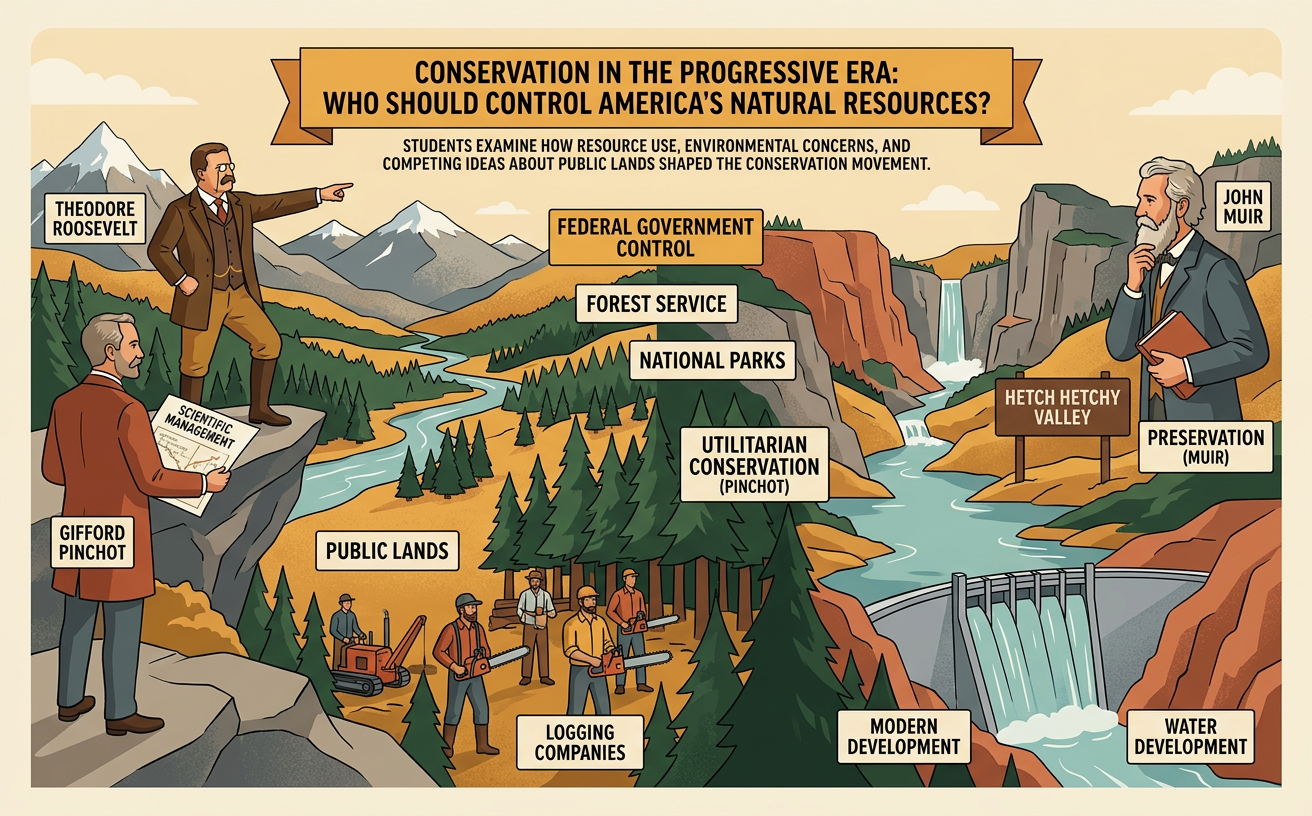
Progressive conservation included two competing ideas. Preservationists argued that some landscapes should be protected from major development because of their beauty, wildlife, and spiritual or cultural value. Advocates of managed use, sometimes called conservationists, supported planned use of forests, water, and minerals so resources would provide lasting public benefits. The debate over Hetch Hetchy Valley in Yosemite National Park made the disagreement clear. San Francisco officials wanted to dam the valley to create a dependable water supply. John Muir opposed the dam because he believed the valley should remain wild. Gifford Pinchot supported the project because he believed public resources should serve the greatest number of people. Congress authorized the dam in 1913. The decision supplied water and hydroelectric power, but it flooded the valley. The example shows that environmental choices can create both benefits and costs.

Roosevelt, Pinchot, and Muir
President Theodore Roosevelt, forester Gifford Pinchot, and writer John Muir became leading figures in Progressive Era conservation, but they did not hold identical views. Roosevelt believed the federal government should protect important places and manage resources for the nation’s future. During his presidency, he greatly expanded national forests and used the Antiquities Act to create national monuments. Pinchot, the first chief of the U.S. Forest Service, promoted scientific forestry and the planned use of resources for long-term public benefit. Muir, founder of the Sierra Club, argued that spectacular wild places deserved protection from commercial development. In 1903, Roosevelt camped with Muir in Yosemite, where they discussed the value of protecting forests and scenery. Their cooperation helped build support for conservation, while their later disagreement over Hetch Hetchy demonstrated important divisions within the movement.

Effects on Native Nations and Local Communities
Conservation policies protected land from some forms of development, but they also harmed many Native Nations and affected rural communities. Officials often described parks and forests as empty wilderness even though Native peoples had lived in, used, and cared for those lands for generations. Park rules sometimes restricted hunting, gathering, burning, ceremonies, and residence. In Yosemite, Native communities faced removal and limits on traditional practices as officials reshaped the valley for tourism and scenic preservation. Federal forest and water policies could also restrict local ranchers, loggers, and farmers, although irrigation projects and tourism created jobs and economic opportunities for some communities. These unequal effects show why historians examine who made conservation decisions and whose knowledge was ignored. A complete account must compare government reports and conservation writings with treaties, Native testimony, oral histories, and local records.

Evaluating the Progressive Conservation Legacy
The Progressive conservation legacy includes major achievements, serious limits, and lasting debates. Federal action protected millions of acres, created professional land-management agencies, and established tools for protecting forests, watersheds, wildlife, and historic sites. In 1908, Theodore Roosevelt used the Antiquities Act to proclaim Grand Canyon National Monument, helping protect the area before it became a national park in 1919. However, conservation policies also supported dams and other development, excluded Native peoples from ancestral lands, and often placed decision-making power in federal experts rather than affected communities. Some past practices, including broad fire suppression, also changed ecosystems in harmful ways. To evaluate this legacy, students should identify the causes of each policy, compare its environmental and social effects, and cite evidence from multiple sources. A strong conclusion recognizes that protection, resource use, government power, and justice were connected rather than separate issues.
