Conservation of Atoms in Chemical Reactions
Students balance chemical equations and use particle models to explain how atoms are rearranged while matter is conserved during a chemical reaction.
Illustrations are auto-generated and may be placeholders. They can be refreshed to match the narration.
Atoms Before and After a Reaction
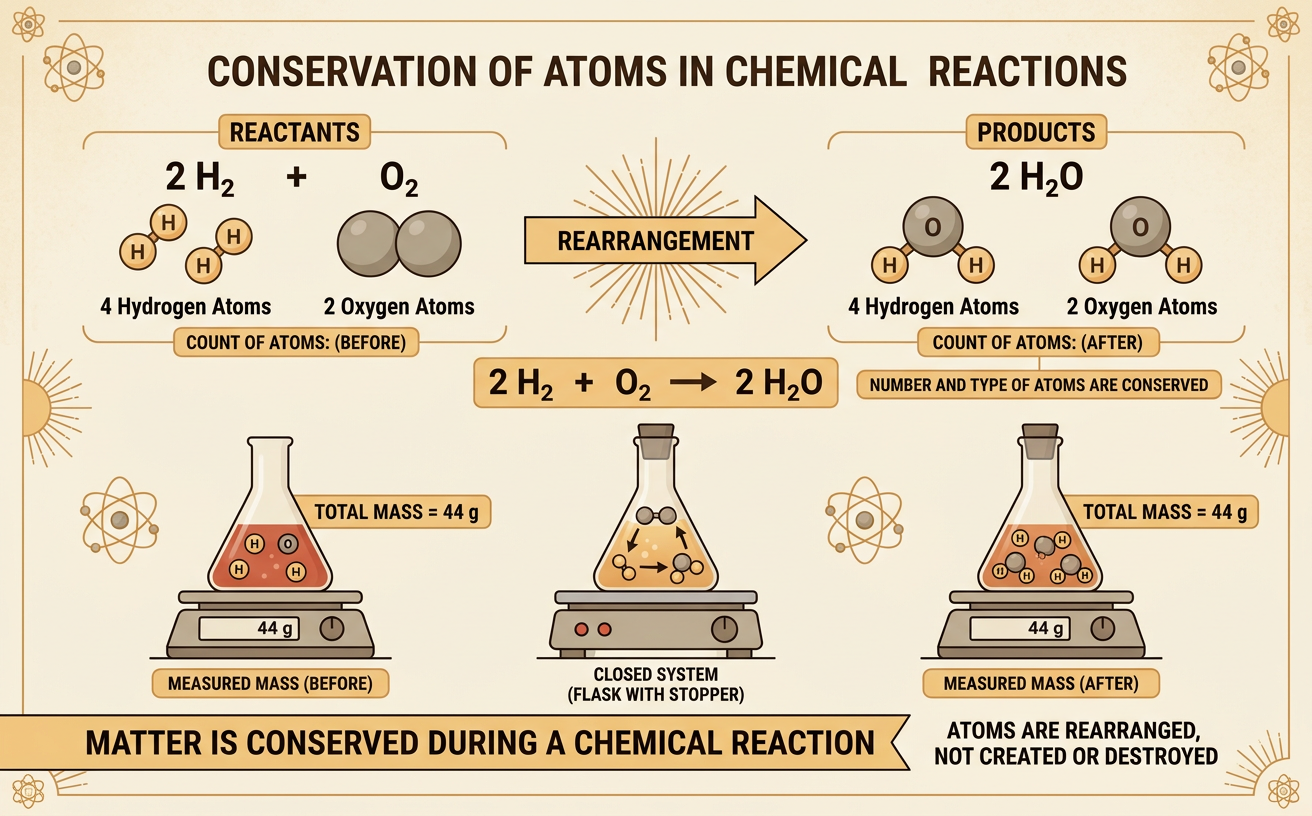
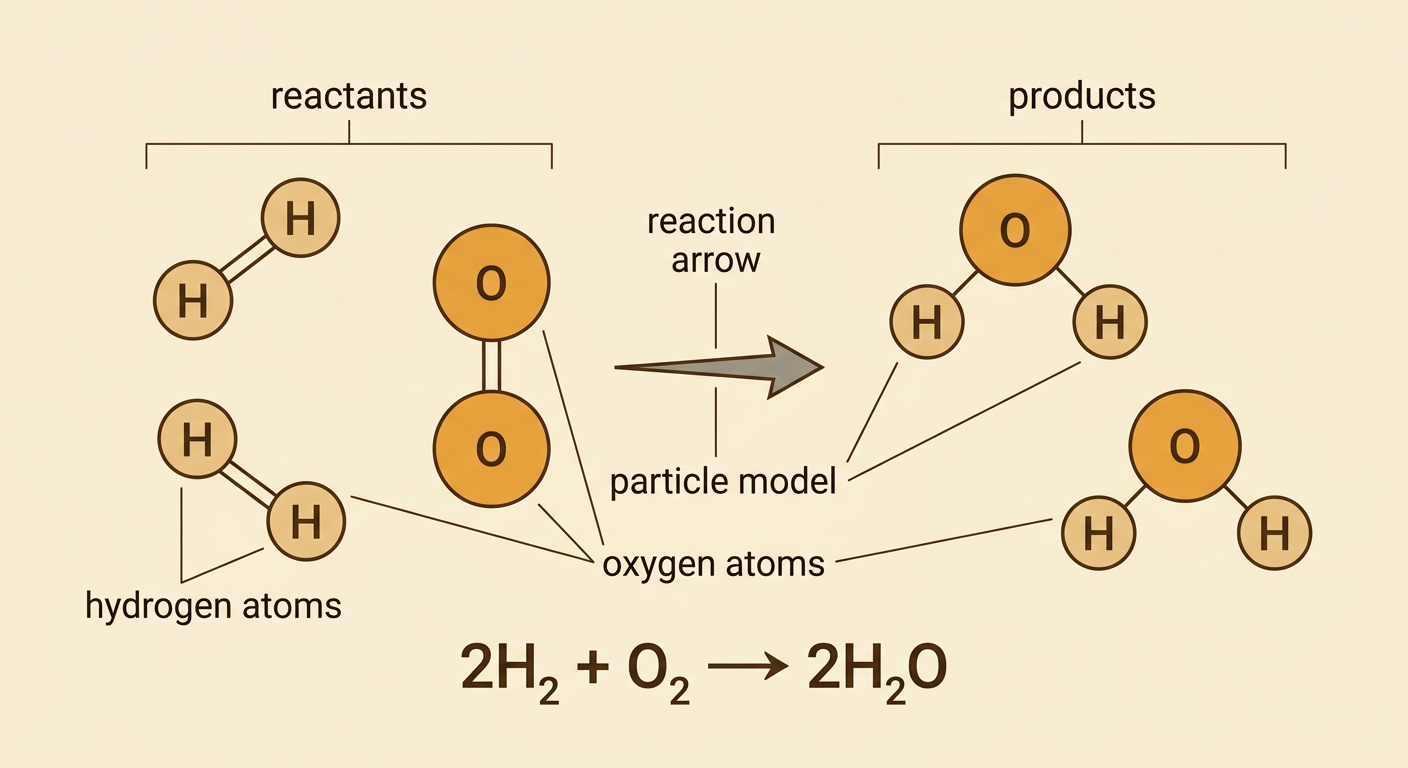
A chemical reaction changes how atoms are connected, but it does not create or destroy atoms. The starting substances are called reactants, and the substances formed are called products. During the reaction, bonds between atoms break, atoms rearrange, and new bonds form. For example, two hydrogen molecules can react with one oxygen molecule to form two water molecules: 2H₂ + O₂ → 2H₂O. Before the reaction, the particles contain four hydrogen atoms and two oxygen atoms. After the reaction, the two water molecules also contain four hydrogen atoms and two oxygen atoms. The atoms have different partners, but the number of each type of atom remains unchanged. A particle model makes this rearrangement visible by showing every atom on both sides of the reaction arrow.
Reading Chemical Equations
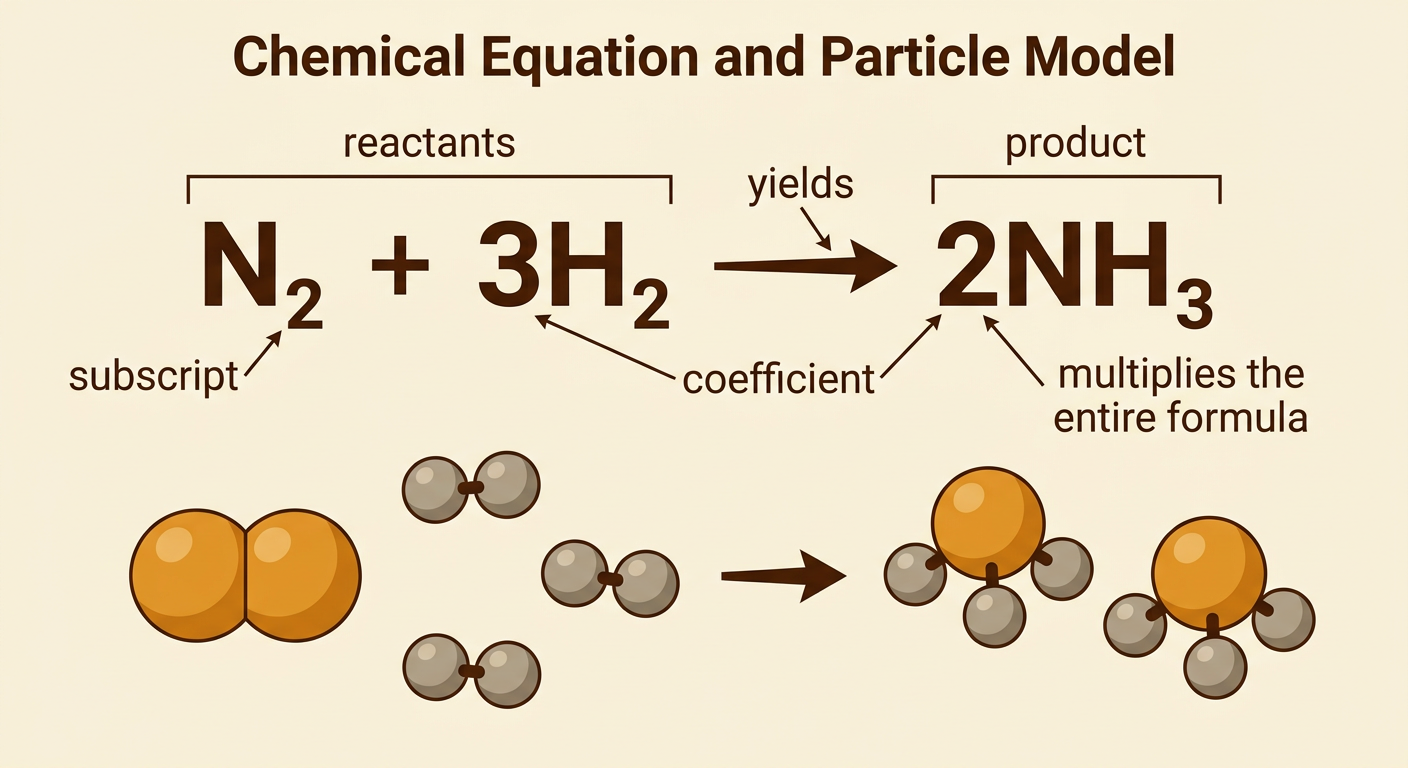
A chemical equation uses symbols and numbers to describe a reaction. Reactant formulas appear to the left of the arrow, and product formulas appear to the right. The arrow means “yields” or “forms.” In N₂ + 3H₂ → 2NH₃, nitrogen and hydrogen react to form ammonia. A subscript is part of a chemical formula and tells how many atoms of an element are in one particle. The subscript 2 in N₂ means one nitrogen molecule contains two nitrogen atoms. A coefficient appears before a formula and tells how many particles or moles are involved. The coefficient 3 in 3H₂ represents three hydrogen molecules, containing six hydrogen atoms total. The coefficient 2 in 2NH₃ represents two ammonia molecules, containing two nitrogen atoms and six hydrogen atoms. Coefficients multiply every atom in the formula.
Counting Atoms Systematically
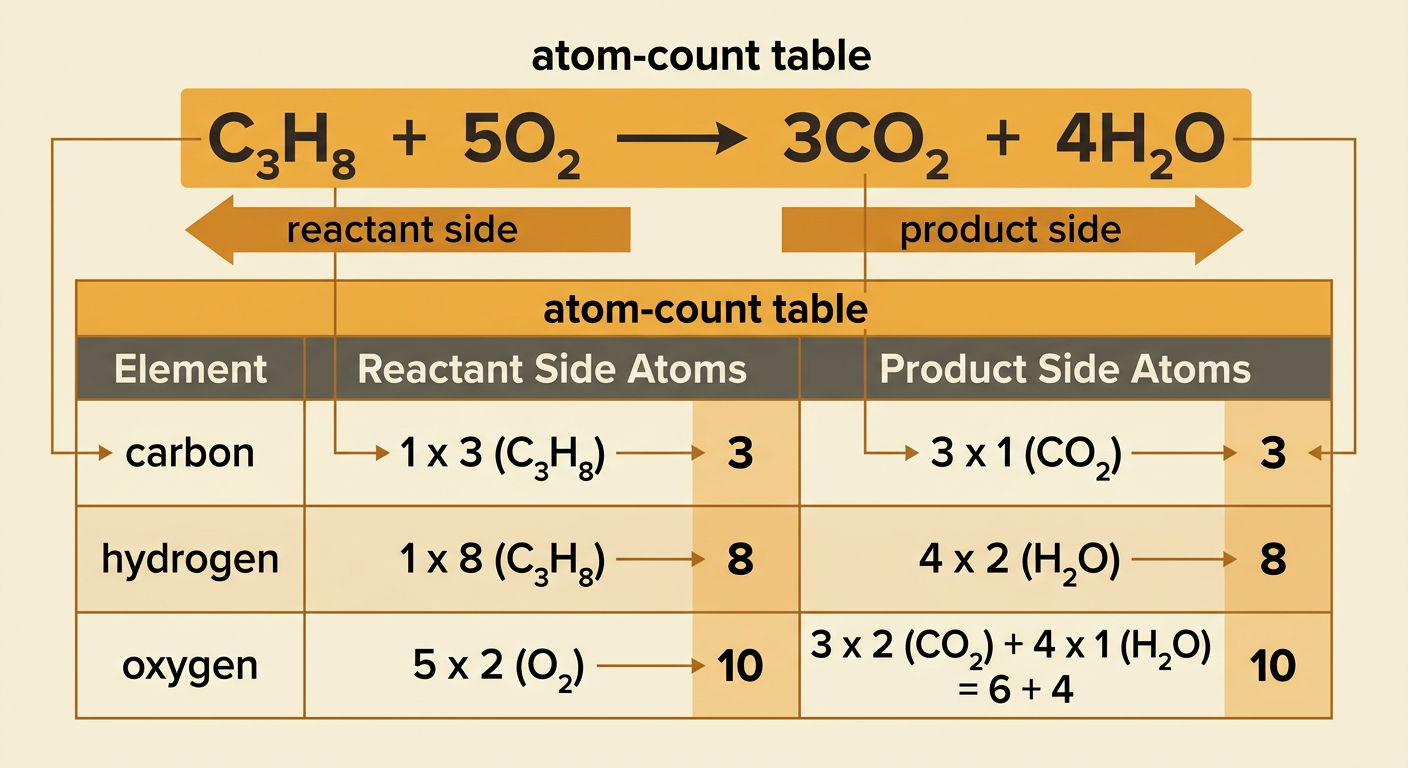
To test whether an equation is balanced, count each element separately on both sides. A table can prevent missed atoms and calculation errors. Consider propane combustion: C₃H₈ + 5O₂ → 3CO₂ + 4H₂O. On the reactant side, C₃H₈ contains three carbon atoms and eight hydrogen atoms. The coefficient 5 gives 5 × 2, or ten, oxygen atoms. On the product side, 3CO₂ contains three carbon atoms and six oxygen atoms. The term 4H₂O contains eight hydrogen atoms and four oxygen atoms. Together, the products contain ten oxygen atoms. The totals are therefore three carbon, eight hydrogen, and ten oxygen atoms on each side. When counting, multiply each subscript by the coefficient. If no coefficient or subscript is written, its value is understood to be one.
Balancing Equations with Coefficients
Balancing an equation means choosing coefficients so that each element has equal atom totals on both sides. Begin with Fe + O₂ → Fe₂O₃. Oxygen appears in groups of two on the left and three on the right. Placing a coefficient of 2 before Fe₂O₃ gives six oxygen atoms on the product side. If x is the coefficient of O₂, the equation 2x = 6 shows that x = 3. The products now contain four iron atoms, so place a coefficient of 4 before Fe. The balanced equation is 4Fe + 3O₂ → 2Fe₂O₃. Check the result: both sides contain four iron atoms and six oxygen atoms. Change only coefficients when balancing. Changing Fe₂O₃ to another subscript would change the identity of the product rather than the amount of that substance.

Explaining Conservation of Mass
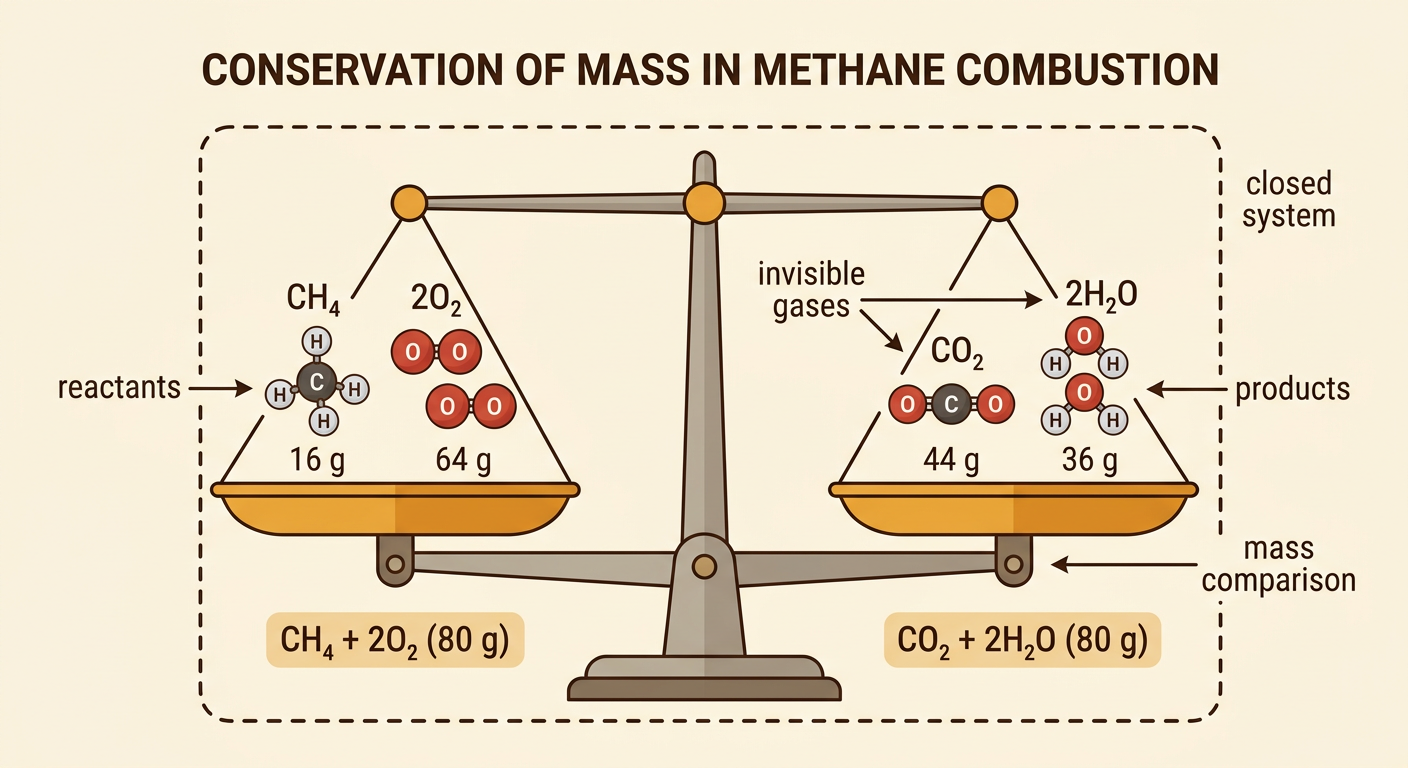
Because atoms are conserved during a chemical reaction, their total mass is also conserved in a closed system. Consider methane combustion: CH₄ + 2O₂ → CO₂ + 2H₂O. Using approximate molar masses, the reactants have 16 grams per mole of methane plus 64 grams for two moles of oxygen, totaling 80 grams. The products have 44 grams per mole of carbon dioxide plus 36 grams for two moles of water, also totaling 80 grams. This mathematical evidence supports the claim that mass is conserved. Someone might argue that burning sometimes leaves less visible material than was present at the start. However, that observation is weak evidence against conservation if the system is open, because gases may escape. A fair mass comparison must include every reactant and product, including invisible gases, within the defined system.