Conservation of Mass in Chemical Reactions
Students use balanced chemical equations and particle models to explain how atoms are rearranged while total mass remains constant during a chemical reaction.

Illustrations are auto-generated and may be placeholders. They can be refreshed to match the narration.
Matter Before and After a Reaction
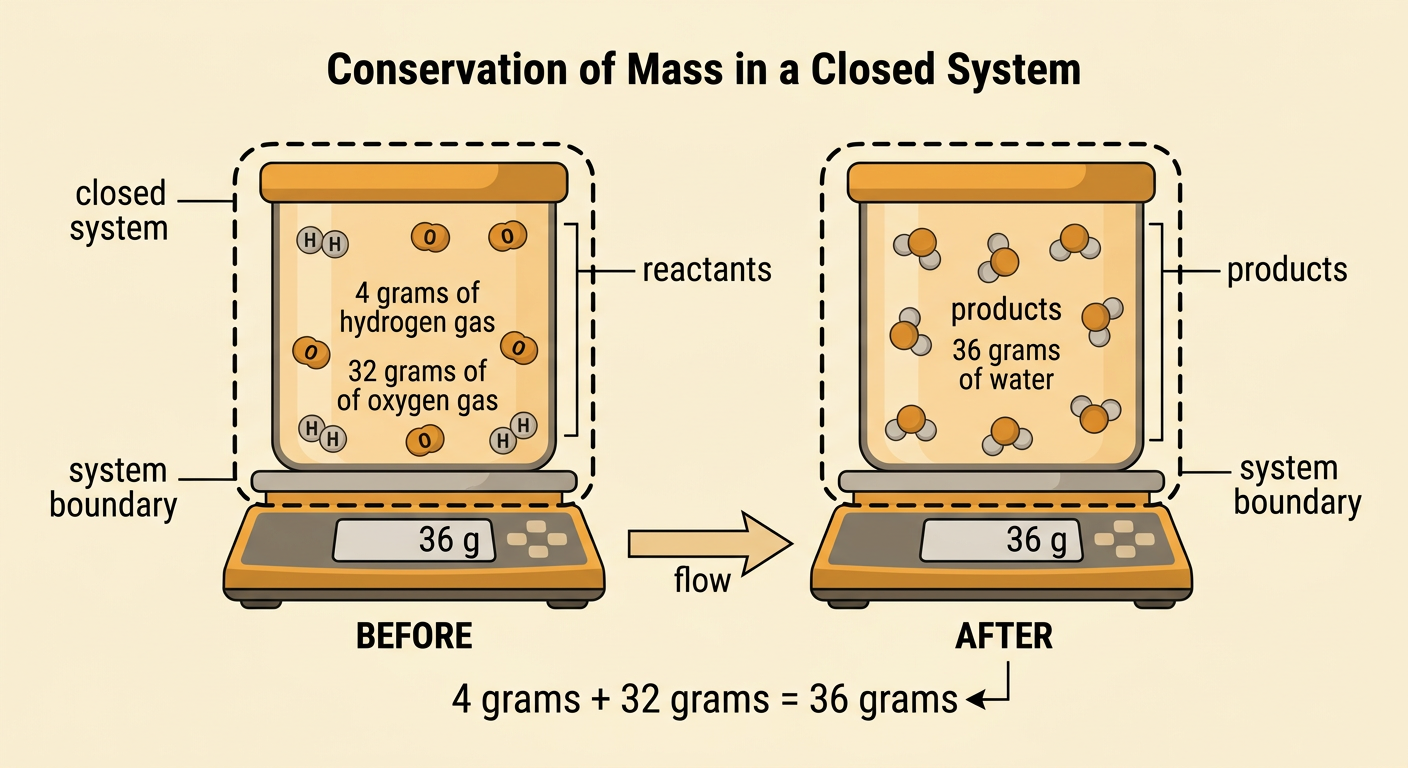
A chemical reaction changes substances into different substances, but it does not change the total amount of matter in a closed system. A closed system prevents matter from entering or leaving. For example, suppose 4 grams of hydrogen gas react completely with 32 grams of oxygen gas inside a sealed container. The reaction produces 36 grams of water. The atoms are combined differently after the reaction, but the total mass remains 4 grams + 32 grams = 36 grams. If the container were open, a gas might escape and make the measured mass appear to decrease. That would not mean matter was destroyed; it would mean some matter left the system. Comparing mass accurately therefore requires identifying the system boundary and accounting for every reactant and product.
Atoms Are Rearranged, Not Created
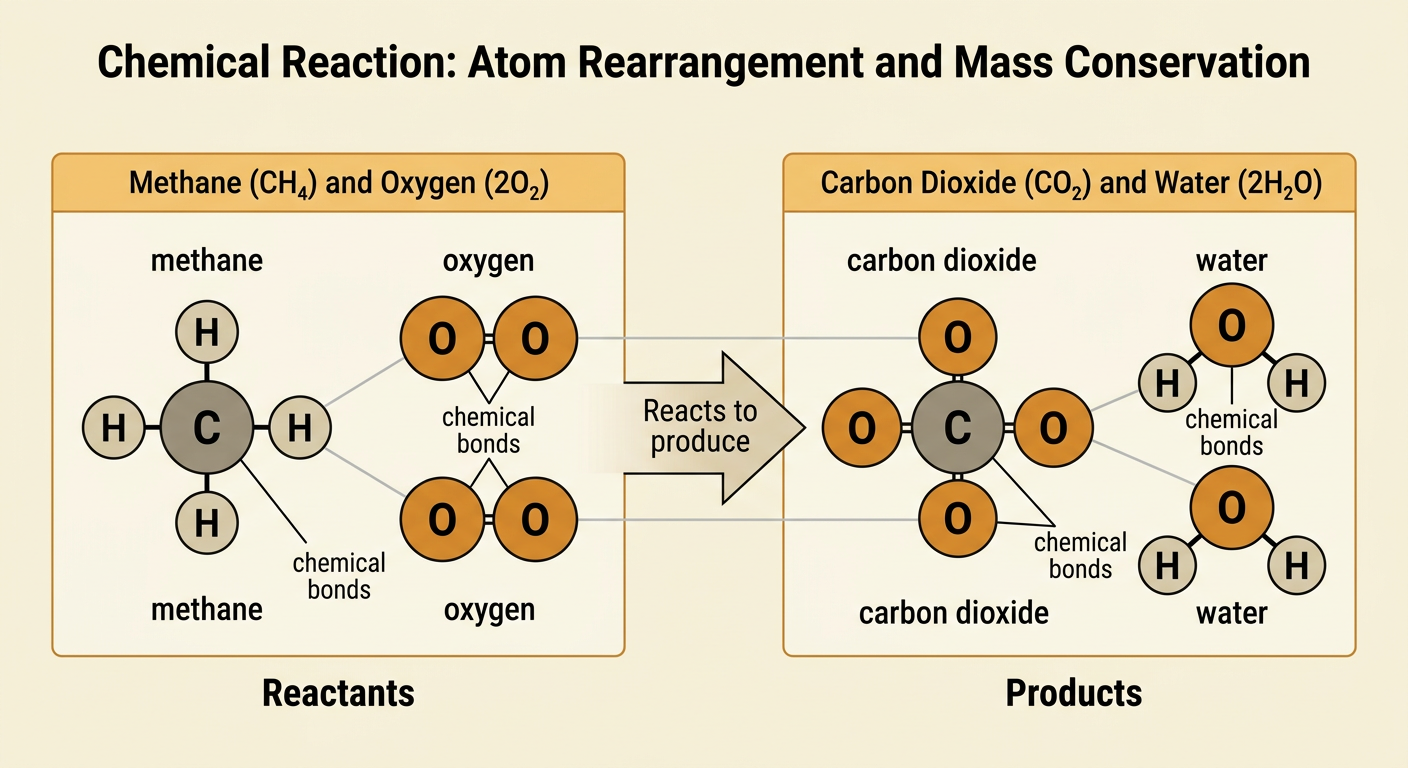
During a chemical reaction, chemical bonds break and new bonds form. The atoms themselves are not created, destroyed, or changed into other elements. Consider methane combustion: CH₄ + 2O₂ → CO₂ + 2H₂O. Before the reaction, one carbon atom is bonded to four hydrogen atoms in methane, while four oxygen atoms are paired in two oxygen molecules. After the reaction, the carbon atom is part of carbon dioxide, and the hydrogen atoms are part of two water molecules. Both sides contain one carbon atom, four hydrogen atoms, and four oxygen atoms. Only the groupings and bonds have changed. Because each type and number of atom remains the same, the total mass of those atoms also remains the same.
Reading Particle Models
Particle models represent atoms as circles and molecules as groups of connected circles. To interpret a model, identify each element, count every atom, and compare the totals before and after the reaction. For example, the reaction 2CO + O₂ → 2CO₂ can be pictured with two carbon monoxide molecules and one oxygen molecule before the reaction. This gives two carbon atoms and four oxygen atoms altogether. After the reaction, two carbon dioxide molecules still contain two carbon atoms and four oxygen atoms. The number of molecules changes from three to two, but the number of each type of atom does not change. A correct particle model must show whole particles, match the balanced equation, and contain equal atom counts on both sides of the reaction arrow.

Balancing Chemical Equations
A balanced chemical equation uses coefficients to show amounts that conserve every type of atom. Begin with the correct chemical formulas, count the atoms on both sides, and then adjust coefficients in front of the formulas. For iron reacting with oxygen, the unbalanced equation is Fe + O₂ → Fe₂O₃. The balanced equation is 4Fe + 3O₂ → 2Fe₂O₃. The reactant side now has four iron atoms and six oxygen atoms. The product side also has four iron atoms and six oxygen atoms. Never change a subscript to balance an equation because a subscript is part of a substance’s chemical identity. Changing Fe₂O₃ to another formula would describe a different compound. Coefficients change the number of particles or formula units without changing the substances involved.

Applying Conservation of Mass
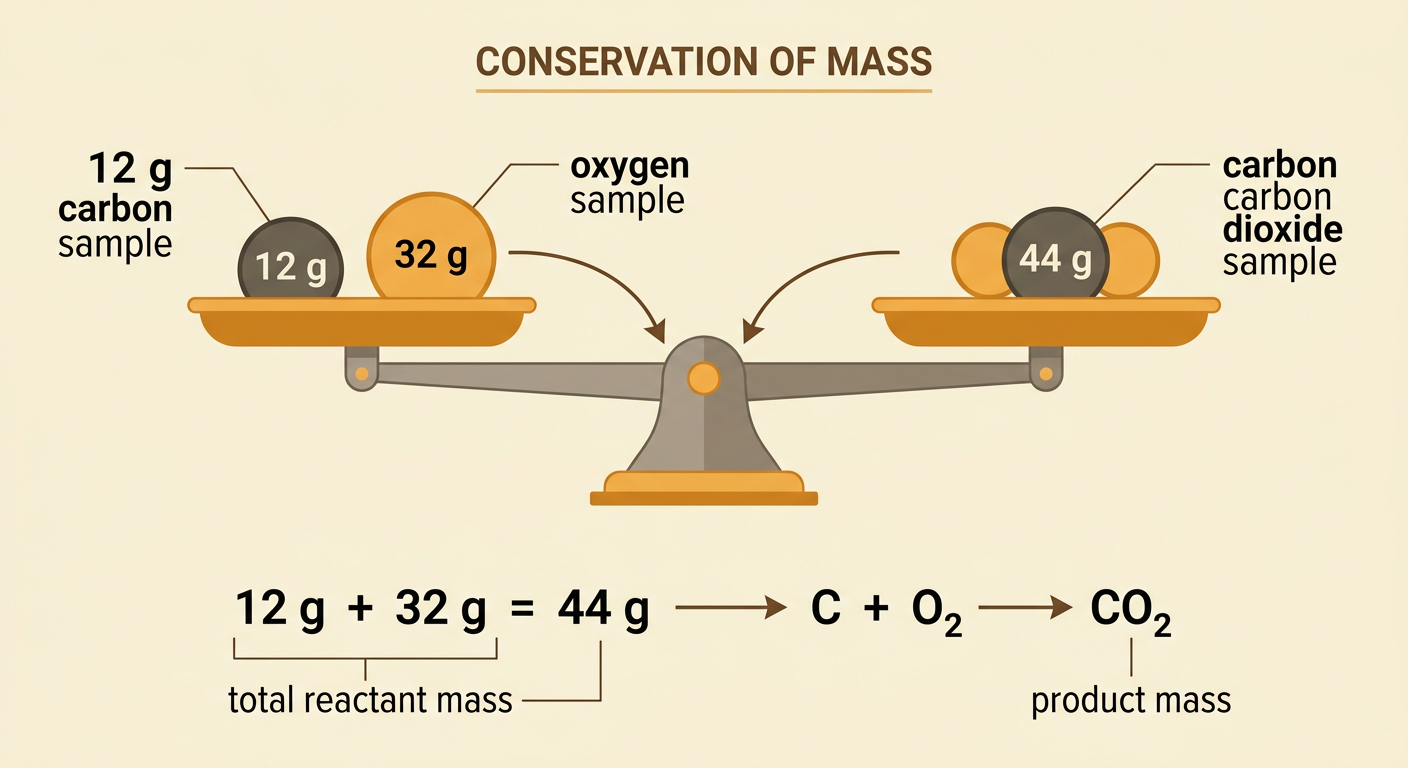
Conservation of mass can be used as a mathematical representation to predict an unknown mass. In the balanced reaction C + O₂ → CO₂, 12 grams of carbon react completely with 32 grams of oxygen to produce carbon dioxide. Let x represent the product mass. Conservation of mass gives 12 g + 32 g = x, so x = 44 g of carbon dioxide. The calculation works because the equation shows one carbon atom and two oxygen atoms on each side. The same reasoning applies when there are several products: the total mass of all reactants must equal the total mass of all products in a closed system. If one product’s mass is unknown, subtract the known product masses from the total reactant mass. Always include gases and other materials that may be easy to overlook.