
Conservation of Mass in Chemical Reactions
Students analyze mass data from a closed-system reaction, balance a chemical equation, and use evidence to explain why matter is conserved.
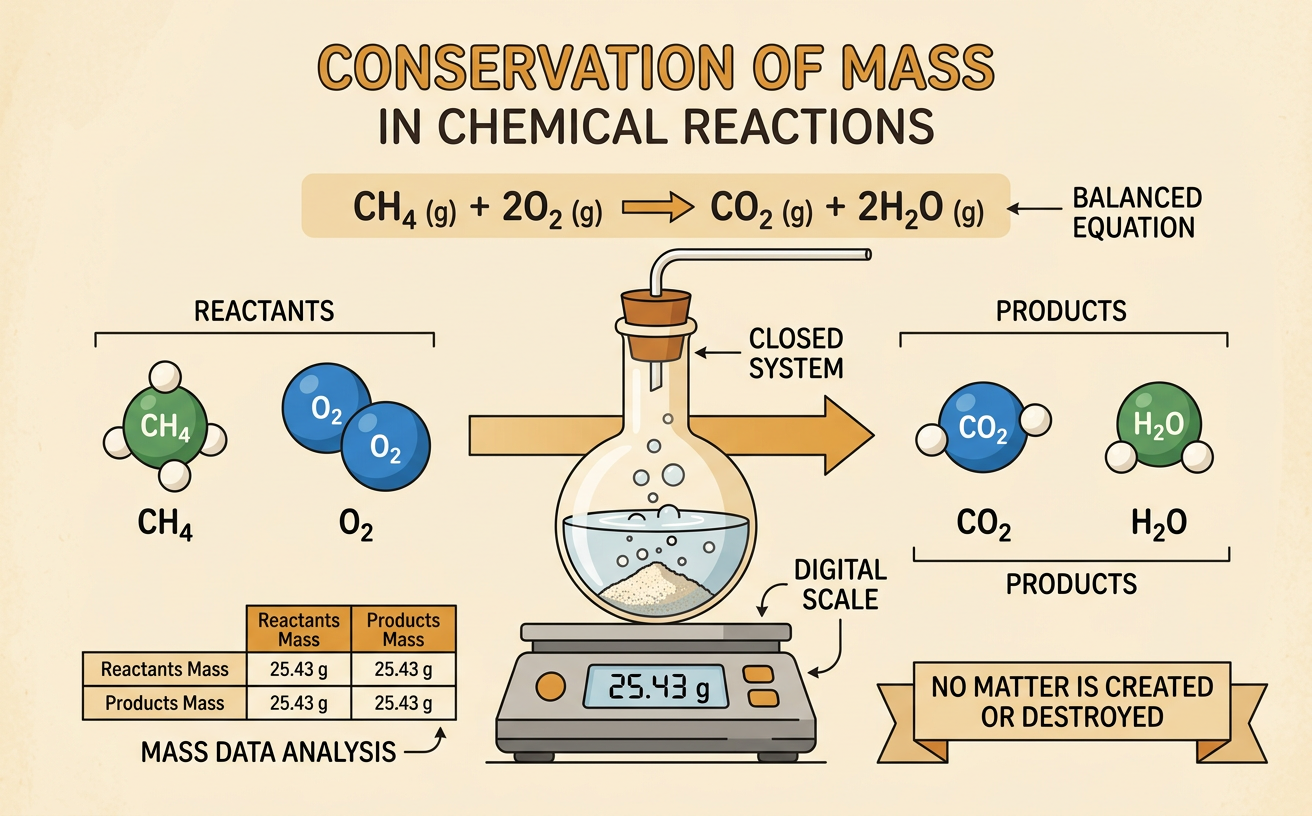
Illustrations are auto-generated and may be placeholders. They can be refreshed to match the narration.
Reactant and Product Mass
Reactants are the starting substances in a chemical reaction, and products are the substances formed. During a reaction, atoms are rearranged but are not created or destroyed. Therefore, the total mass of the reactants equals the total mass of the products when all matter is measured. For example, hydrogen gas reacts with oxygen gas to form water. If 4.0 grams of hydrogen reacts completely with 32.0 grams of oxygen, the total reactant mass is 36.0 grams. The reaction produces 36.0 grams of water. Include units in every calculation: 4.0 g + 32.0 g = 36.0 g. Equal masses do not mean that each substance has the same mass. They mean that the combined mass before the reaction matches the combined mass after the reaction.

Closed-System Data
A closed system prevents matter from entering or leaving during a reaction. This allows a fair comparison of mass before and after the reaction. Suppose students place vinegar and baking soda in a sealed plastic bag without mixing them. They measure the sealed setup and record 125.6 grams. Next, they mix the substances while keeping the bag sealed. Bubbles form because carbon dioxide gas is produced, but the gas remains inside the bag. After the reaction, the setup still has a mass of 125.6 grams. A useful procedure is to seal the system, measure the initial mass, mix the reactants, wait for the reaction to finish, and measure the final mass using the same balance. If the bag were open, escaping carbon dioxide could make the measured final mass appear smaller.

Counting Atoms
Chemical formulas show which atoms are present and how many of each are in one particle. A subscript applies to the element immediately before it. In H2O, the subscript 2 means that each water molecule contains two hydrogen atoms and one oxygen atom. A coefficient multiplies the entire formula. Therefore, 2H2O contains four hydrogen atoms and two oxygen atoms. Consider the unbalanced statement H2 + O2 → H2O. The reactant side has two hydrogen atoms and two oxygen atoms, while the product side has two hydrogen atoms and only one oxygen atom. This count shows that the equation is not yet balanced. An atom inventory table helps prevent mistakes: list each element, count its atoms on both sides, and compare the totals before changing any coefficients.

Balancing the Equation
A balanced chemical equation has the same number of atoms of each element on both sides. Balance an equation by changing coefficients, never subscripts. Changing a subscript would change the identity of a substance. Start with H2 + O2 → H2O. Place a coefficient of 2 before H2O so that the product side has two oxygen atoms: H2 + O2 → 2H2O. The product side now has four hydrogen atoms, so place a coefficient of 2 before H2. The balanced equation is 2H2 + O2 → 2H2O. Check the result: both sides contain four hydrogen atoms and two oxygen atoms. The coefficients also represent proportional amounts. Two moles of hydrogen react with one mole of oxygen to produce two moles of water.

Evidence-Based Conservation Claim
A strong scientific argument includes a claim, evidence, and reasoning. Claim: Mass is conserved when hydrogen and oxygen react in a closed system. Evidence: The reactants have a total mass of 4.0 g + 32.0 g = 36.0 g, and the water product has a mass of 36.0 g. The balanced equation, 2H2 + O2 → 2H2O, also shows four hydrogen atoms and two oxygen atoms before and after the reaction. Reasoning: Because the same types and numbers of atoms remain present, the total mass remains constant. The atoms are rearranged into new molecules rather than created or destroyed. The claim should also address measurement conditions. If a measured mass changes in an open container, matter may have entered or escaped, so that observation does not disprove conservation of mass.
