Conserving Matter During Changes
Students use measurements before and after a physical change to show that the total amount of matter remains the same.

Illustrations are auto-generated and may be placeholders. They can be refreshed to match the narration.
The Conservation Question
Matter is anything that has mass and takes up space. The law of conservation of matter says that matter does not disappear during a physical change. We can test this idea by measuring a closed system before and after a change. Imagine placing several ice cubes in a sealed plastic bag. The investigation question is: Will the total mass change when the ice melts? The ice changes from solid water to liquid water, but the bag keeps all the water inside. A balance can measure the mass of the sealed bag and its contents in grams. A fair test uses the same bag, balance, and measurement unit both times. If the measurements are equal, they provide evidence that the total amount of matter was conserved.

Measure the Starting Matter
Begin by measuring all the matter that will be part of the investigation. Place three ice cubes in a dry plastic bag, push out extra air, and seal the bag tightly. Put the sealed bag on a digital balance and record the mass. Suppose the display reads 120 grams. This starting mass includes the ice, the bag, and the air trapped inside. Do not remove or add anything after making this measurement. Record the unit as well as the number because 120 without a unit is unclear. If results must be reported in kilograms, convert within the metric system: 1,000 grams equals 1 kilogram, so 120 grams equals 0.12 kilogram. Careful measurement creates reliable evidence for comparing the system before and after the change.

Change Without Losing Matter
Leave the sealed bag in a warm place until all the ice melts. Melting is a physical change because the water changes state from solid to liquid but remains the same substance. Keep the bag sealed while the change happens. If water leaks out or evaporated water escapes, the system is no longer closed and the comparison will not include all the original matter. After melting, dry any moisture from the outside of the bag without opening it. Then place the same sealed bag on the same balance. Suppose the balance again reads 120 grams. The shape, movement, and state of the water have changed, but no matter entered or left the bag. This controlled procedure makes the before-and-after measurements useful evidence.

Compare Before-and-After Data
Organize the measurements so the result is easy to see. A data table can list 120 grams before melting and 120 grams after melting. Find the difference by subtracting: 120 grams minus 120 grams equals 0 grams. A difference of zero means the measured mass did not change. You can also make a bar graph with one bar for “Before melting” and another for “After melting.” Both bars should reach 120 grams on the vertical scale. Label the graph’s axes and use equal intervals, such as 20 grams. The table gives exact values, while the graph makes the equal measurements easy to compare. Repeated trials with similar results would provide even stronger evidence that matter is conserved during melting.

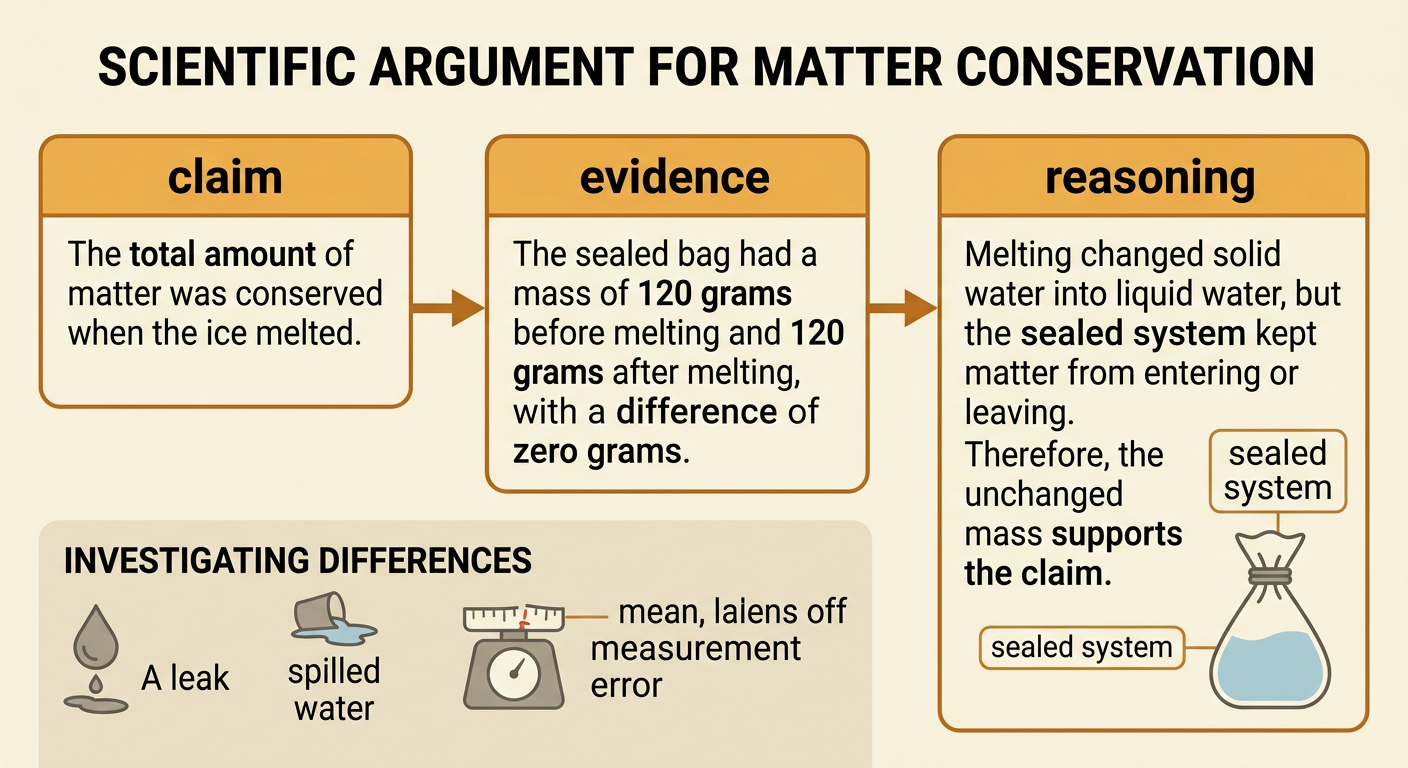
Explain the Results with Evidence
A strong scientific argument includes a claim, evidence, and reasoning. The claim can be: The total amount of matter was conserved when the ice melted. The evidence is that the sealed bag had a mass of 120 grams before melting and 120 grams after melting, for a difference of 0 grams. The reasoning connects the evidence to the science idea: melting changed water from a solid to a liquid, but the sealed system prevented matter from entering or leaving. Therefore, the unchanged mass supports the claim. Share the argument with classmates and consider their questions. If another group recorded a small difference, examine possible causes such as a leak, spilled water, or measurement error. Revising an explanation after considering evidence helps make the argument more accurate and convincing.