
Coordinate Proofs in Geometry
Students use slopes, distances, and midpoints to prove geometric properties of figures represented on the coordinate plane.
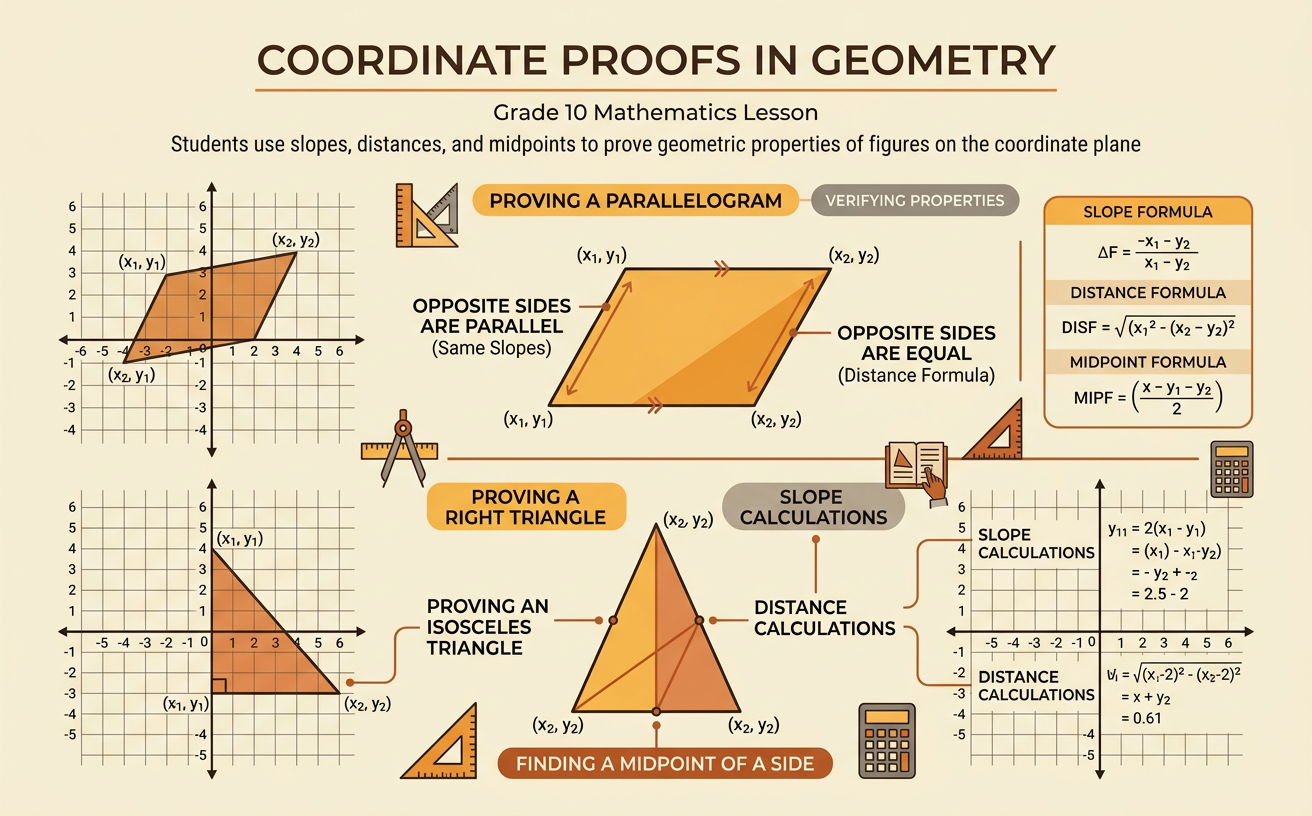
Illustrations are auto-generated and may be placeholders. They can be refreshed to match the narration.
Coordinate Proof Strategy
A coordinate proof translates a geometric claim into algebra. First, plot and label every given point. Next, identify what must be proved and choose the appropriate formula: slope for parallel or perpendicular lines, distance for congruent segments, and midpoint for bisected segments. Show substitutions and simplify carefully before connecting the results to a geometric definition or theorem. For example, let A(0, 0), B(4, 1), C(6, 4), and D(2, 3) be the vertices of quadrilateral ABCD. The slopes of AB and DC are both 1/4. The slopes of BC and AD are both 3/2. Therefore, both pairs of opposite sides are parallel. By the definition of a parallelogram, ABCD is a parallelogram. A complete coordinate proof always ends by explaining what the calculations establish.
Slope and Parallel Lines
Slope measures a line’s vertical change compared with its horizontal change. For points (x₁, y₁) and (x₂, y₂), calculate slope as (y₂ − y₁)/(x₂ − x₁). Distinct nonvertical lines are parallel when their slopes are equal. Consider quadrilateral PQRS with P(−3, 1), Q(3, 3), R(5, 7), and S(−1, 5). The slope of PQ is (3 − 1)/(3 − (−3)) = 2/6 = 1/3. The slope of SR is (7 − 5)/(5 − (−1)) = 2/6 = 1/3. Because PQ and SR have the same slope and lie on different lines, PQ is parallel to SR. This calculation proves that the quadrilateral has one pair of parallel opposite sides, an important part of proving that it is a trapezoid.
Perpendicular Slopes
Two nonvertical lines are perpendicular when their slopes are negative reciprocals. This means their product is −1. Horizontal and vertical lines are also perpendicular, although a vertical line’s slope is undefined. For example, use A(−1, 1), B(3, 3), and C(4, 1). The slope of AB is (3 − 1)/(3 − (−1)) = 2/4 = 1/2. The slope of BC is (1 − 3)/(4 − 3) = −2/1 = −2. Since 1/2 and −2 are negative reciprocals and their product is −1, AB is perpendicular to BC. Therefore, angle ABC is a right angle, and triangle ABC is a right triangle. Notice that the right angle is at B because segments AB and BC meet there.
Distance and Congruent Segments
The distance formula proves that segments are congruent by showing that they have equal lengths. For endpoints (x₁, y₁) and (x₂, y₂), the distance is the square root of (x₂ − x₁)² + (y₂ − y₁)². Consider triangle ABC with A(0, 4), B(−3, 0), and C(3, 0). The length AB is √[(−3 − 0)² + (0 − 4)²] = √(9 + 16) = 5. The length AC is √[(3 − 0)² + (0 − 4)²] = √(9 + 16) = 5. Because AB and AC have equal lengths, they are congruent. Therefore, triangle ABC is isosceles, with base BC. The distance formula provides algebraic evidence for the congruence instead of relying on how the drawing appears.
Midpoints and Bisectors
A midpoint divides a segment into two congruent parts. The midpoint of endpoints (x₁, y₁) and (x₂, y₂) is ((x₁ + x₂)/2, (y₁ + y₂)/2). Midpoints can prove that diagonals bisect each other. Let A(0, 0), B(6, 2), C(8, 6), and D(2, 4) form quadrilateral ABCD. The midpoint of diagonal AC is ((0 + 8)/2, (0 + 6)/2) = (4, 3). The midpoint of diagonal BD is ((6 + 2)/2, (2 + 4)/2) = (4, 3). Since both diagonals have the same midpoint, each diagonal cuts the other into two equal parts. Thus, the diagonals bisect each other. By the converse of the parallelogram diagonals theorem, ABCD is a parallelogram.
Writing the Conclusion
The conclusion of a coordinate proof must connect the algebraic results to a geometric definition or theorem. Do not end with only a list of slopes, distances, or midpoints. State what each calculation proves and why that evidence establishes the desired claim. For example, let A(1, 1), B(5, 1), C(5, 4), and D(1, 4). Segments AB and CD are horizontal, so they are parallel. Segments BC and AD are vertical, so they are parallel. Thus, ABCD is a parallelogram. In addition, horizontal AB is perpendicular to vertical BC, so angle ABC is a right angle. A parallelogram with one right angle is a rectangle. Therefore, ABCD is a rectangle. This final sentence completes the logical chain from coordinate calculations to the geometric classification.