
Cotton, Slavery, and the Transformation of the Antebellum South
Students examine how cotton production, technological change, forced migration, and enslaved labor reshaped the Southern economy, society, and environment before the Civil War.

Illustrations are auto-generated and may be placeholders. They can be refreshed to match the narration.
The Cotton Gin and Rising Demand
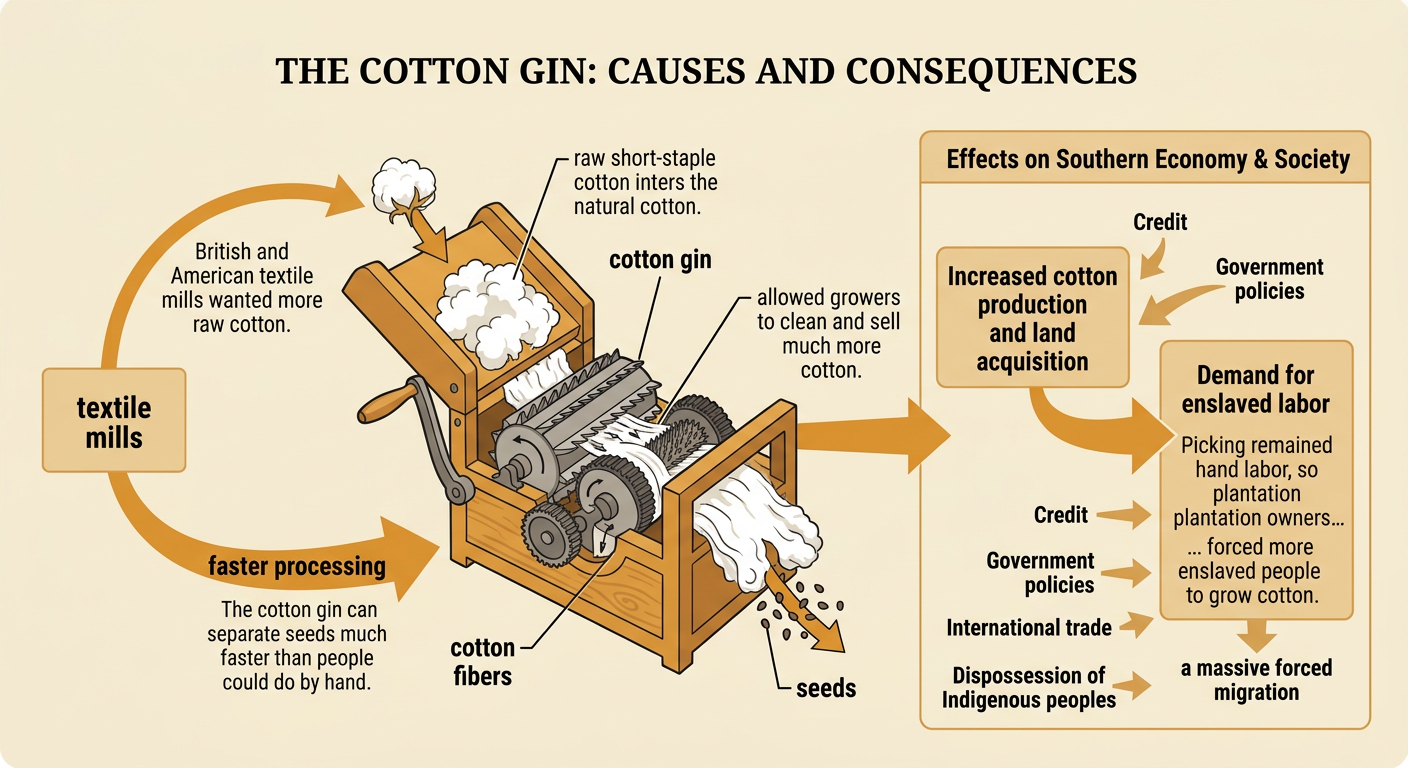
Before the 1790s, removing sticky seeds from short-staple cotton was slow work. In 1793, Eli Whitney developed a cotton gin, later patented in 1794, that used rotating parts to separate cotton fibers from seeds much faster than workers could do by hand. At the same time, British and American textile mills demanded more raw cotton. Together, faster processing and rising demand made cotton increasingly profitable. Plantation owners responded by acquiring more land and forcing more enslaved people to plant and pick cotton. The gin did not reduce the need for enslaved field labor; it increased the amount of cotton that could be processed and sold. Technology alone did not cause this expansion. Credit, available land, international markets, government policies, and the dispossession of Indigenous peoples also contributed.
Expansion of Slavery and Forced Migration
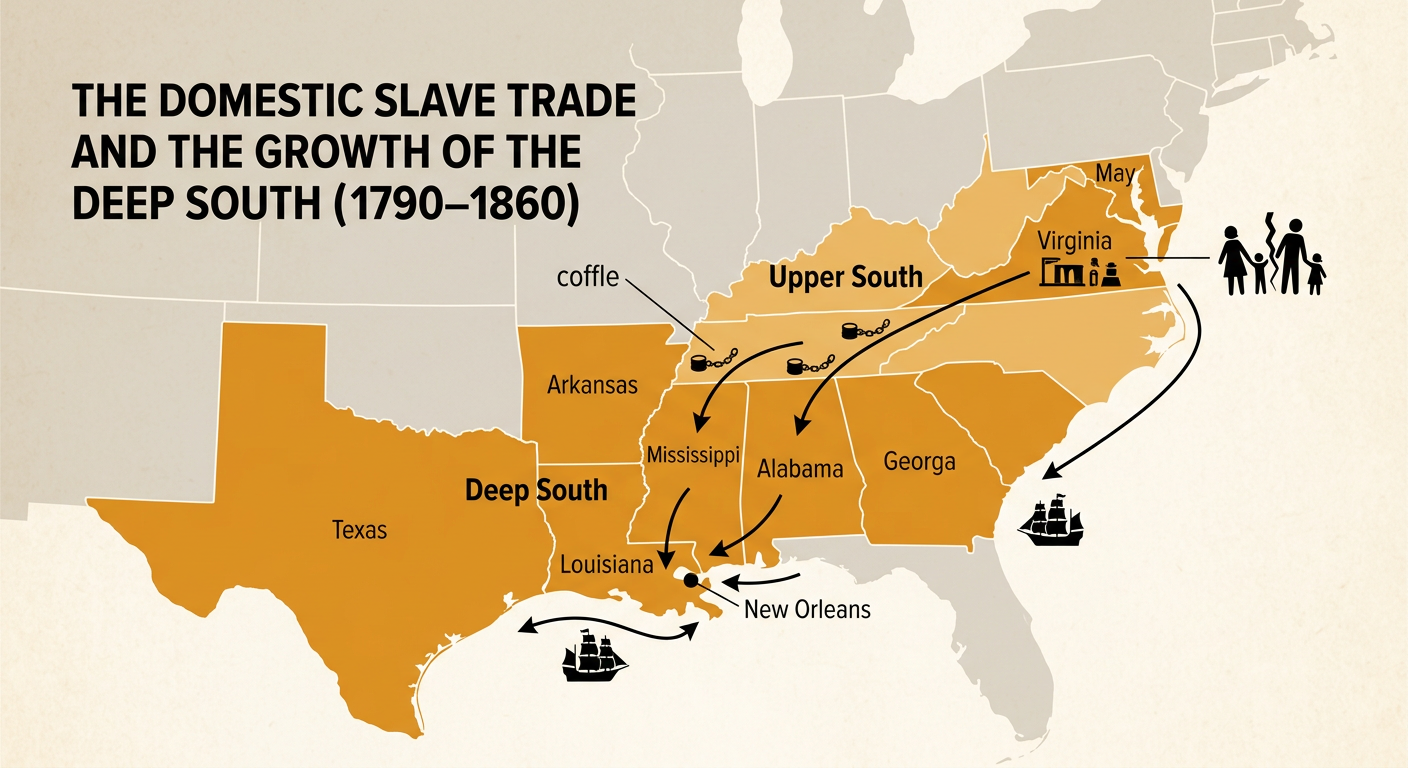
As cotton cultivation spread into Alabama, Mississippi, Louisiana, Arkansas, and Texas, enslavers demanded more labor in the Deep South. Between 1790 and 1860, roughly one million enslaved people were forcibly relocated from the Upper South through the domestic slave trade. Traders marched people south in chained groups called coffles or transported them by ship to ports such as New Orleans. Auctions and private sales separated spouses, parents, children, and communities. This migration was forced, not a voluntary movement to find work. For example, an enslaved person sold in Virginia might be taken hundreds of miles to a Mississippi cotton plantation with little chance of seeing family again. By 1860, nearly four million enslaved people lived in the United States, with large numbers concentrated across the expanding cotton-producing region.
Plantation Labor and Resistance
Cotton plantations depended on the knowledge and forced labor of enslaved people. Workers cleared land, planted seeds, removed weeds, picked cotton, operated gins, repaired tools, prepared food, and cared for children. On many large plantations, overseers organized field workers into gangs and enforced long hours or daily picking quotas through surveillance, threats, and violence. The cotton gin made cleaning cotton faster, but picking still had to be done by hand. Enslaved people resisted in many ways, including working more slowly, breaking tools, preserving family and religious traditions, learning in secret, escaping, and sometimes openly rebelling. Every form of resistance carried serious risks. In 1848, Ellen and William Craft escaped slavery in Georgia by using disguises and traveling publicly toward the North. Their escape shows how planning, courage, and cooperation could challenge enslavers’ control.

Cotton and the National Economy
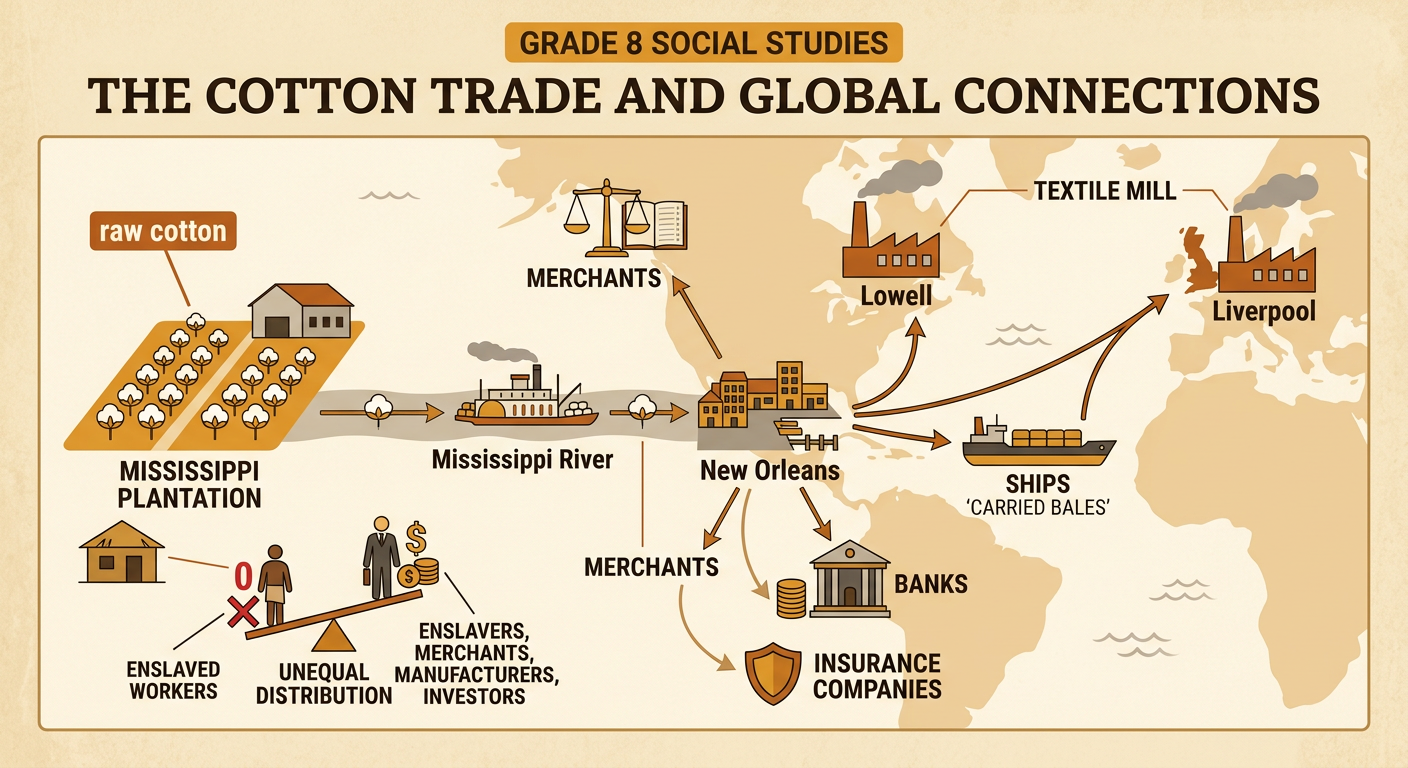
Cotton linked the Southern plantation economy to businesses across the United States and overseas. Southern plantations produced raw cotton, but Northern and British mills turned it into cloth. Merchants arranged sales, shipping companies carried bales, and banks and insurance firms financed or protected transactions. For example, cotton could travel from a Mississippi plantation down the Mississippi River to New Orleans, then by ship to a textile mill in Liverpool, England, or Lowell, Massachusetts. By the eve of the Civil War, cotton represented well over half the value of United States exports in some years. This wealth was distributed unequally: enslavers, merchants, manufacturers, and investors gained profits, while enslaved workers received no wages and remained legally treated as property. Cotton therefore tied many parts of the national economy to slavery, even where state law had ended slavery.
Soil Exhaustion and Land Expansion
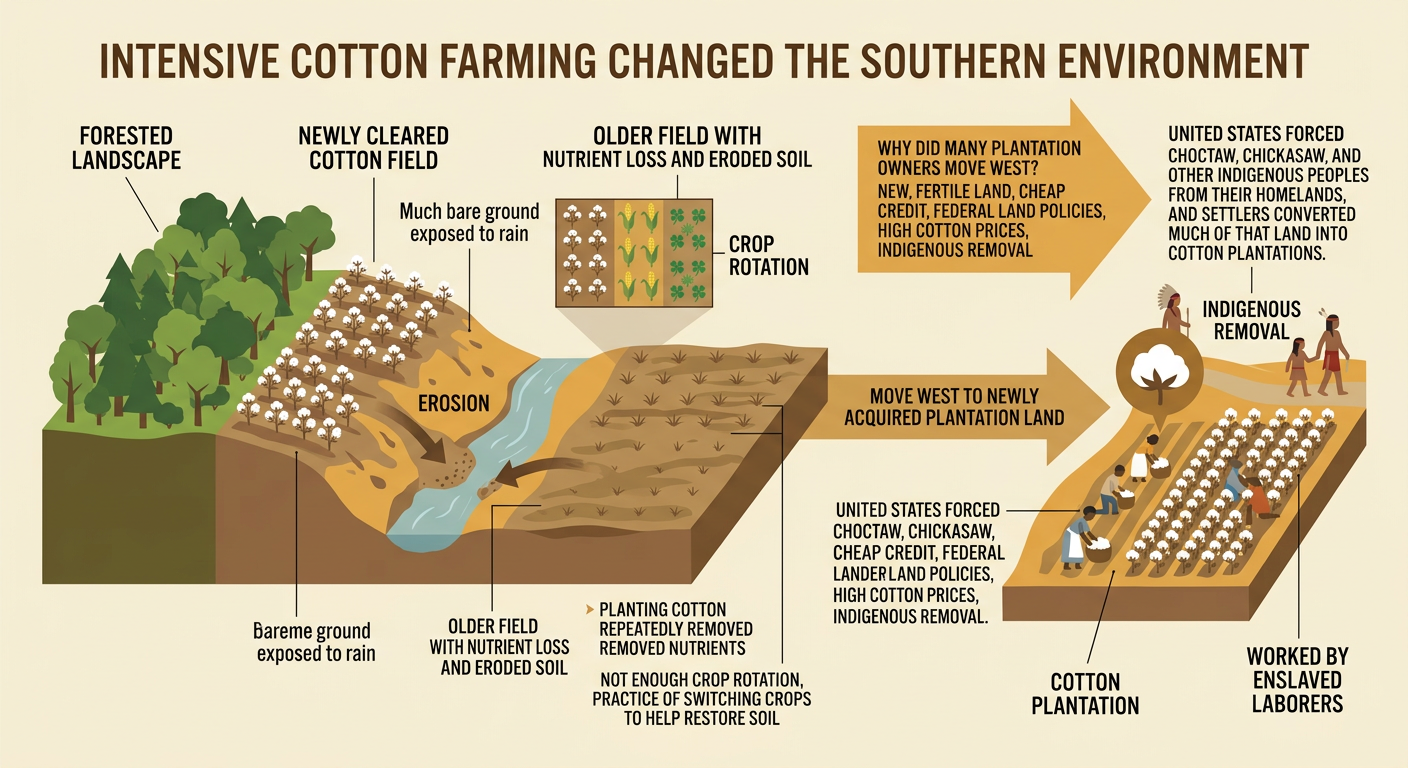
Intensive cotton farming transformed the Southern environment. Repeatedly planting cotton without enough crop rotation or soil restoration removed nutrients from the ground. Clearing forests exposed soil to heavy rain, increasing erosion and carrying sediment into streams. As yields declined on some older fields, plantation owners often sought new, fertile land farther west. High cotton prices, inexpensive credit, federal land policies, and the forced removal of Indigenous nations also encouraged this expansion. For example, after the United States forced many Choctaw and Chickasaw people from Mississippi, settlers and enslavers converted large areas into cotton plantations worked by enslaved laborers. Expanding production meant clearing more forests and consuming more soil and water resources. Evidence about land use, crop yields, population growth, and erosion can support an argument that growing human demand for cotton altered ecosystems as well as the economy.
Tracing Causes and Consequences
The growth of the Cotton South resulted from several connected causes rather than one invention or decision. Rising textile demand, the cotton gin, access to credit, fertile land, Indigenous dispossession, and laws protecting slavery made expansion possible. Major consequences included forced migration, family separation, plantation profits, national economic ties to slavery, and environmental damage. Historians test these connections by comparing sources. A cotton-gin patent can show technological change, census tables can show population patterns, sale advertisements can document the domestic slave trade, and plantation records can reveal production goals. For example, evidence that the enslaved population grew from about 700,000 in 1790 to nearly four million in 1860 supports a claim about slavery’s expansion, but it does not prove that the gin was the only cause. A strong argument cites specific evidence, considers each source’s purpose, and explains how multiple causes produced multiple effects.
