Coulomb’s Law and Electric Fields
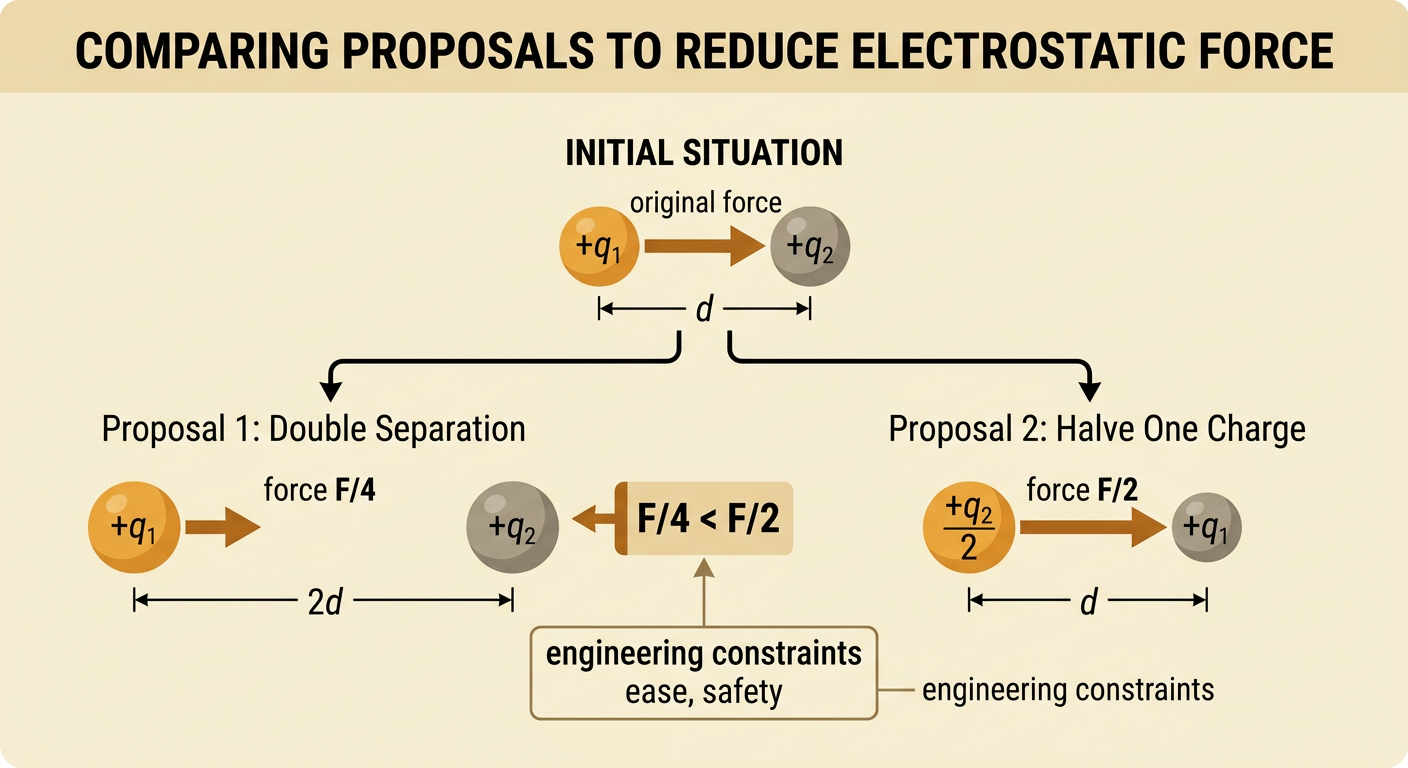
Students calculate electrostatic forces between charged objects and use electric-field diagrams to predict the direction and relative strength of forces on test charges.
Illustrations are auto-generated and may be placeholders. They can be refreshed to match the narration.
Charge, Attraction, and Repulsion
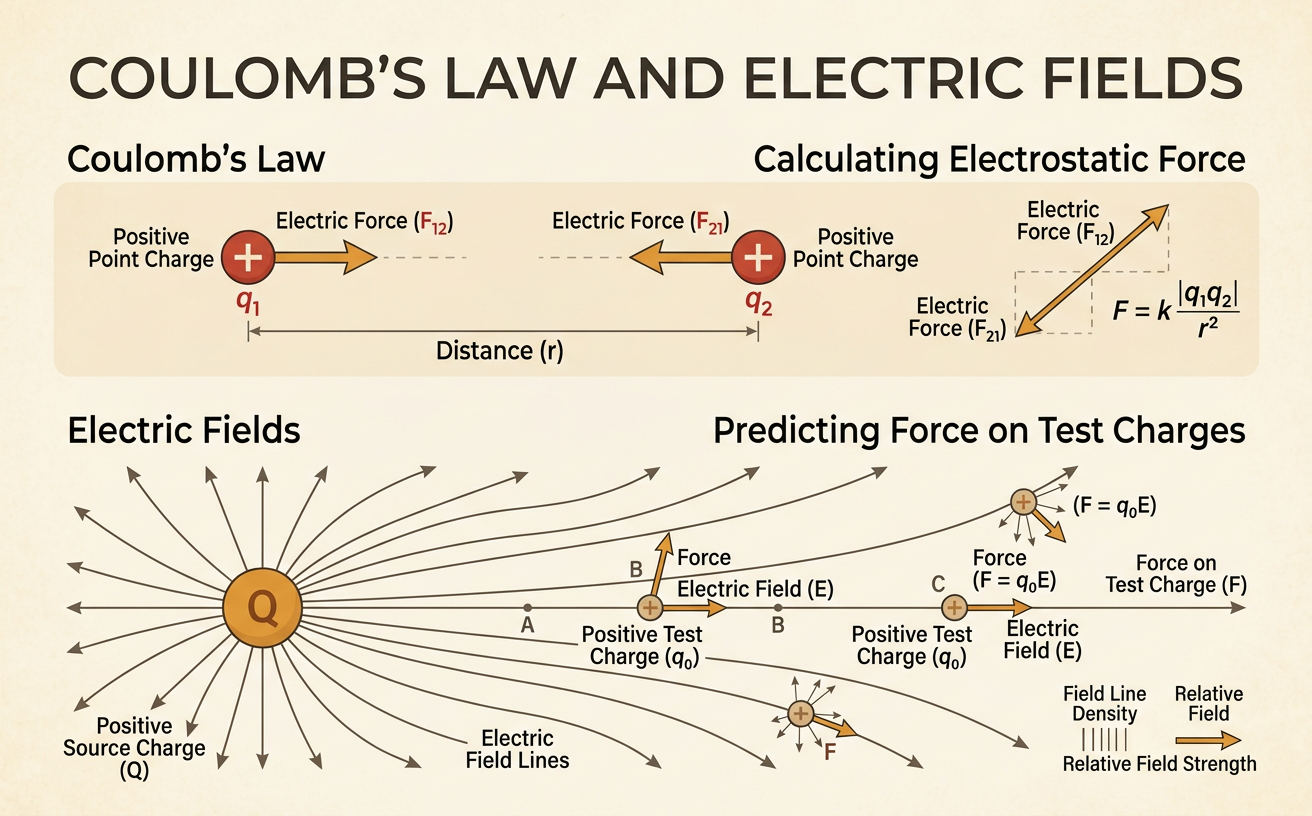
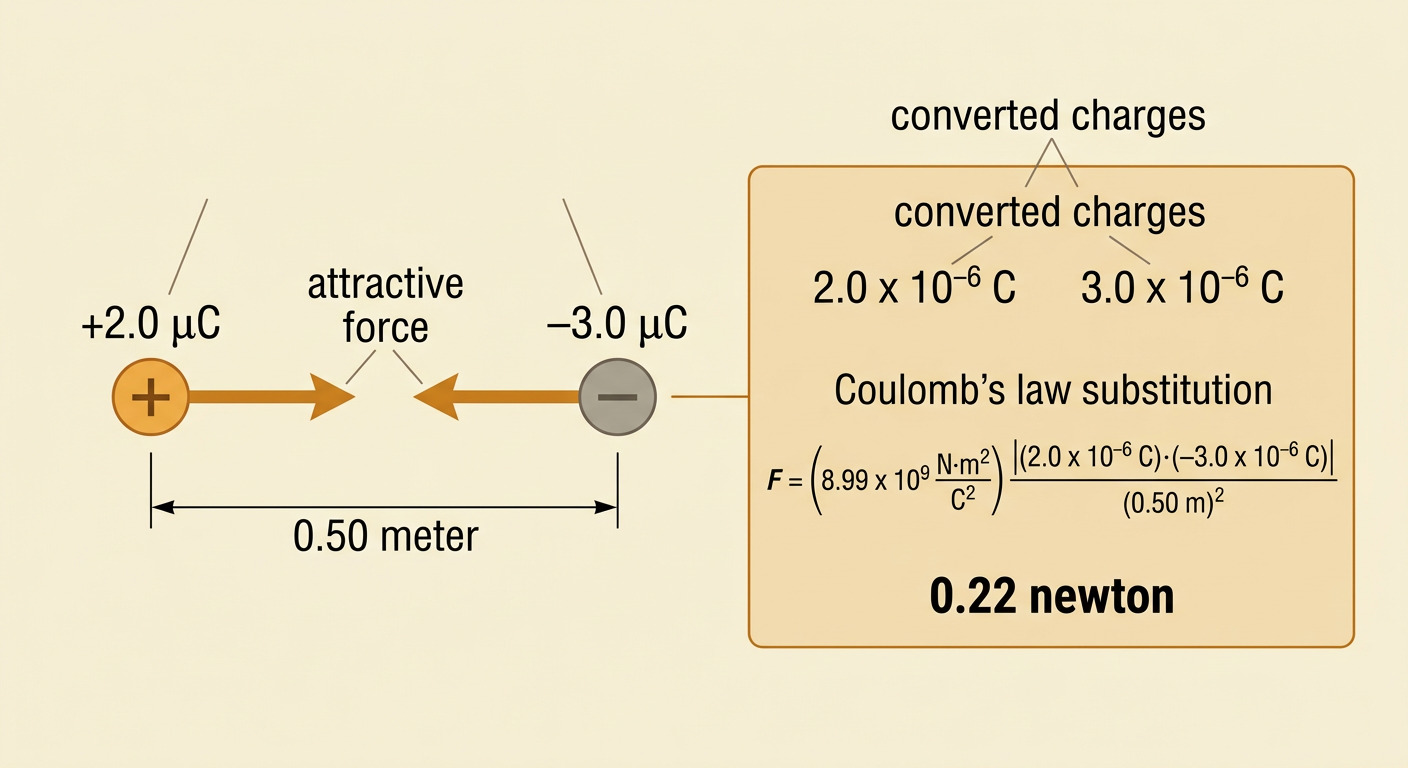
Electric charge is a property of matter that produces electric forces. Charge can be positive or negative and is measured in coulombs (C). Objects with charges of the same sign repel, while objects with charges of opposite signs attract. The forces on the two objects are always equal in magnitude and opposite in direction, consistent with Newton’s third law. For example, suppose two small spheres have charges of +2.0 μC and −3.0 μC. Each sphere experiences an attractive force directed toward the other sphere. If both spheres instead have positive charges, each force points away from the other sphere. An object can also be neutral, meaning its net charge is zero. However, a charged object may still attract a neutral object by shifting, or polarizing, the positive and negative charges within it.
Variables in Coulomb’s Law
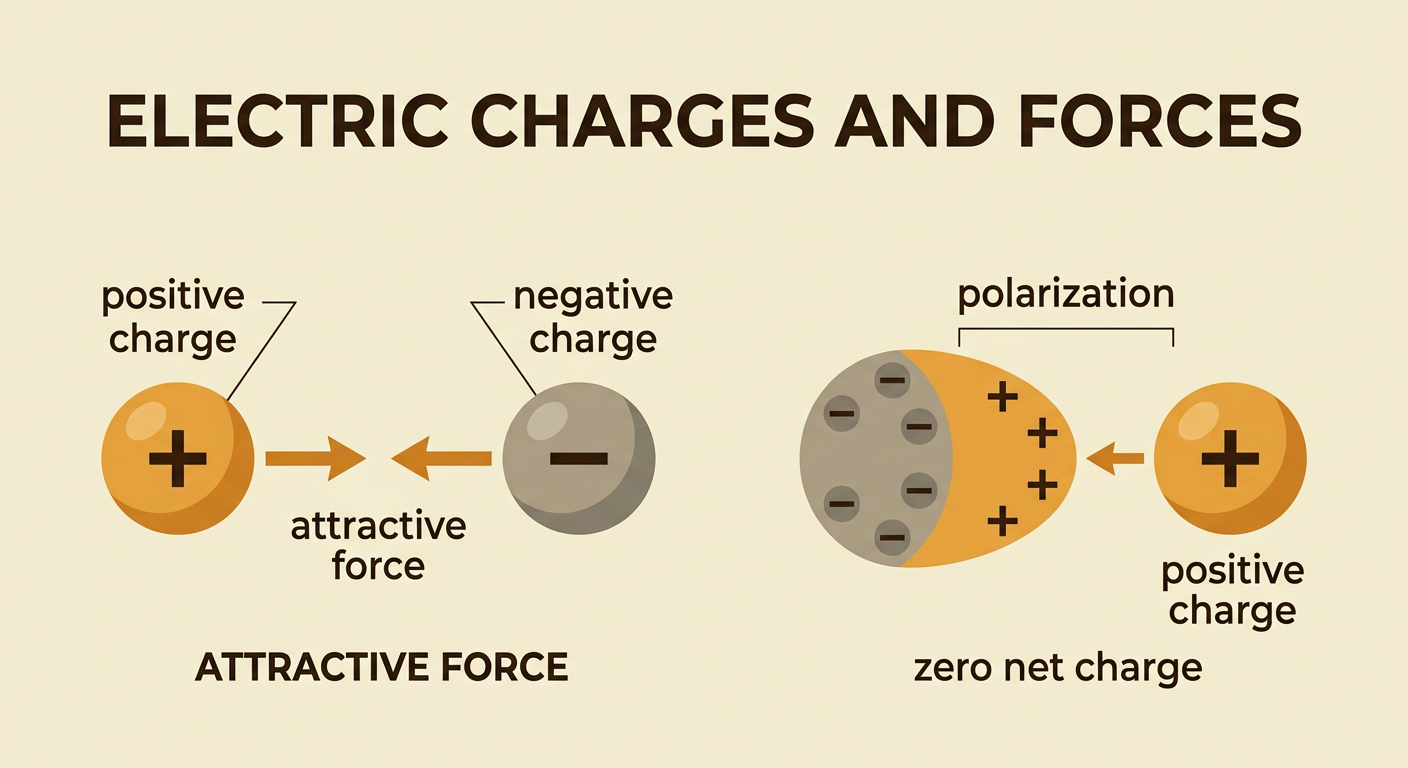
Coulomb’s law gives the magnitude of the electrostatic force between two point charges: F = k|q₁q₂|/r². In this equation, F is force in newtons, q₁ and q₂ are charges in coulombs, r is the distance between their centers in meters, and k is Coulomb’s constant, approximately 8.99 × 10⁹ N·m²/C². The absolute value makes the calculated magnitude positive; the charge signs determine whether the force is attractive or repulsive. Force is directly proportional to each charge and inversely proportional to the square of distance. For example, doubling one charge doubles the force. Doubling the distance reduces the force to one-fourth. The equation can be rearranged to highlight another quantity. To solve for distance, multiply by r², divide by F, and take the square root: r = √(k|q₁q₂|/F).
Calculating Electrostatic Force
To calculate electrostatic force, first convert all charges to coulombs and distance to meters. Consider charges q₁ = +2.0 μC and q₂ = −3.0 μC separated by 0.50 m. Convert the charges: 2.0 μC = 2.0 × 10⁻⁶ C and 3.0 μC = 3.0 × 10⁻⁶ C. Substitute their magnitudes into Coulomb’s law: F = (8.99 × 10⁹)(2.0 × 10⁻⁶)(3.0 × 10⁻⁶)/(0.50)². The result is about 0.22 N. Because the charges have opposite signs, the force is attractive. Each charge experiences a 0.22 N force toward the other charge. A useful check is to inspect units and direction: the units must simplify to newtons, and unlike charges must attract. Rounding should reflect the least precise measurement.
Mapping Electric Fields
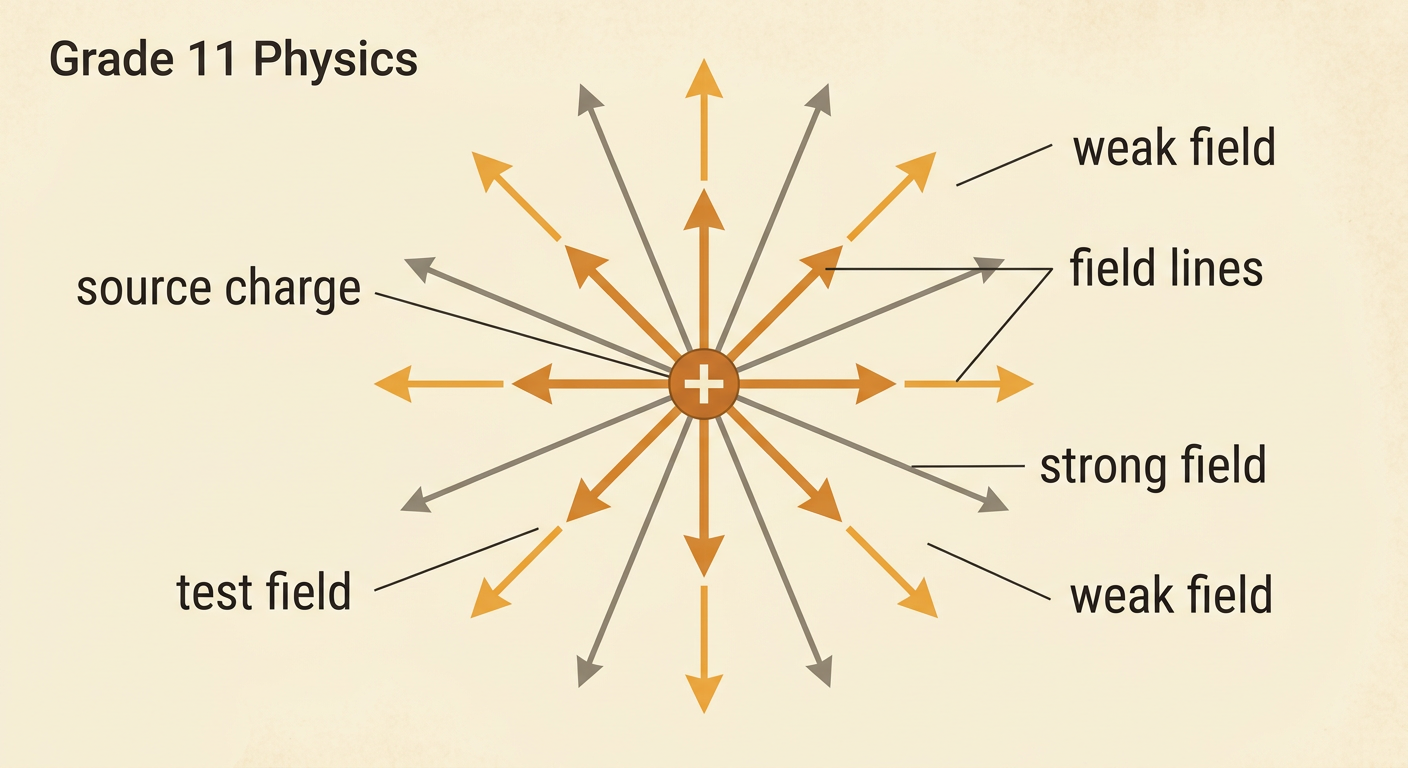
An electric field describes how a source charge affects the space around it. The electric field at a location is defined as force per unit positive test charge: E = F/q. Its units are newtons per coulomb (N/C). Electric-field arrows point in the direction a positive test charge would be pushed. Therefore, field lines point away from positive source charges and toward negative source charges. Lines never cross because the field has only one direction at any point. A greater density of lines represents a stronger field, although the number of drawn lines is a visual convention rather than a measured quantity. For example, around an isolated positive point charge, lines radiate outward symmetrically. The field becomes weaker with distance according to E = k|Q|/r², so arrows or line spacing should indicate decreasing strength farther from the charge.
Predicting Forces on Test Charges
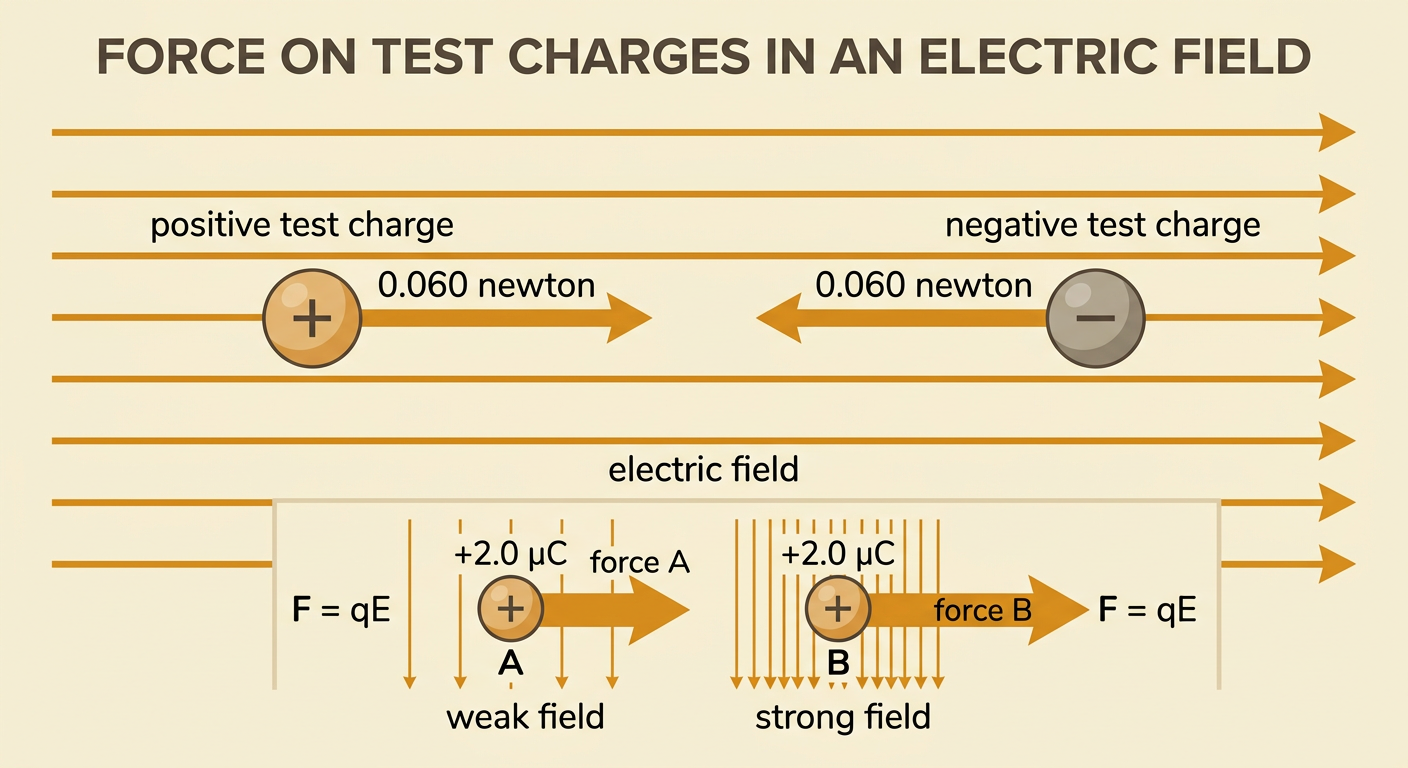
Once the electric field is known, the force on a test charge is found with F = qE. A positive test charge experiences force in the same direction as the electric field. A negative test charge experiences force in the opposite direction because q is negative. The force magnitude is |F| = |q|E. For example, place a +2.0 μC test charge in a uniform electric field of 3.0 × 10⁴ N/C directed right. Its force is (2.0 × 10⁻⁶ C)(3.0 × 10⁴ N/C) = 0.060 N to the right. A −2.0 μC charge at the same location experiences a 0.060 N force to the left. If identical test charges are placed at different points, the one where field lines are more densely packed experiences the greater force. Test charges are assumed to be small enough that they do not significantly change the original field.
Evidence-Based Application
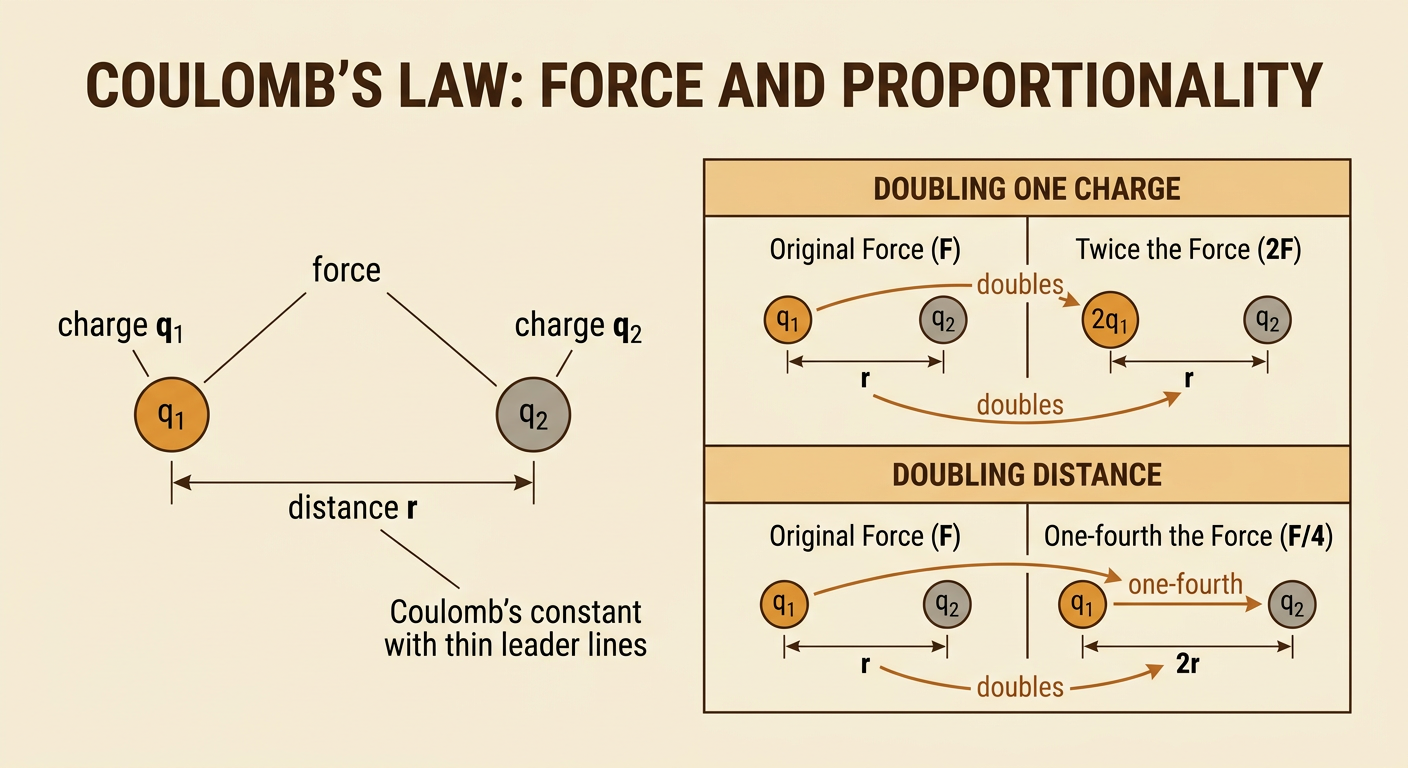
Scientific arguments should connect a precise claim to mathematical and visual evidence while recognizing limitations. Imagine two proposals for reducing electrostatic force between charged components: double their separation or reduce one charge by half. The claim that doubling separation is more effective is supported by Coulomb’s law. Because F is proportional to 1/r², doubling r makes the force F/4. Halving one charge makes the force F/2. Thus, doubling separation produces the smaller remaining force. A counterclaim might state that reducing charge is easier or safer in a real device. That concern may be valid, but it addresses practicality rather than the predicted force reduction. The argument also has limits: Coulomb’s law treats the objects as point charges or spherically symmetric charge distributions and assumes the surrounding medium remains unchanged. A strong conclusion distinguishes the mathematical prediction from engineering constraints and identifies what additional evidence is needed.