Count Coins and Solve Money Problems
Students identify pennies, nickels, dimes, and quarters, find the total value of coin collections, and solve simple money word problems.

Illustrations are auto-generated and may be placeholders. They can be refreshed to match the narration.
Review Coins and Their Values
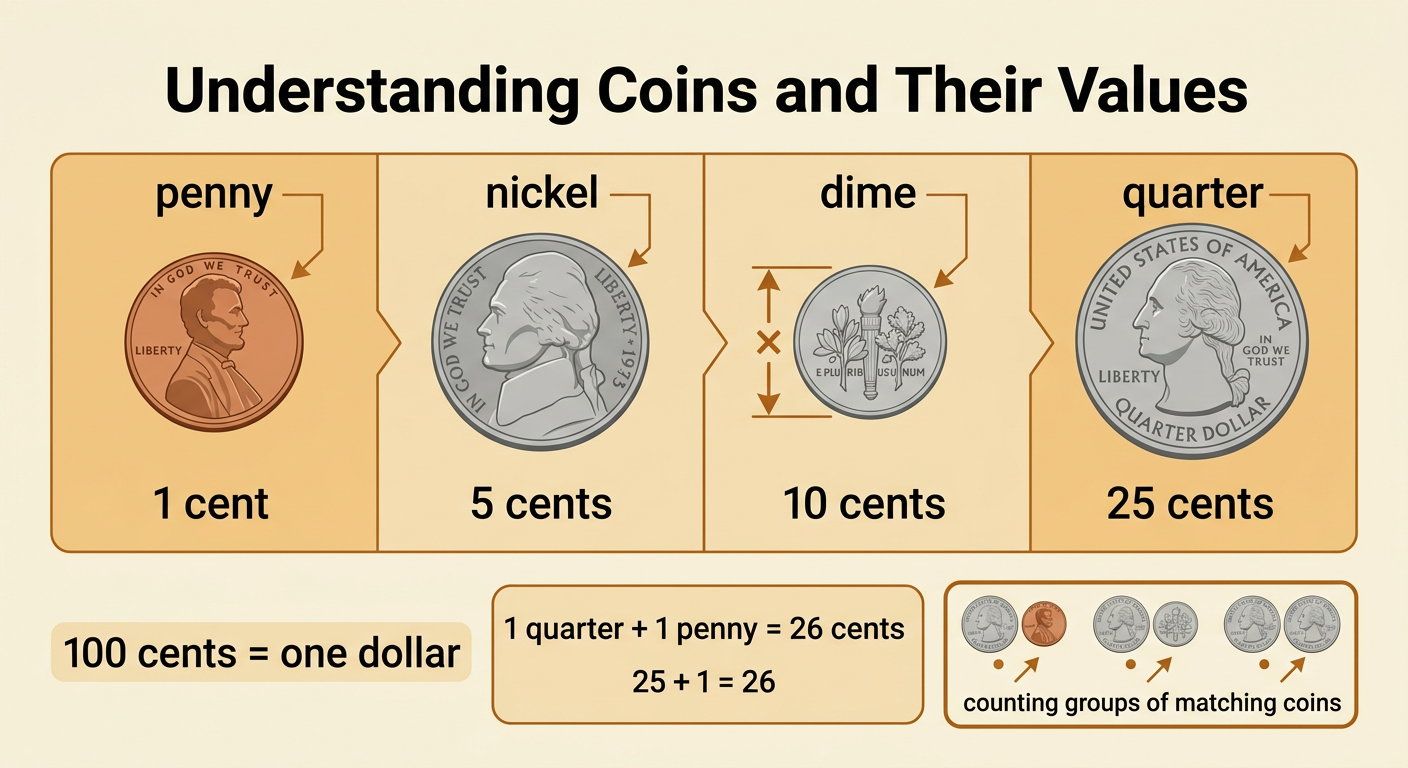
Coins have different names, sizes, colors, and values. A penny is worth 1 cent, or 1¢. A nickel is worth 5 cents, or 5¢. A dime is worth 10 cents, or 10¢. A quarter is worth 25 cents, or 25¢. A dime is smaller than a nickel, but it is worth more. Coin designs may look different depending on when the coins were made, so use the coin’s name and value when counting. For example, one quarter and one penny are two coins, but their total value is 26¢. Remember that 100 cents equals one dollar, written as $1.00.
Count Coins of the Same Kind
When all the coins are the same kind, skip-count by that coin’s value. Count pennies by ones, nickels by fives, dimes by tens, and quarters by twenty-fives. Touch or point to each coin once as you count. Suppose you have four nickels. Start at 0¢ and count 5¢, 10¢, 15¢, 20¢. Four nickels are worth 20¢. If you have three quarters, count 25¢, 50¢, 75¢. Three quarters are worth 75¢. Write the cent sign after an amount that is less than one dollar. Skip-counting helps you find the total without adding each value separately.

Count Mixed Coins
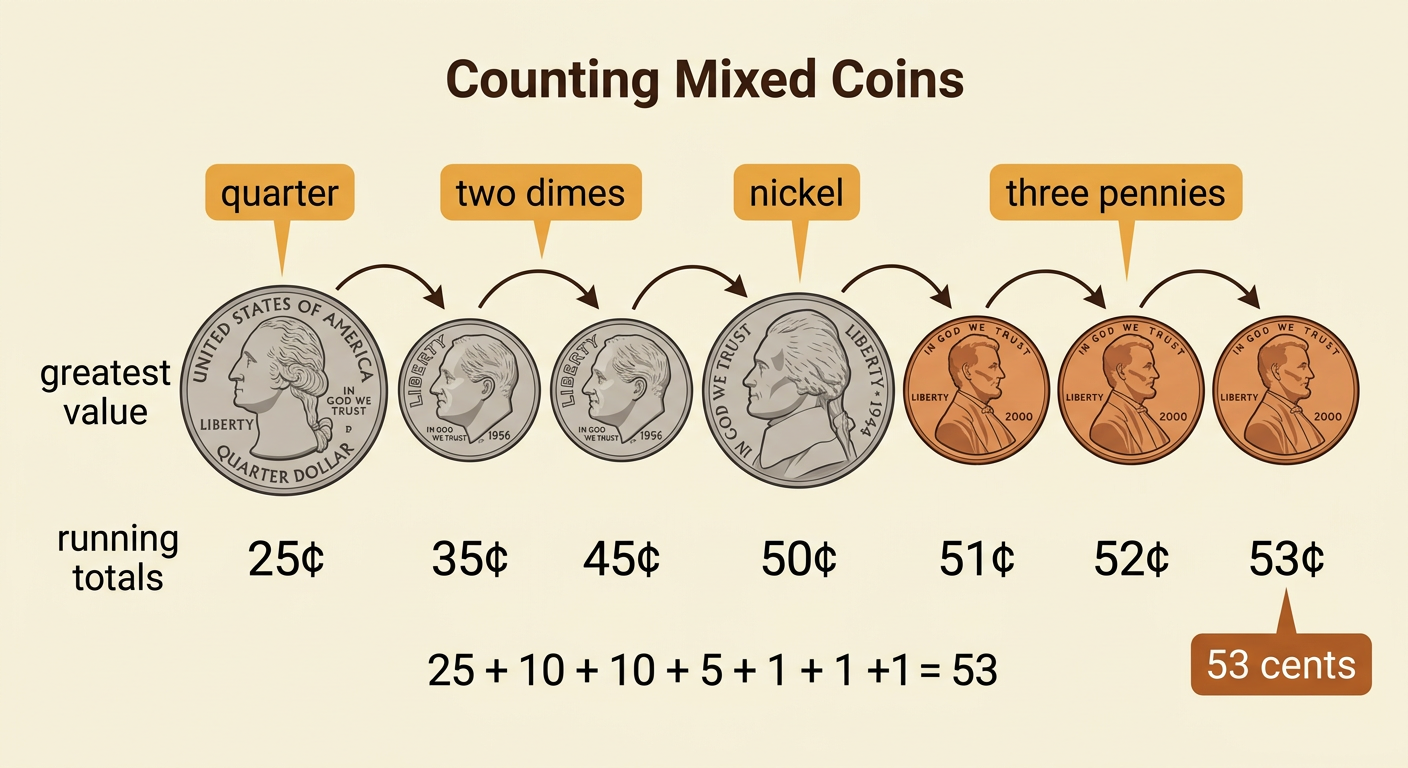
A mixed collection has more than one kind of coin. Begin with the coin worth the most, and then count on. This keeps the numbers easier to track. Imagine you have one quarter, two dimes, one nickel, and three pennies. Start with 25¢. Count the dimes: 35¢, 45¢. Count the nickel: 50¢. Count the pennies: 51¢, 52¢, 53¢. The collection is worth 53¢. You can also write an addition equation: 25¢ + 10¢ + 10¢ + 5¢ + 1¢ + 1¢ + 1¢ = 53¢. Arrange coins from greatest value to least value before counting.
Model a Money Word Problem
Read a money problem carefully. Ask what you know and what you need to find. Then choose an equation. Maya has one quarter, two nickels, and four pennies. She wants to buy a sticker that costs 38¢. Does Maya have enough money? First, find her total: 25¢ + 5¢ + 5¢ + 1¢ + 1¢ + 1¢ + 1¢ = 39¢. Compare 39¢ with 38¢. Since 39¢ is greater than 38¢, Maya has enough money. She will have 1¢ left because 39¢ − 38¢ = 1¢. The equation and coin model both show the answer.

Practice and Explain
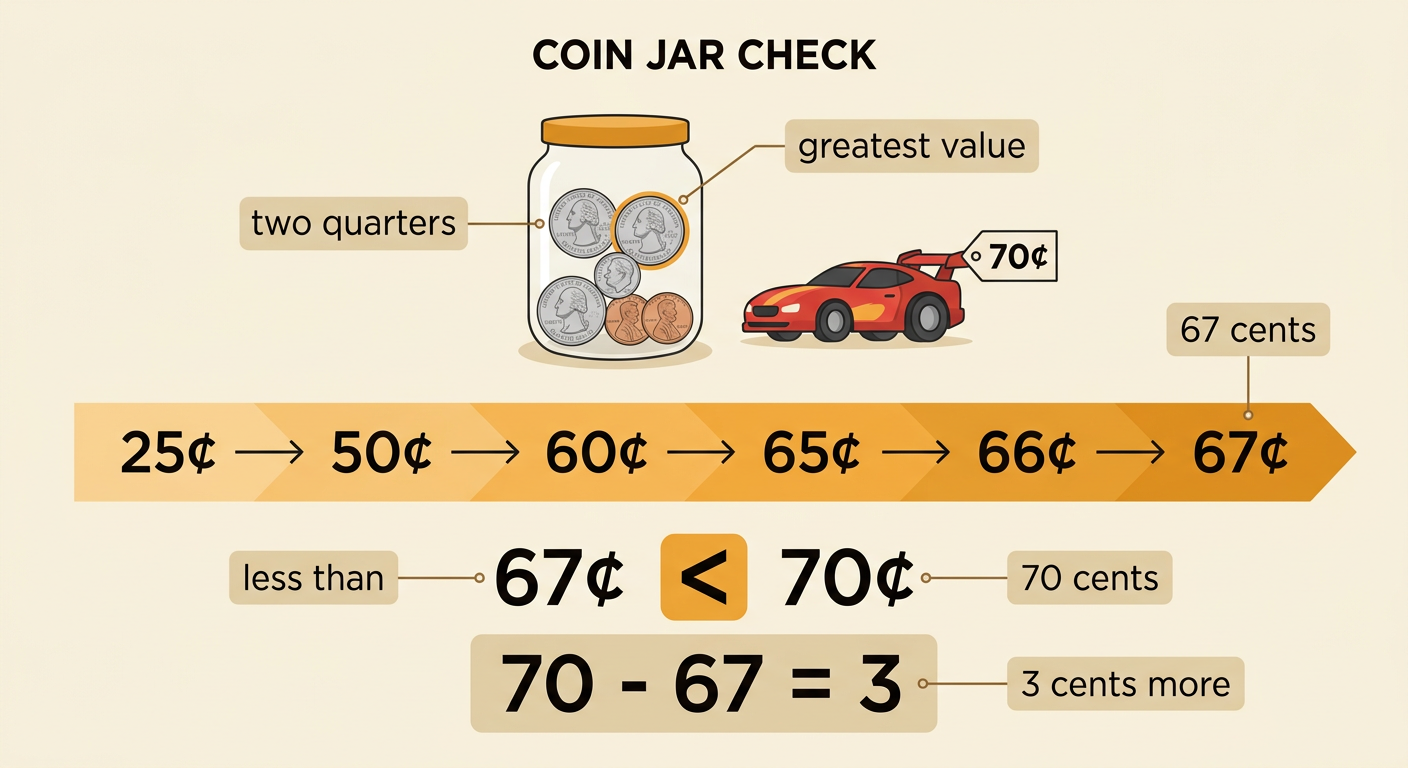
Solve each money problem by naming the coins, finding their values, and showing your steps. Suppose a jar holds two quarters, one dime, one nickel, and two pennies. Count 25¢, 50¢, 60¢, 65¢, 66¢, 67¢. The total is 67¢. Now imagine a toy costs 70¢. The jar does not hold enough money because 67¢ is less than 70¢. It needs 3¢ more because 70¢ − 67¢ = 3¢. When you explain, say how you counted and why your answer makes sense. You might say, “I started with the quarters because they have the greatest value, and then I counted on.”
Exit Check
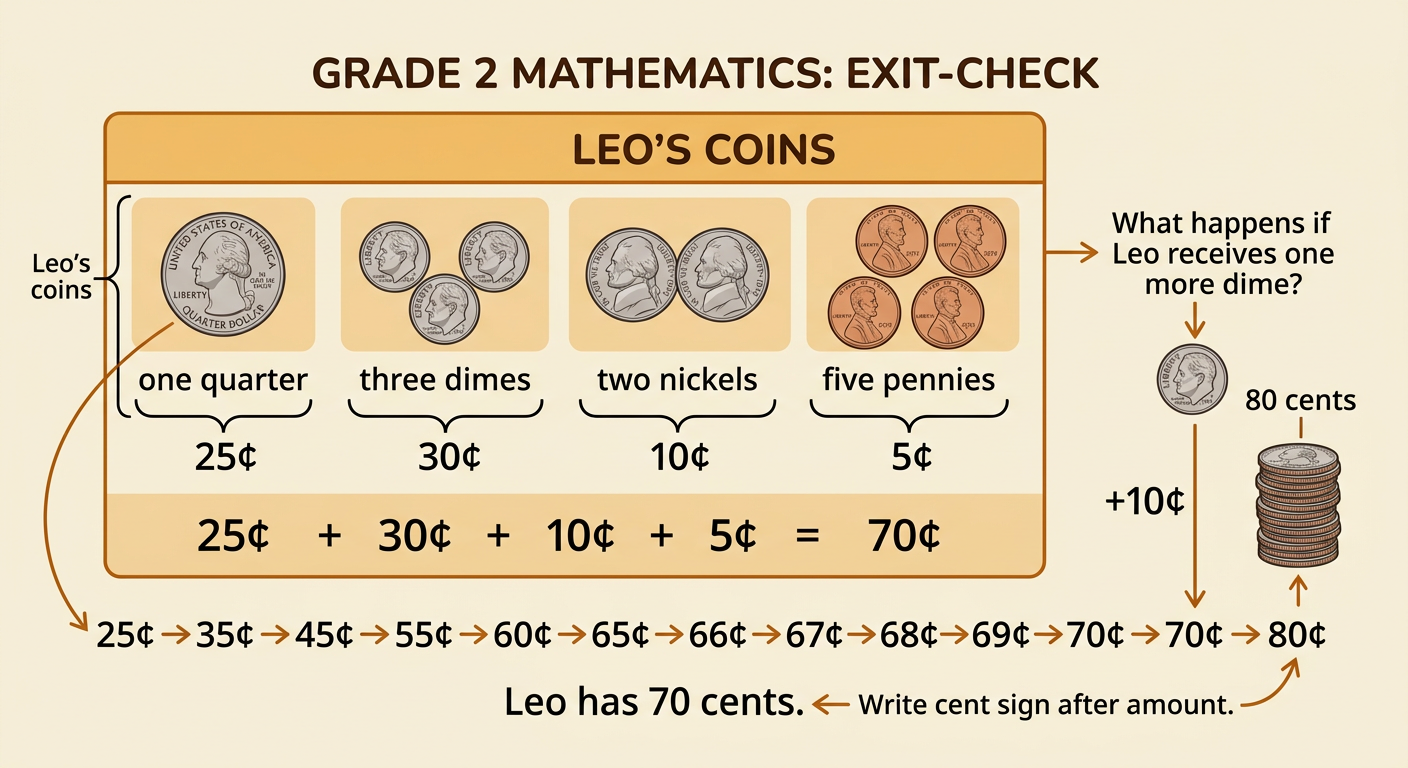
Use what you learned to complete a final check. Leo has one quarter, three dimes, two nickels, and five pennies. How much money does he have? Count from the greatest value: 25¢, 35¢, 45¢, 55¢, 60¢, 65¢, 66¢, 67¢, 68¢, 69¢, 70¢. Leo has 70¢. If he receives one more dime, he will have 80¢. Explain your answer by writing an equation or describing your counting steps. A correct equation is 25¢ + 30¢ + 10¢ + 5¢ = 70¢. Check that every coin was counted once and that the cent sign is written after the amount.