Count Objects and Tell How Many
Students count objects accurately and state the total number in each set.
Illustrations are auto-generated and may be placeholders. They can be refreshed to match the narration.
Review the Counting Sequence
Counting words always come in the same order. Begin with 1 and say one number for each step: 1, 2, 3, 4, 5, and so on. Do not skip a number or say a number twice. You can use a number path to help you remember what comes next. For example, start at 1 and move along the path as you count to 10. After 6 comes 7, and after 9 comes 10. Practice counting forward to 20. You may also begin at a number other than 1. If you begin at 4, the next numbers are 5, 6, and 7. Knowing the counting sequence helps you count objects accurately.
Touch and Count
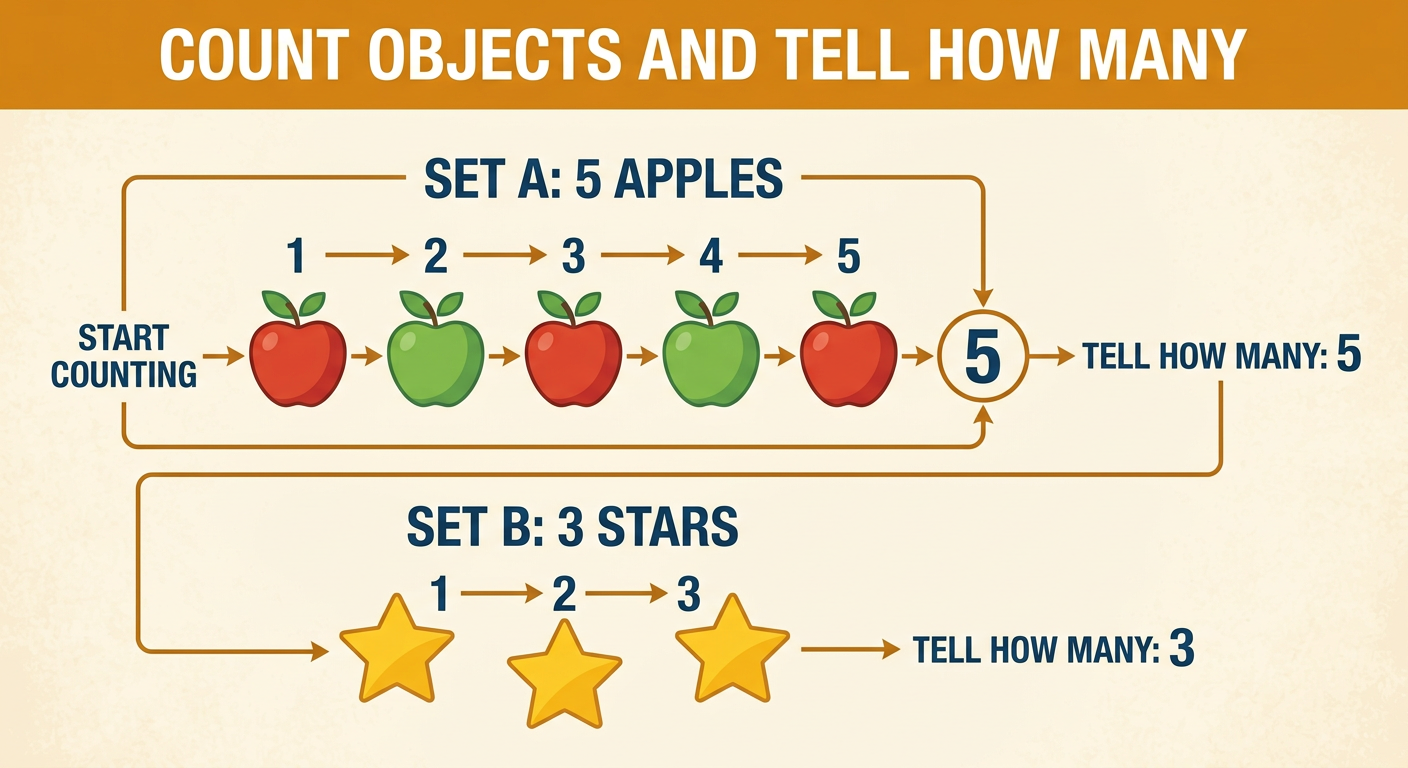
To find how many objects are in a set, touch each object one time as you count. Say one counting number for each object you touch. This is called matching one number to one object. Move from left to right so you can remember which objects you have counted. Suppose there are 8 apples in a row. Touch the first apple and say “1.” Keep touching and counting until you touch the last apple and say “8.” The last number you say tells how many objects are in the whole set. There are 8 apples. Count slowly and carefully. Do not miss an apple, and do not count the same apple more than once.
Count Different Arrangements
Objects can be arranged in different ways, but the total does not change. You may see objects in a line, in rows and columns, around a circle, or scattered apart. Use a careful counting path for every arrangement. For example, count 6 buttons in a line from left to right. In a rectangular array, count across the first row and then across the second row. Around a circle, choose one button as the starting point and stop when you return to it. For scattered buttons, touch or mark each one as you count. Each picture still has 6 buttons. The space between objects and the way they are arranged do not tell the total. Counting tells how many.
Make a Given Quantity
Sometimes you are given a number and asked to make a set with that many objects. Read or listen for the number first. Then move one object at a time into a new group while you count. Stop when you say the given number. For example, suppose the number card shows 7. Take one cube and say “1.” Keep moving and counting cubes until you place the seventh cube and say “7.” Stop there. Your new set has 7 cubes. Check your work by touching and counting the cubes again. If you count fewer than 7, add cubes. If you count more than 7, take cubes away. The number card and the total number of cubes should match.

Share Counting Strategies
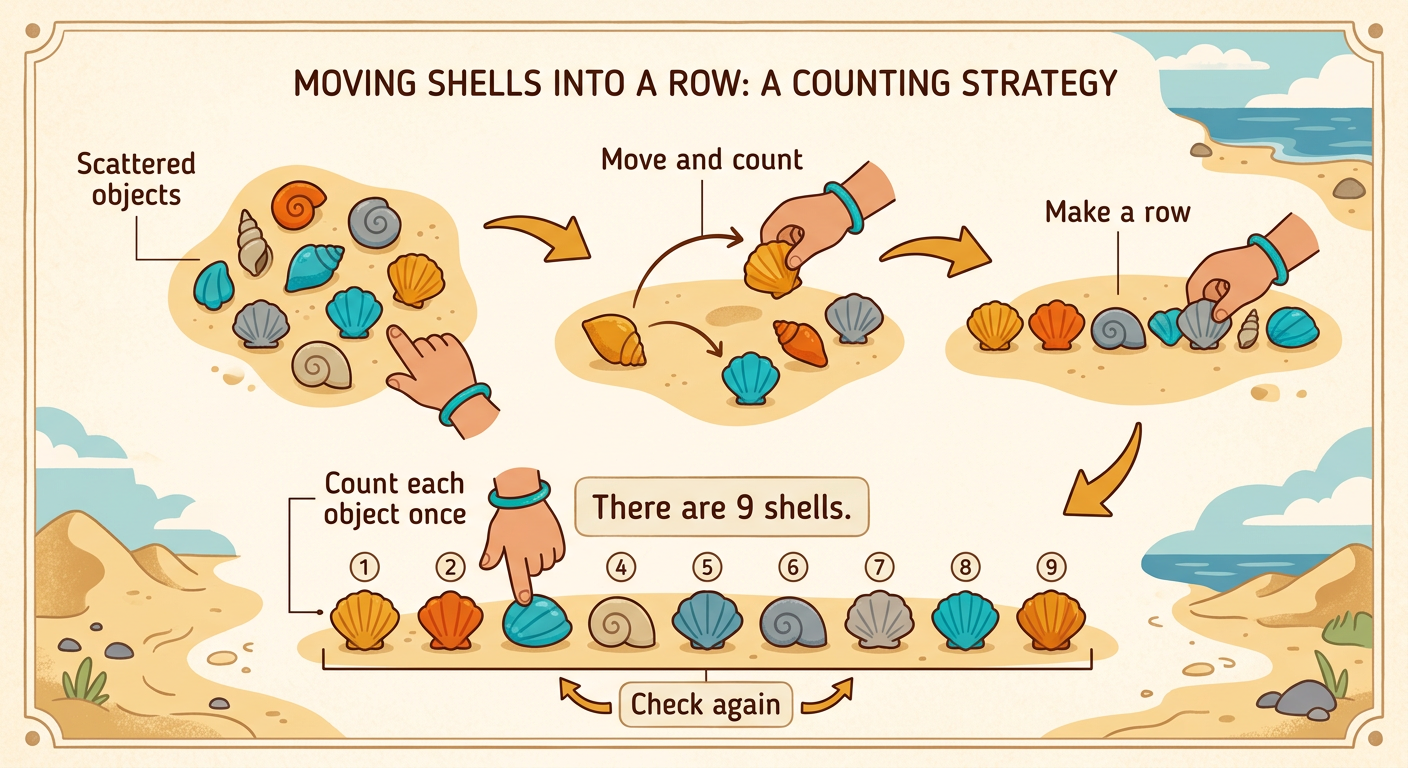
A counting strategy is a plan that helps you count correctly. You can touch each object, move counted objects to one side, line up scattered objects, or mark where you started. After counting, tell the total in a complete sentence. For example, imagine 9 shells scattered on a table. You can move each shell into a row while saying one number for each shell. When you say “9,” all the shells are in the row. Then say, “There are 9 shells.” A partner may use a different strategy and get the same total. Listen to your partner’s idea and explain your own plan. If your totals are different, count the objects again together and check each object carefully.