
Count to 100 by Ones and Tens
Students practice saying the counting sequence to 100 using ones and groups of ten.
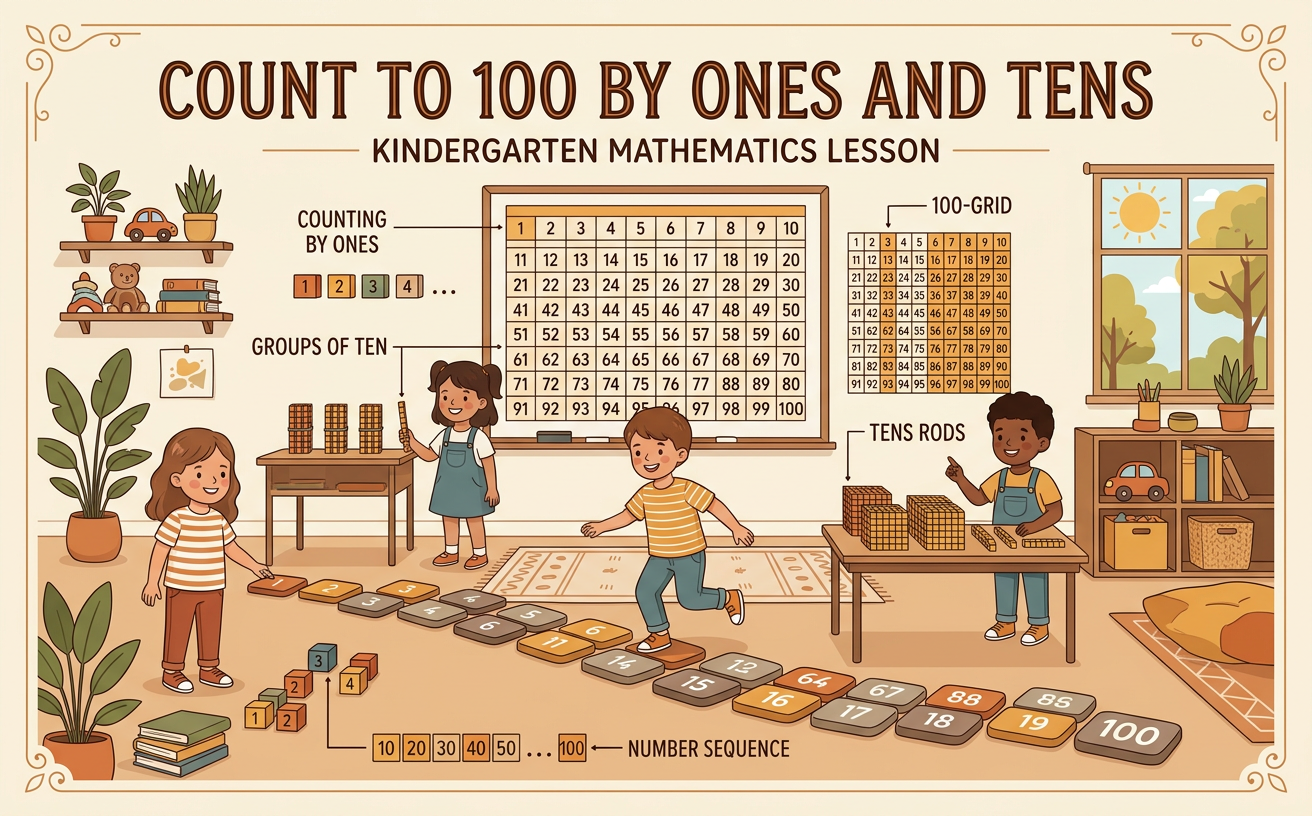
Illustrations are auto-generated and may be placeholders. They can be refreshed to match the narration.
Warm-Up Count
Let us warm up our counting voices. Stand tall and count slowly from 1 to 20. Say one number for each clap: 1, 2, 3, 4, 5, and keep going. The numbers always follow the same order. After 8 comes 9, and after 9 comes 10. Try not to skip a number or say two numbers for one clap. Now count again while taking one small step for each number. For example, if you take 12 steps, your last number is 12. That tells you that you took 12 steps. Listen to the numbers around the change from 19 to 20. End together by saying 18, 19, 20 clearly. Counting with movements helps your voice and body keep the same steady rhythm.

Count by Ones
Counting by ones means saying every number in order. Each new number is one more than the number before it. Begin at 1 and continue across a 100 chart. Say 1, 2, 3, 4, 5, and keep going without skipping any boxes. At the end of a row, move to the first box in the next row. For example, after 28 comes 29, and after 29 comes 30. Then continue with 31. You can touch one box as you say each number. Pause after each group of ten if you need a breath, but do not change the order. Work toward the final row: 91, 92, 93, 94, 95, 96, 97, 98, 99, 100. You have counted to 100 by ones.

Make Groups of Ten
A group of ten has exactly 10 objects. Grouping objects into tens makes a large amount easier to count. Place counters in a row and move 10 counters into one circle. Count them to check: 1, 2, 3, 4, 5, 6, 7, 8, 9, 10. That circle is one group of ten. Then begin another group. For example, with 34 counters, you can make three full groups of ten and have four single counters left. The three groups hold 30 counters because 10, 20, 30 are three tens. The four counters left are ones. Altogether, 30 and 4 make 34. Making groups does not add or remove objects. It only arranges the same objects so they are easier to see and count.

Count by Tens
Counting by tens means adding one full group of ten each time. Begin with one group and say 10. Add another group and say 20. Continue in the same pattern: 10, 20, 30, 40, 50, 60, 70, 80, 90, 100. The ones digit stays 0 while the tens digit changes. For example, six full ten-frames hold 60 counters. When one more full ten-frame is added, there are 70 counters. Point to each group as you say the next number. Keep a steady beat, and listen for the repeated ending in each number word: twenty, thirty, forty, fifty, and so on. Ten groups of ten make 100. Counting by tens lets you count 100 objects faster than counting each object separately.

Closing Number Chant
Finish the lesson with a number chant. First, count by ones while tapping your knees once for each number. Start with 1 and continue all the way to 100. Keep the numbers in order, and slow down near changes such as 39 to 40, 59 to 60, and 99 to 100. Next, count by tens while raising your hands once for each number: 10, 20, 30, 40, 50, 60, 70, 80, 90, 100. For a final challenge, a partner can say a number and you can say the next number. If your partner says 67, you say 68. If your partner says 90 while counting by tens, you say 100. End by saying together, “We can count to 100 by ones and by tens!”