Counting Atoms in Molecules and Extended Structures
Students interpret chemical formulas and particle models to determine the types, numbers, and fixed ratios of atoms in simple molecules and repeating extended structures.
Illustrations are auto-generated and may be placeholders. They can be refreshed to match the narration.
From Chemical Formulas to Atom Counts
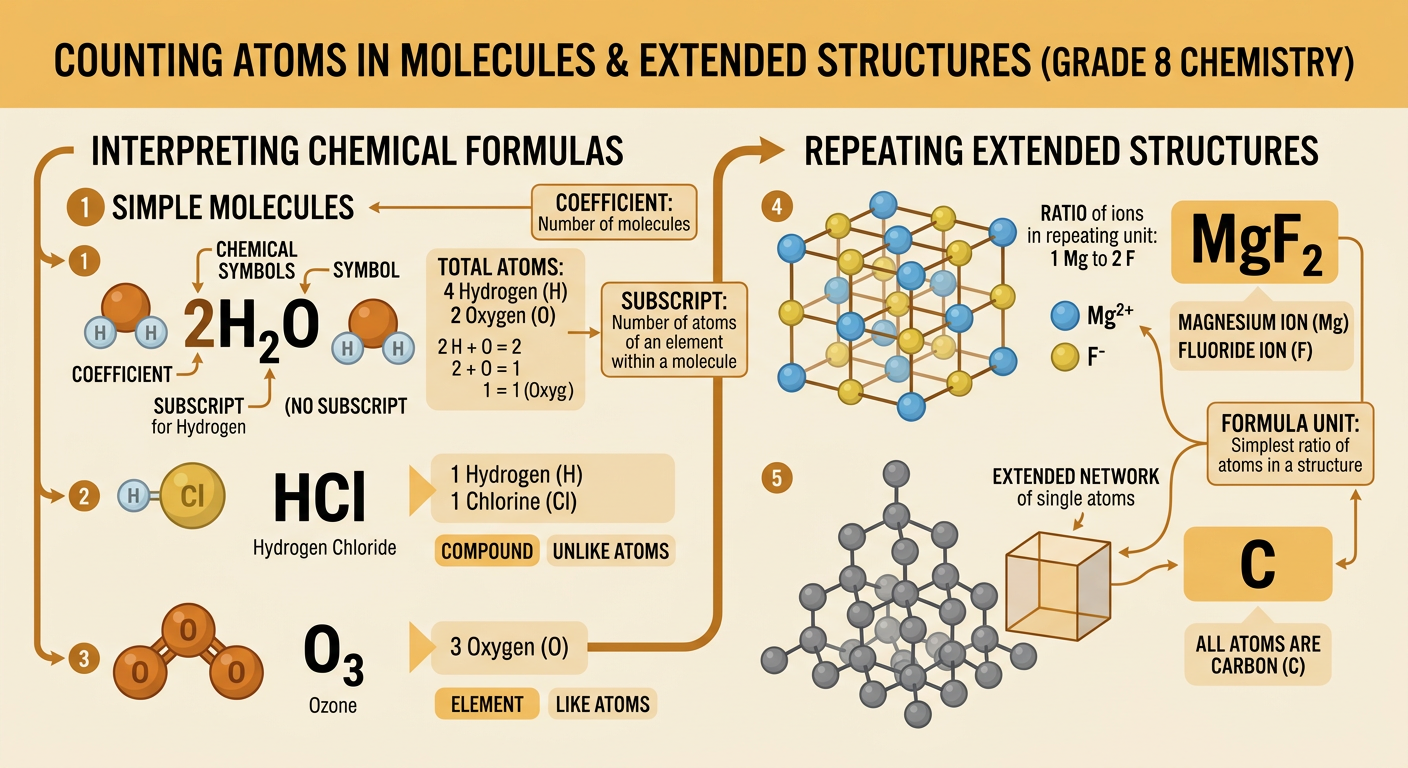
A chemical formula identifies the elements in a substance and shows how many atoms of each element belong in its basic particle or composition ratio. Read each element symbol first. A capital letter begins every symbol, and a lowercase letter may follow it. In H2O, H represents hydrogen and O represents oxygen. The subscript 2 applies only to H, so one water molecule contains two hydrogen atoms and one oxygen atom, for three atoms total. When an element symbol has no subscript, its count is understood to be 1. For another example, C6H12O6 contains 6 carbon atoms, 12 hydrogen atoms, and 6 oxygen atoms in each molecule. Adding those counts gives 24 atoms total. Always list each element separately before finding the total.
Subscripts and Fixed Atomic Ratios
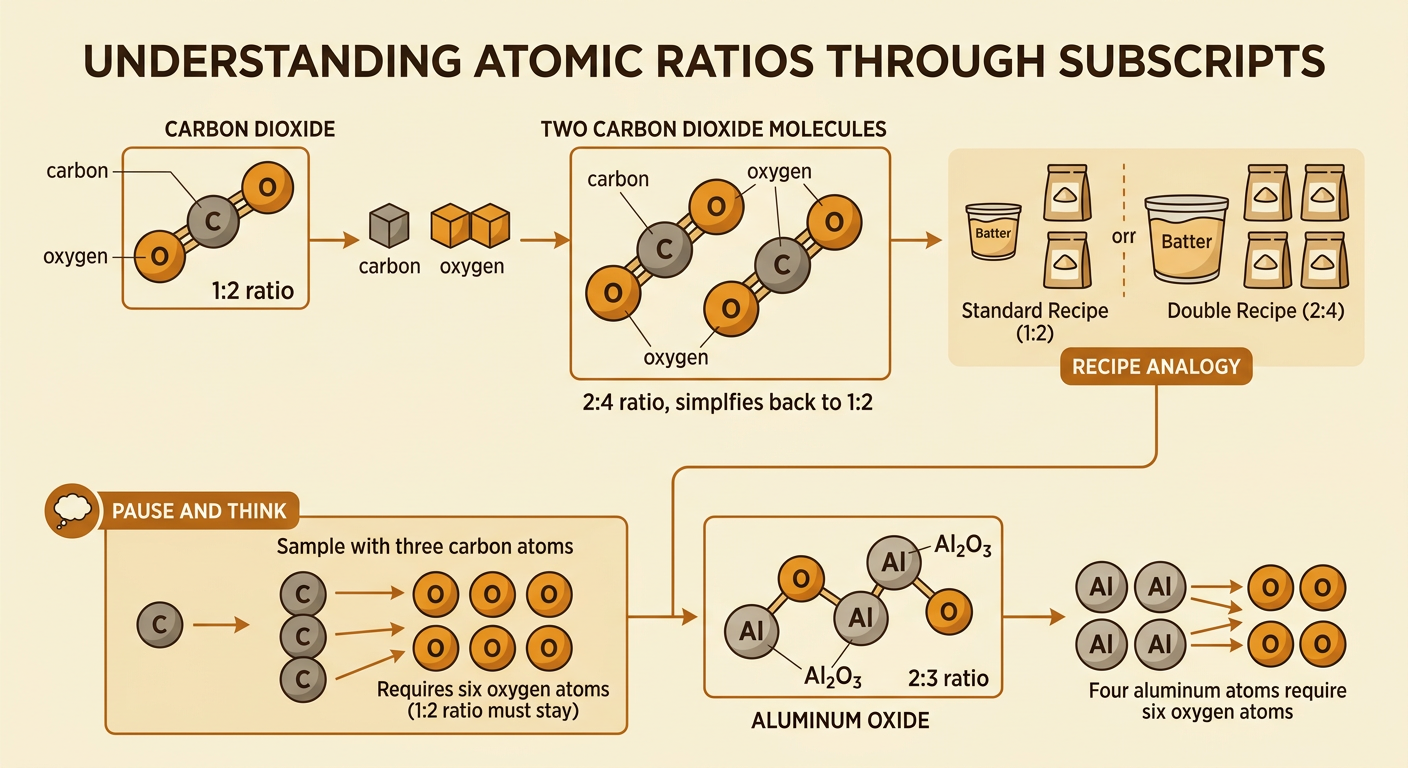
Subscripts show a fixed atomic ratio in a pure substance. In carbon dioxide, CO2, the missing subscript after C means one carbon atom, while the 2 means two oxygen atoms. The carbon-to-oxygen ratio is therefore 1:2. Every carbon dioxide molecule has this same ratio. Two molecules contain 2 carbon atoms and 4 oxygen atoms, but the ratio is still 2:4, which simplifies to 1:2. Ratios help scientists compare samples of different sizes without changing the substance’s composition. Consider Al2O3: its aluminum-to-oxygen ratio is 2:3. A model with 4 aluminum atoms would need 6 oxygen atoms to keep that ratio. Changing only one atom count would represent a different composition, not a larger sample of the same substance.
Modeling Simple Molecules
A particle model represents atoms with circles or spheres and bonds with lines. A key is needed because colors alone do not identify elements reliably. Methane has the formula CH4. Its model contains one carbon atom connected to four hydrogen atoms, so the total atom count is five. The model should match both the formula and the element key. It can also show how atoms are connected, although a flat drawing does not show every detail of a molecule’s three-dimensional shape. To check a methane model, count one carbon sphere and four hydrogen spheres, then compare those counts with the subscripts in CH4. Models are useful evidence, but they are simplified: atoms are not actually solid colored balls, and bond lines represent attractions between atoms rather than physical sticks.

Repeating Units in Extended Structures
Some substances do not consist of separate molecules. Instead, their particles form an extended structure that repeats in many directions. Sodium chloride is an ionic solid made of sodium ions and chloride ions arranged in a three-dimensional crystal lattice. The formula NaCl does not name a single NaCl molecule. It gives the simplest whole-number ratio in the structure: one sodium ion for every one chloride ion. A larger portion might contain 8 sodium ions and 8 chloride ions, which still gives a 1:1 ratio. Scientists can draw a small representative section or identify a repeating pattern to model the much larger crystal. When counting a displayed section, use the model’s boundaries and key carefully. The complete crystal contains an enormous number of ions, but the same overall composition ratio continues throughout it.

Comparing Molecular and Extended Models
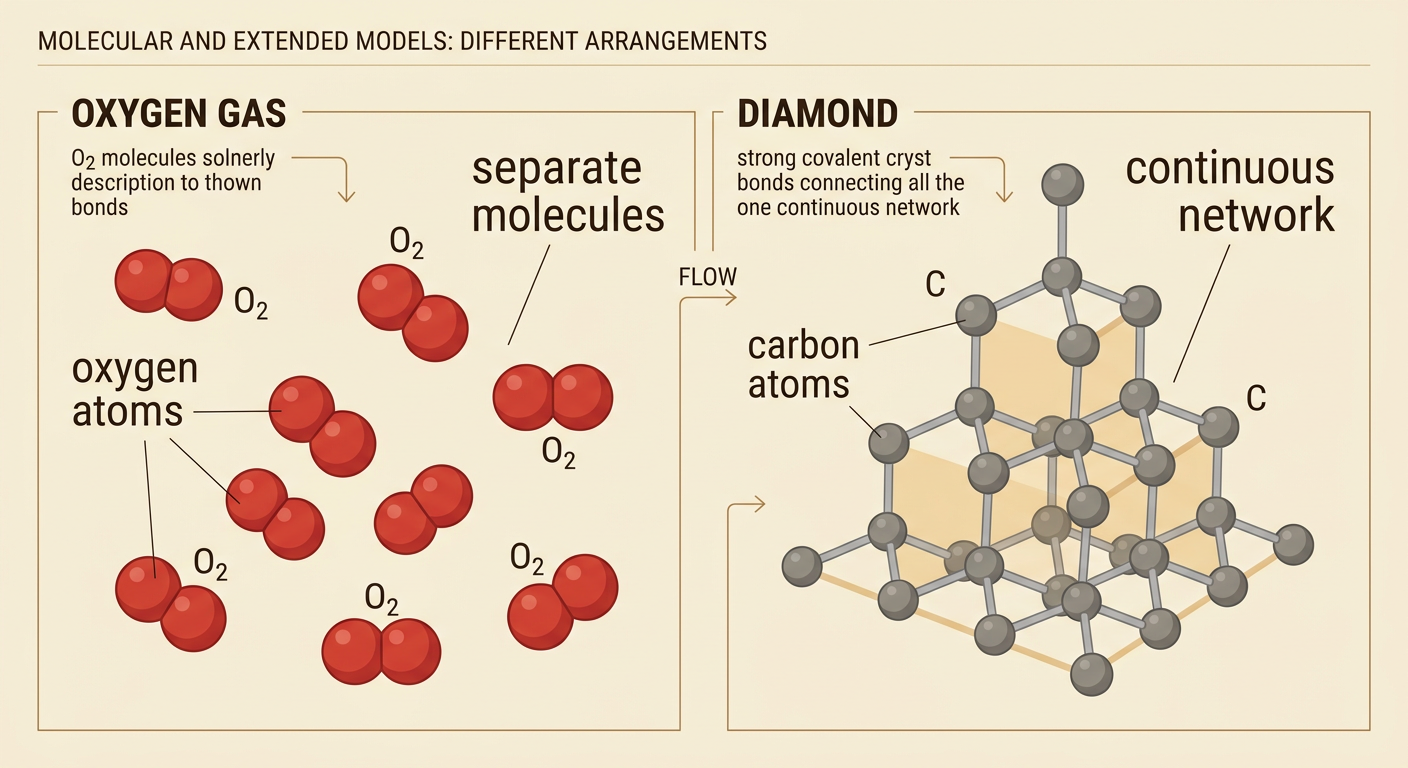
Molecular and extended models communicate composition in different ways. An oxygen molecule, O2, is a separate group of two bonded oxygen atoms. A sample can contain many distinct O2 molecules, and each pair can be counted as one molecule. Diamond is different. It is an extended structure in which every carbon atom is bonded within one continuous network. Its formula is C because only carbon is present, but the solid is not made of separate one-atom diamond molecules. In both models, the element symbols identify atom types, while the visual arrangement shows whether particles occur as separate groups or as a repeating network. Compare boundaries carefully: clear gaps between identical groups suggest molecules, while bonds or repeating connections continuing across the model suggest an extended structure. The formula alone may not show the full arrangement.
Evidence-Based Model Check
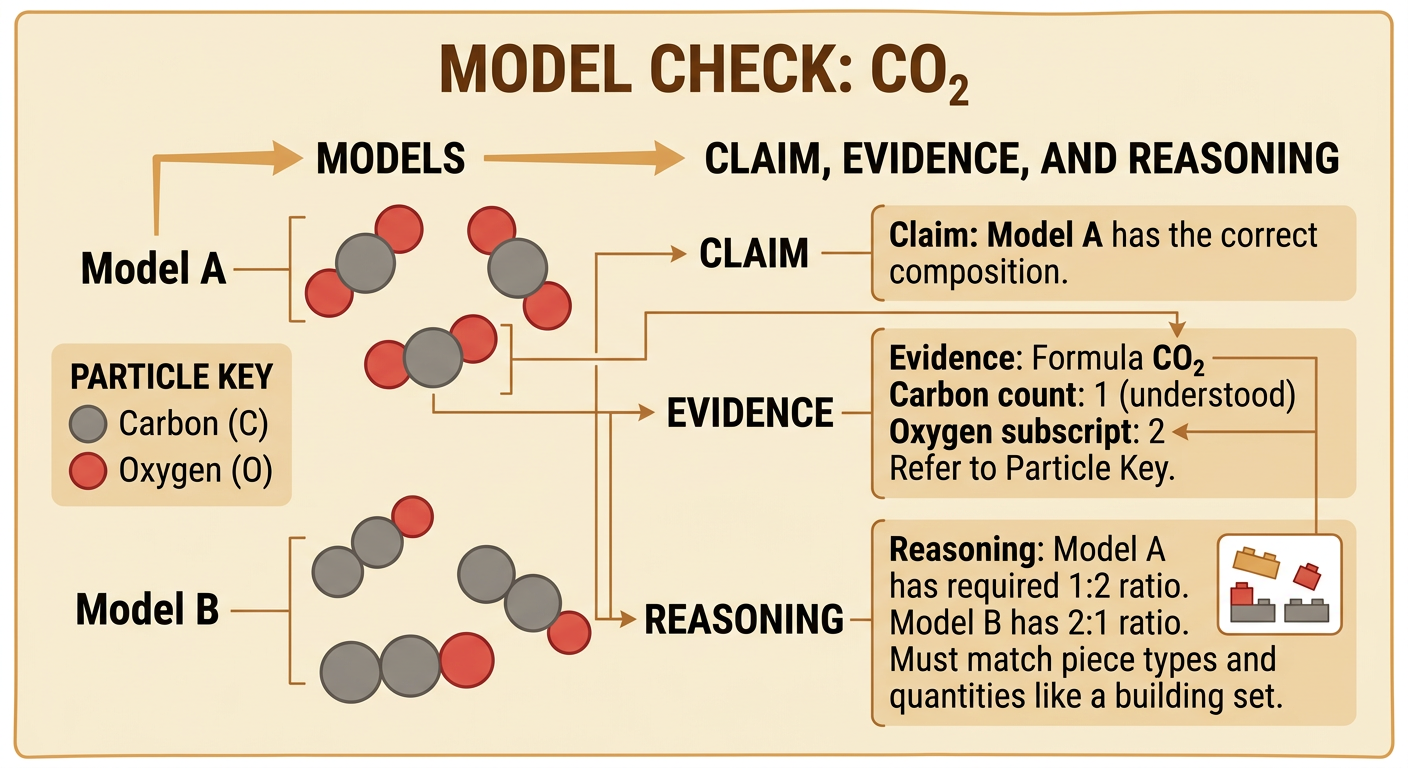
A strong model check uses a claim, evidence, and reasoning. Suppose the formula is CO2 and two particle models are offered. Model A shows one carbon atom and two oxygen atoms in each group. Model B shows two carbon atoms and one oxygen atom. The claim is that Model A correctly represents the atomic composition of carbon dioxide. Evidence comes from the formula: the understood subscript after C is 1, and the subscript after O is 2. A particle key confirms which circles represent each element. The reasoning connects the evidence to the claim: Model A has the required 1:2 carbon-to-oxygen ratio, while Model B has a 2:1 ratio. Use all relevant sources, including the written formula, model key, labels, and particle counts. Also remember that a formula verifies composition but may not prove every detail of shape or bonding.