
Counting Objects and Understanding How Many
Students use one-to-one counting to count groups of objects and understand that the final number said tells how many objects are in the group.

Illustrations are auto-generated and may be placeholders. They can be refreshed to match the narration.
Counting One Object at a Time
Counting tells us how many objects are in a group. Touch or move each object while saying one number name. Each object gets exactly one number, and no object should be skipped or counted twice. Place five counters in a row. Touch the first counter and say one, touch the next and say two, and continue with three, four, five. Moving each counted counter to a new spot can help us remember which ones we already counted. After counting, check by pointing to each counter again. Careful counting works with toys, blocks, crayons, students, or sounds. The objects may look different, but the counting process stays the same.

The Last Number Tells How Many
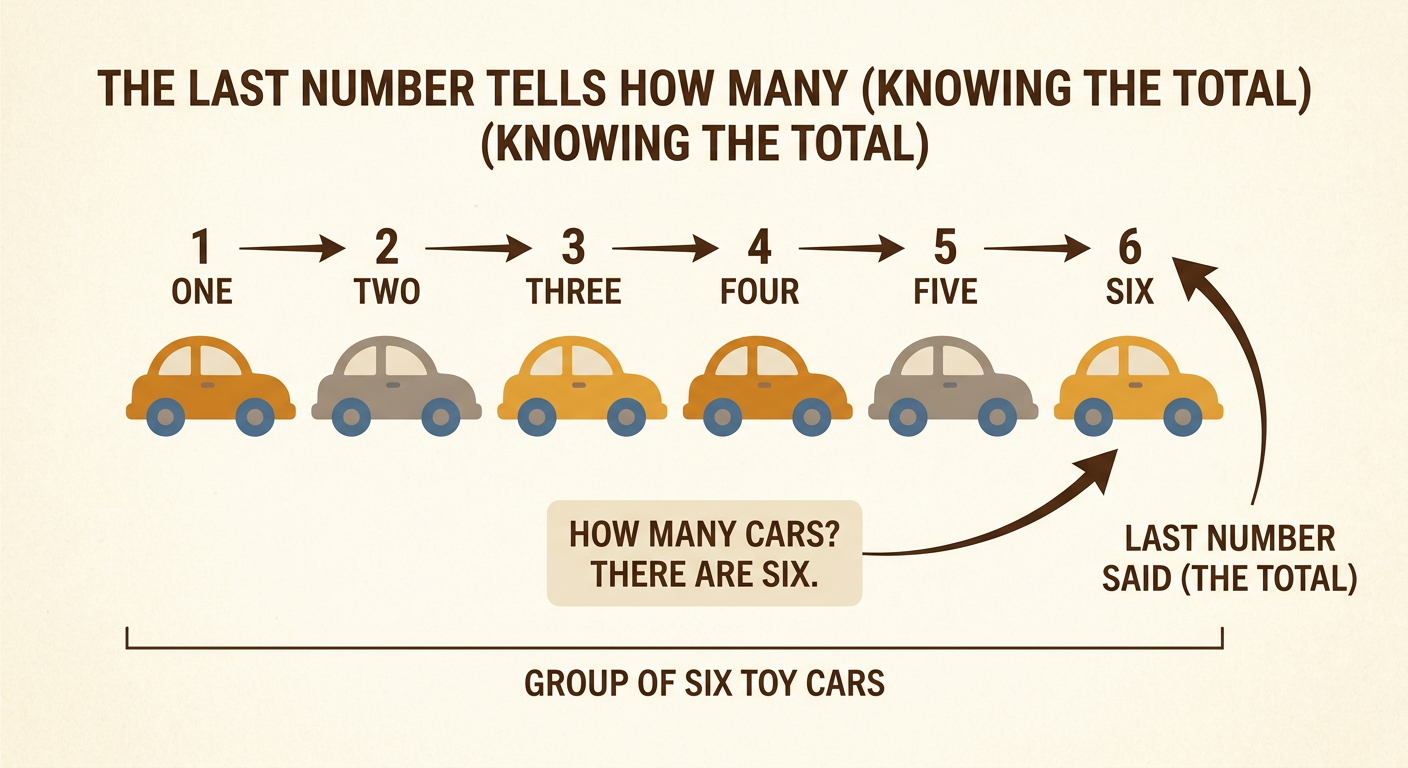
The last number we say when counting a group tells how many objects are in the whole group. This idea is called knowing the total. Suppose there are six toy cars. Count them in order by saying one, two, three, four, five, six. Because six is the last number said, there are six cars altogether. We do not need to count the cars again when someone asks, “How many?” We can answer, “There are six.” Practice with a group of four buttons. After counting one, two, three, four, say the complete sentence, “There are four buttons.” Connecting the last number to the total helps counting have meaning.
The Total Stays the Same
A group has the same number of objects even when the objects are moved. Arrange seven cubes in a straight line and count them. Then spread the same cubes far apart and count again. There are still seven cubes because none were added and none were taken away. A long row does not always contain more objects than a short row. We must count to be certain. Try placing five counters in a circle, then rearranging them into a row. Both arrangements contain five counters. This activity shows that how objects are placed does not change how many there are. The total changes only when an object is added to or removed from the group.

Counting in Different Orders
Objects can be counted in different orders without changing the total. Begin with eight picture cards scattered on a table. One student may count from left to right, while another may begin at the bottom and count upward. If both students count every card once, both will find eight cards. To keep track, turn over each card after counting it or slide it into a counted group. Listen for number names in the correct order and make sure every object receives one number name. If two different totals are reported, count again slowly to find a skipped or repeated object. Accurate counting depends on matching one number name to each object, not on where counting begins.