
Counting to 100 by Ones and Tens
Students build a reliable number sequence to 100, notice groups of ten, count on from a given number, and identify missing numbers.
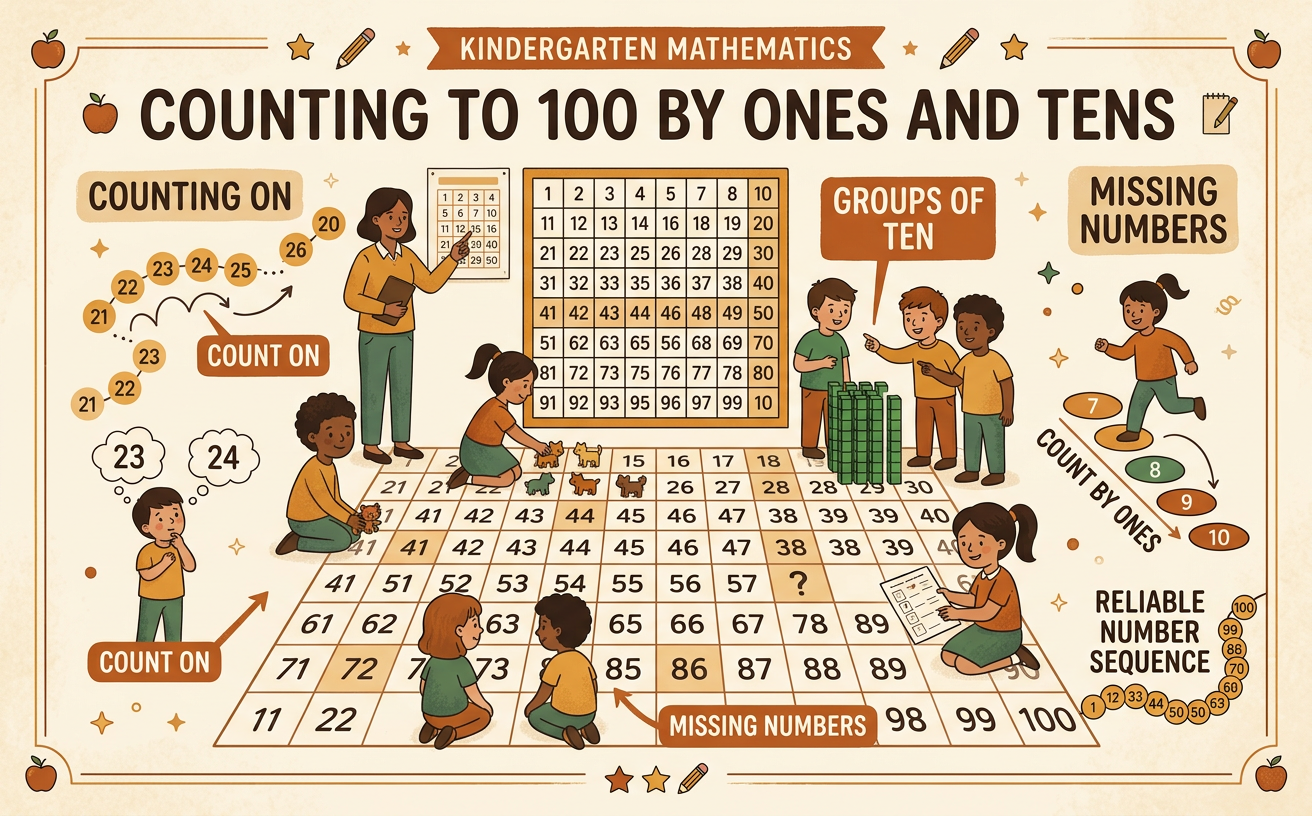
Illustrations are auto-generated and may be placeholders. They can be refreshed to match the narration.
Saying Numbers in Order
Counting words follow an order that stays the same each time. Begin at 1 and say each number clearly while the teacher points to a classroom number chart. Students may clap once for every number they say to keep a steady rhythm. Listen closely around numbers that sound similar, such as thirteen and thirty. For example, count together from 1 to 20, pause, and then continue to 30. If the class says 27, 28, 29, the next number is 30. Practice in short parts at first, and then connect the parts. The goal is to say the numbers in order without skipping a number or saying the same number twice.
Finding Patterns on a Hundred Chart
A hundred chart helps students see how the counting sequence is organized. Read each row from left to right. Most rows contain ten numbers, so the number at the end of one row connects to the first number on the next row. Notice that numbers in the same column often have the same last digit. For example, 4, 14, 24, and 34 are in one column because they all end in 4. Cover one number and use the numbers before and after it as clues. If 42 and 44 are showing, the covered number must be 43. These visual patterns help students remember the sequence all the way to 100.

Counting by Tens
Counting by tens means saying every tenth number instead of naming every number. Use bundles of ten craft sticks, connecting cubes, or fingers shown by several students. Point to one bundle and say 10. Point to two bundles and say 20. Continue with 30, 40, 50, 60, 70, 80, 90, and 100. The words follow a repeating pattern, although students should pay special attention to twenty and thirty. For example, five bundles of ten contain 50 sticks, so the class says 10, 20, 30, 40, 50 while touching each bundle. Counting by tens prepares students to organize larger amounts efficiently and recognize groups of ten.
Counting On from Any Number
Counting does not always have to begin at 1. To count on, start with a given number and say the numbers that come next. The starting number is named first, and then counting continues by ones. For example, begin at 36 and count 36, 37, 38, 39, 40, 41. A number chart can help students check what comes next. Play a circle game in which one student receives a starting number and each following student says the next number. If the starting card is 72, the next students say 73, 74, and 75. Counting on strengthens knowledge of the entire sequence and helps students move through numbers without returning to 1.