CRISPR Gene Editing: Mechanism, Evidence, and Ethics
Students model how CRISPR-Cas9 modifies DNA, evaluate evidence about possible outcomes, and consider scientific and civic criteria for responsible use.
Illustrations are auto-generated and may be placeholders. They can be refreshed to match the narration.
DNA Targets and Guide RNA
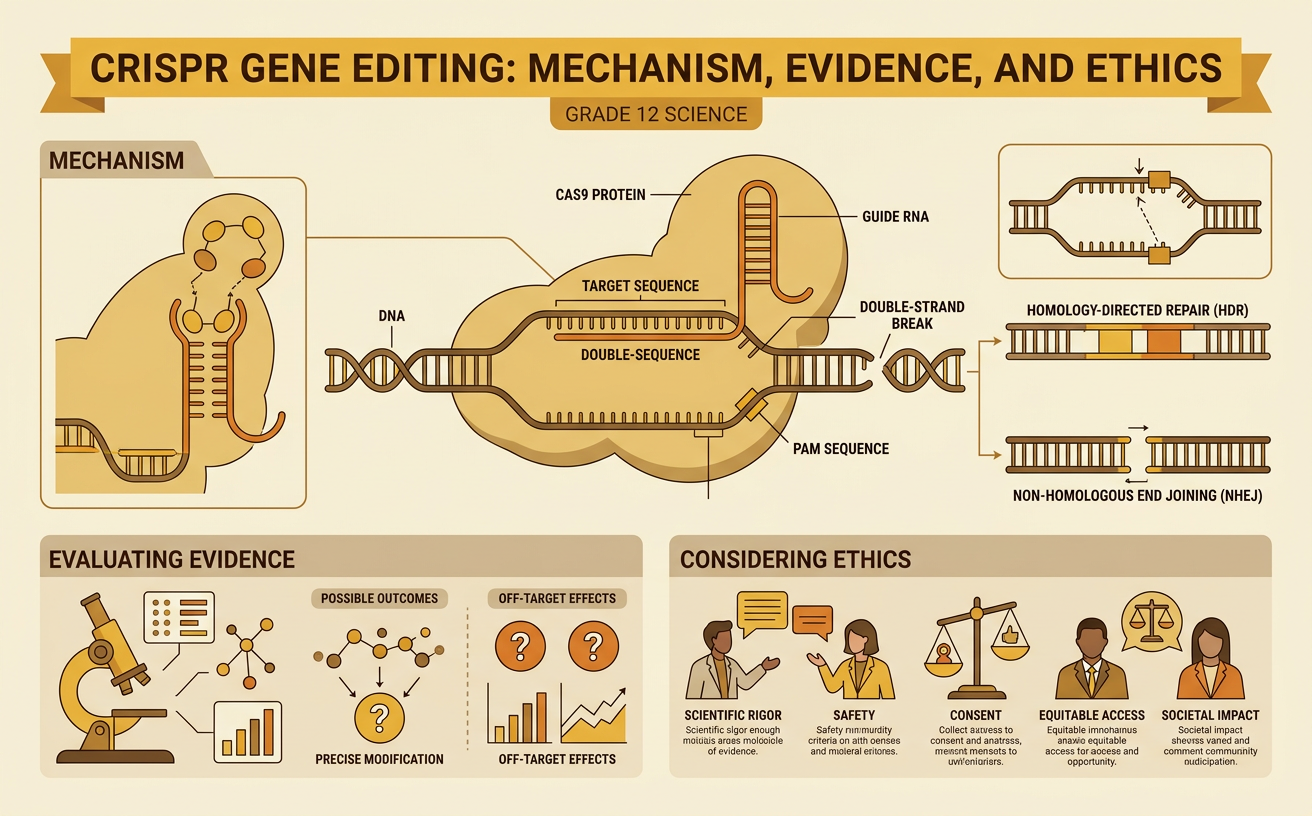
DNA is packaged into chromosomes, and genes are DNA sequences that can influence inherited traits. CRISPR-Cas9 is directed to a chosen DNA target by a guide RNA. Part of the guide RNA contains about 20 nucleotides designed to pair with a complementary DNA sequence. Cas9 also requires a nearby short sequence called a protospacer adjacent motif, or PAM. For the commonly used Streptococcus pyogenes Cas9, the PAM is usually NGG, where N can be any nucleotide. For example, researchers studying sickle cell disease might design a guide RNA for a sequence in or near the HBB gene, which helps encode beta-globin. A matching sequence alone is not enough; the correct PAM must also be present. Students can ask how the target’s location on a chromosome connects a DNA change to a possible change in a protein and inherited trait.

How Cas9 Cuts DNA
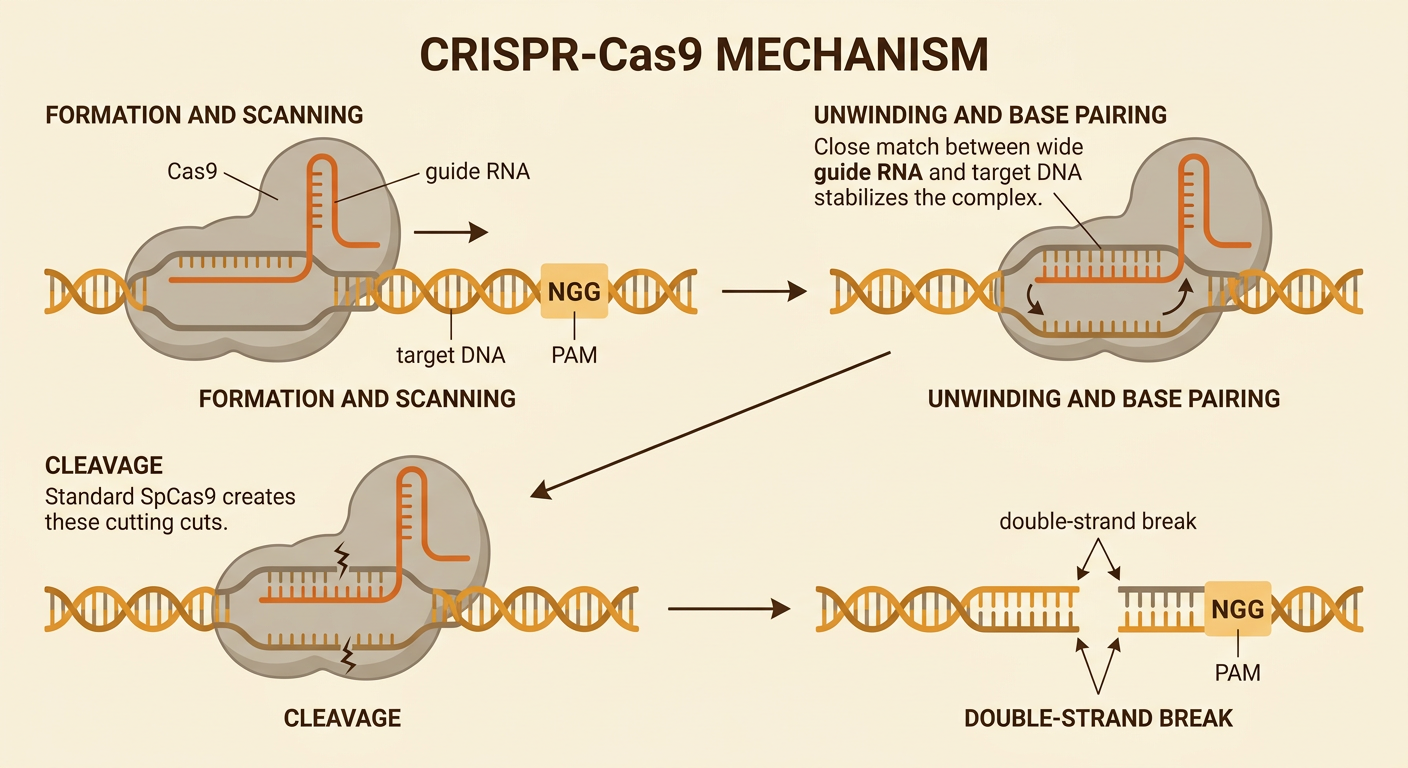
Cas9 is an enzyme that can cut both strands of DNA. The guide RNA binds Cas9 and helps the complex search DNA for a suitable PAM. After Cas9 recognizes the PAM, the nearby DNA briefly unwinds so the guide sequence can test whether its bases match the target. A close match stabilizes the complex and activates two nuclease regions of Cas9. One cuts the DNA strand paired with the guide RNA, while the other cuts the opposite strand. With standard SpCas9, the cuts usually occur about three base pairs before the PAM, creating a double-strand break. For example, a guide aimed at a pigment-related gene could direct Cas9 to cut that gene in cultured cells. Cas9 does not determine the final genetic outcome by itself; the cell’s repair processes act on the broken DNA and produce the lasting change.
Cellular DNA Repair Pathways
After Cas9 cuts DNA, the cell can repair the break through different pathways. Nonhomologous end joining, or NHEJ, reconnects the ends quickly but may add or remove a few nucleotides. These insertions or deletions can shift a gene’s reading frame and disrupt its function. For example, scientists may use NHEJ to disable a gene that produces an unwanted protein. Homology-directed repair, or HDR, can make a more specific change when researchers provide a donor DNA template with matching sequences. A cell could copy a corrected nucleotide from that template into a disease-related gene. However, HDR is generally less efficient than NHEJ and is most active during certain stages of the cell cycle. Repair outcomes can vary among cells, so an edited sample may contain several DNA versions. Sequencing is needed to determine which repairs actually occurred rather than assuming that every cell received the intended edit.

Benefits and Off-Target Risks
CRISPR may provide benefits when an edit changes cells in a useful and measurable way. For example, an approved treatment for sickle cell disease edits a regulatory region in a patient’s blood-forming stem cells outside the body, increasing fetal hemoglobin after the cells are returned. Evidence of benefit includes laboratory measurements, clinical outcomes, treatment duration, and comparisons with existing care. Risks include edits at unintended, or off-target, DNA sites, unexpected repair at the intended site, immune reactions, and effects that appear later. A guide RNA may bind a similar DNA sequence elsewhere in the genome, although mismatches often reduce binding. Researchers evaluate risk with DNA sequencing, computational predictions, cell studies, and long-term patient monitoring. Students should cite specific findings from technical sources, including sample size, measured edit frequency, and uncertainty. A claim that editing is “safe” is weak unless the evidence identifies which outcomes were tested and for how long.

Evidence-Based Bioethics Decision
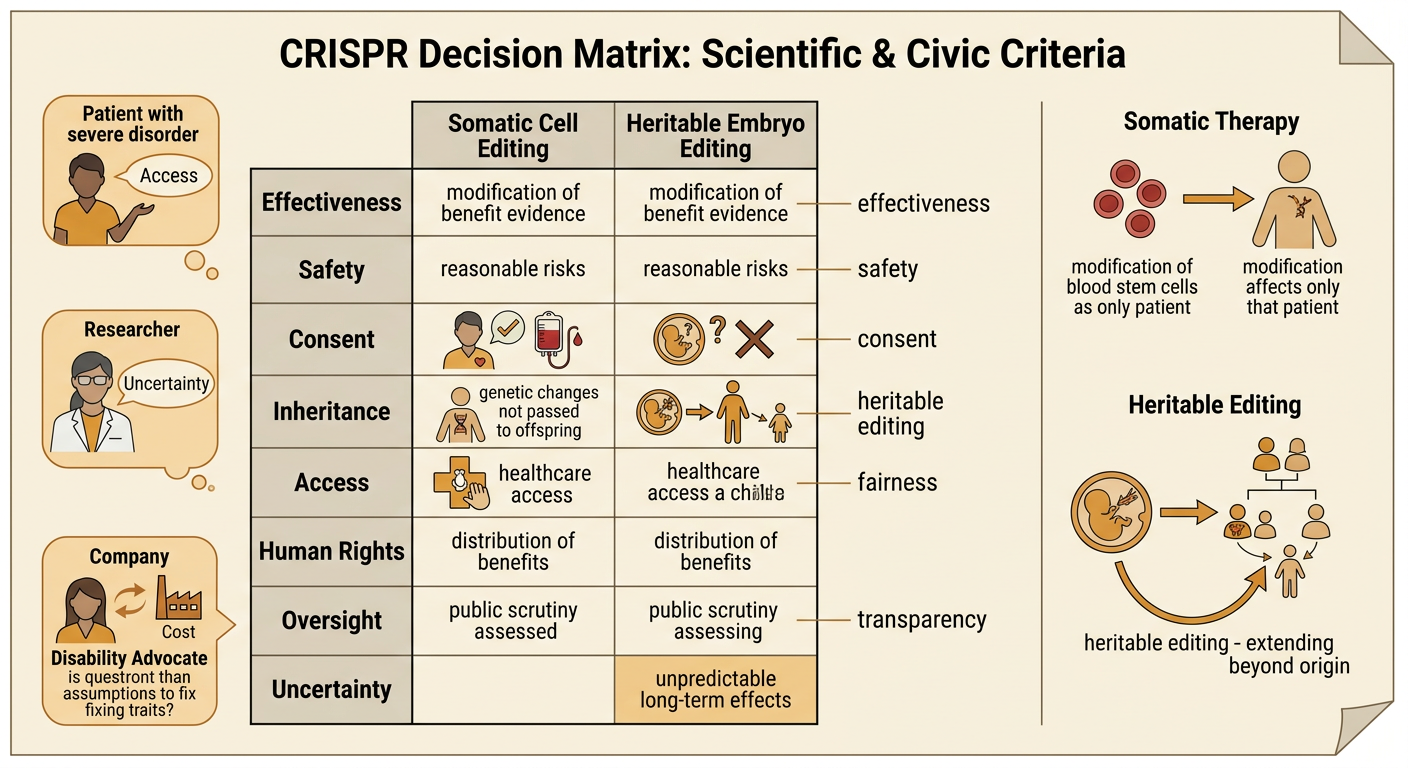
A responsible CRISPR decision combines scientific evidence with ethical and civic criteria. Decision makers can ask whether the use is effective, reasonably safe, voluntary, fair, transparent, and respectful of human rights. They should also identify whose perspectives shape the debate. A patient with a severe inherited disorder may prioritize access to treatment, while a researcher may emphasize uncertainty, a company may consider cost, and disability advocates may question assumptions about which traits need correction. For example, editing a consenting adult’s blood stem cells affects that patient, but editing an embryo could affect future people who cannot consent and could pass changes to later generations. A public decision should therefore consider bodily autonomy, equal protection, privacy, affordability, oversight, and effects on marginalized communities. Students can compare options in a decision matrix, cite evidence for benefits and risks, disclose uncertainties and conflicts of interest, and justify a policy such as permitting monitored somatic therapy while restricting heritable editing.