CRISPR Gene Editing: Mechanisms, Evidence, and Societal Decisions
Students model how CRISPR modifies DNA, evaluate data about editing outcomes, and consider evidence-based limits on the use of heritable gene editing.

Illustrations are auto-generated and may be placeholders. They can be refreshed to match the narration.
CRISPR Components and Target Recognition
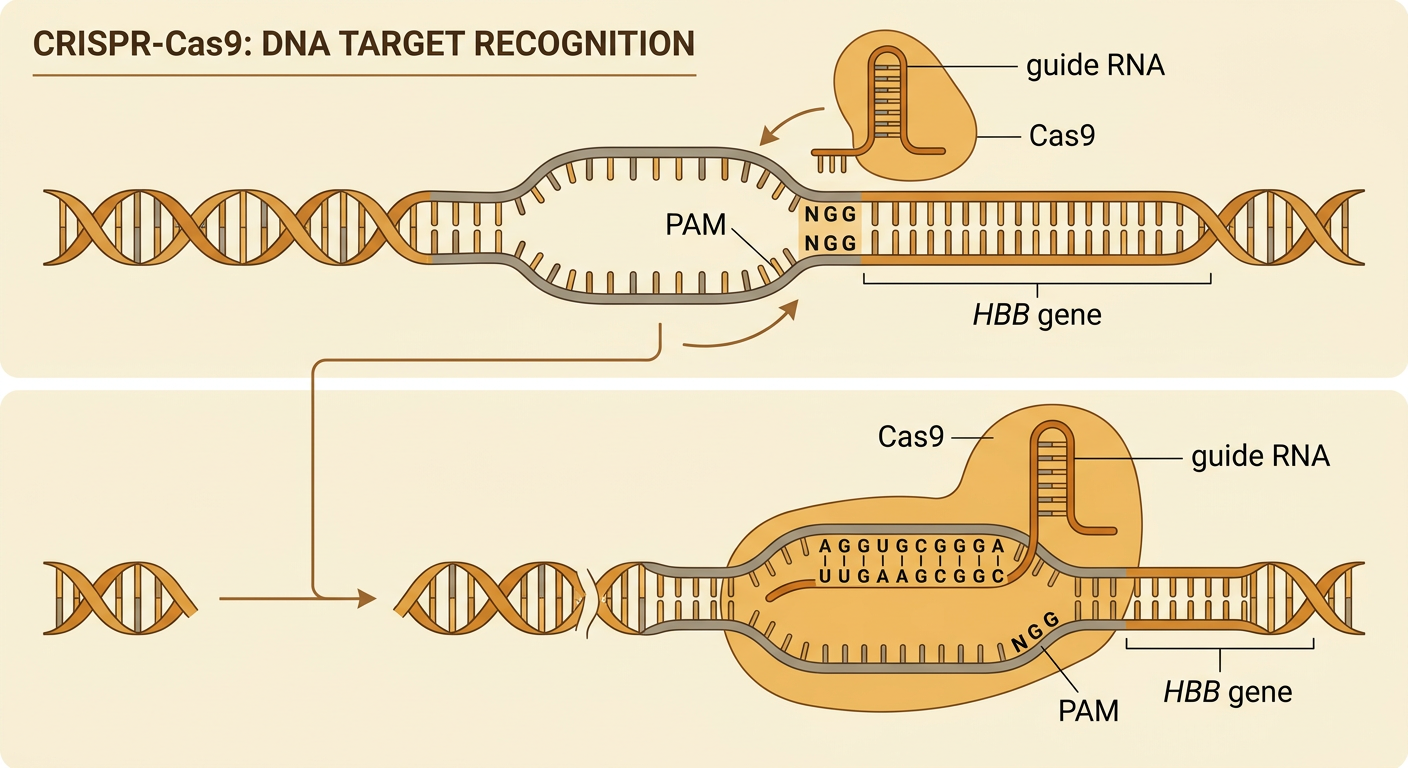
CRISPR-Cas9 editing commonly uses a guide RNA and the Cas9 protein. Part of the guide RNA is designed to be complementary to a chosen DNA sequence. The guide brings Cas9 to DNA, but Cas9 binds and cuts efficiently only when a nearby protospacer adjacent motif, or PAM, is present. For the widely used SpCas9 enzyme, the PAM is usually NGG, where N can be any DNA base. Cas9 first recognizes the PAM and then checks whether the neighboring DNA closely matches the guide. A strong match allows the guide RNA to pair with one DNA strand. For example, researchers might design a guide to recognize a sequence near a disease-causing variant in the HBB gene. Target recognition alone does not determine the final edit; it positions Cas9 for the next step.
DNA Cutting and Cellular Repair
After target recognition, Cas9 cuts both DNA strands, usually a few bases from the PAM. The cell then repairs the double-strand break. Nonhomologous end joining, or NHEJ, reconnects the broken ends but may add or remove bases. These insertions or deletions can disrupt a gene by changing its reading frame. Homology-directed repair, or HDR, can make a more precise change when a repair template with matching DNA regions is available, although HDR is often less efficient and depends on cell type and cell-cycle stage. For example, an NHEJ edit could disable a receptor gene used by a virus, while HDR could replace a disease-associated DNA base with a different base. If an edit occurs in a sperm, egg, or early embryo and contributes to reproductive cells, the resulting variation may be inherited by future generations.

Intended Edits and Off-Target Effects
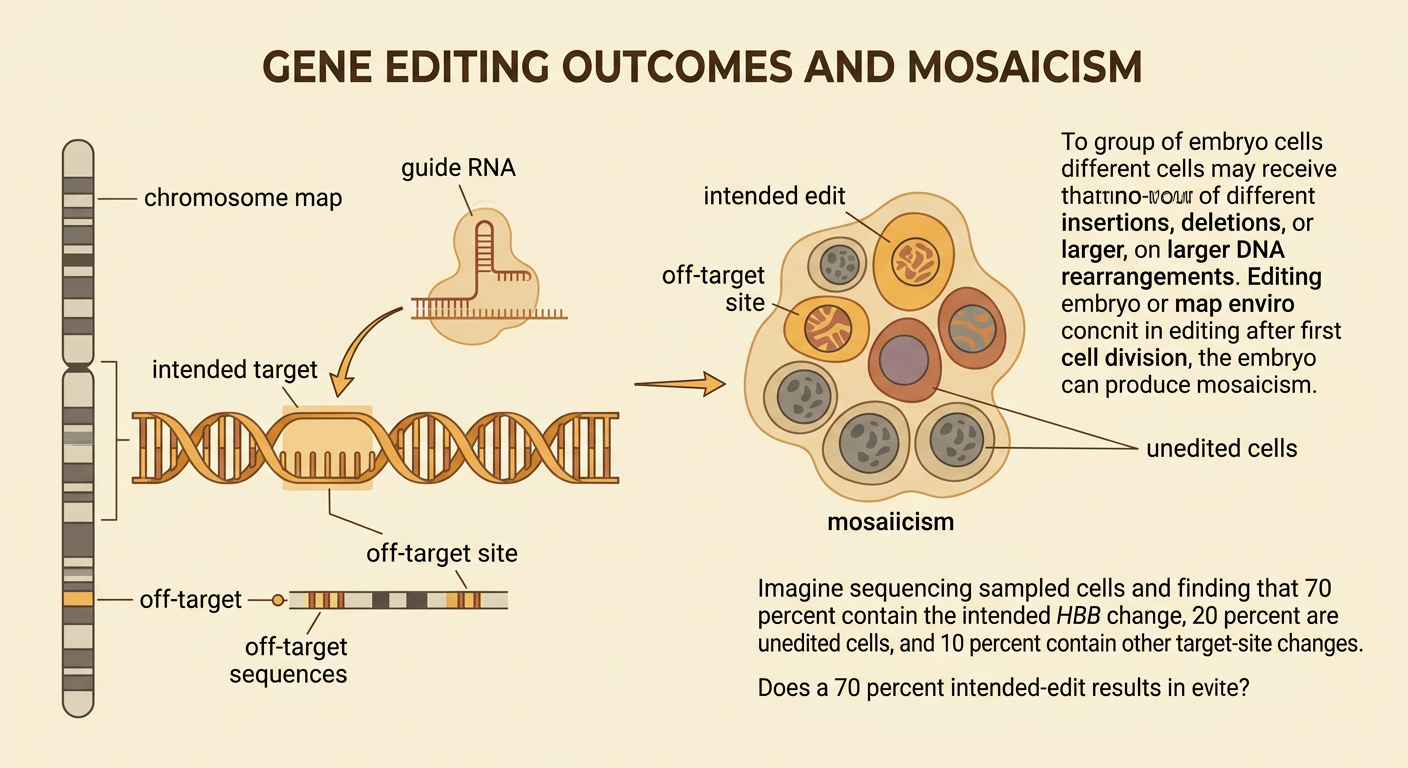
An intended edit occurs at the selected DNA target and produces the planned sequence change or gene disruption. However, Cas9 may also cut at off-target sites whose sequences are similar to the guide RNA. Repair at those sites can create unintended mutations. Even at the intended site, cells may develop different insertions, deletions, or larger rearrangements. In an early embryo, editing after the first cell division can cause mosaicism, meaning that some cells carry an edit while others do not. For example, sequencing might show that 70 percent of sampled cells contain the intended HBB change, 20 percent remain unedited, and 10 percent contain other changes at the target. Researchers must also screen predicted and unexpected off-target locations. Evidence of target editing alone is therefore insufficient to establish that a procedure is effective or safe.
Interpreting Gene-Editing Data
Gene-editing claims should be evaluated using sample size, comparison groups, outcome definitions, uncertainty, and measurement methods. Suppose a report states that 108 of 180 treated samples had the intended edit, giving an observed rate of 60 percent. If 27 samples also had a detected off-target change, the observed off-target rate is 15 percent. These categories may overlap, so the percentages should not automatically be subtracted from one another. Students should ask whether untreated controls were sequenced, whether all samples were analyzed, and whether confidence intervals were reported. They should also compare multiple technical sources because different sequencing methods have different detection limits. Targeted sequencing can miss unexpected sites, while broader genome sequencing may still miss rare variants. A strong conclusion identifies these limitations instead of treating one percentage as proof of safety or effectiveness.

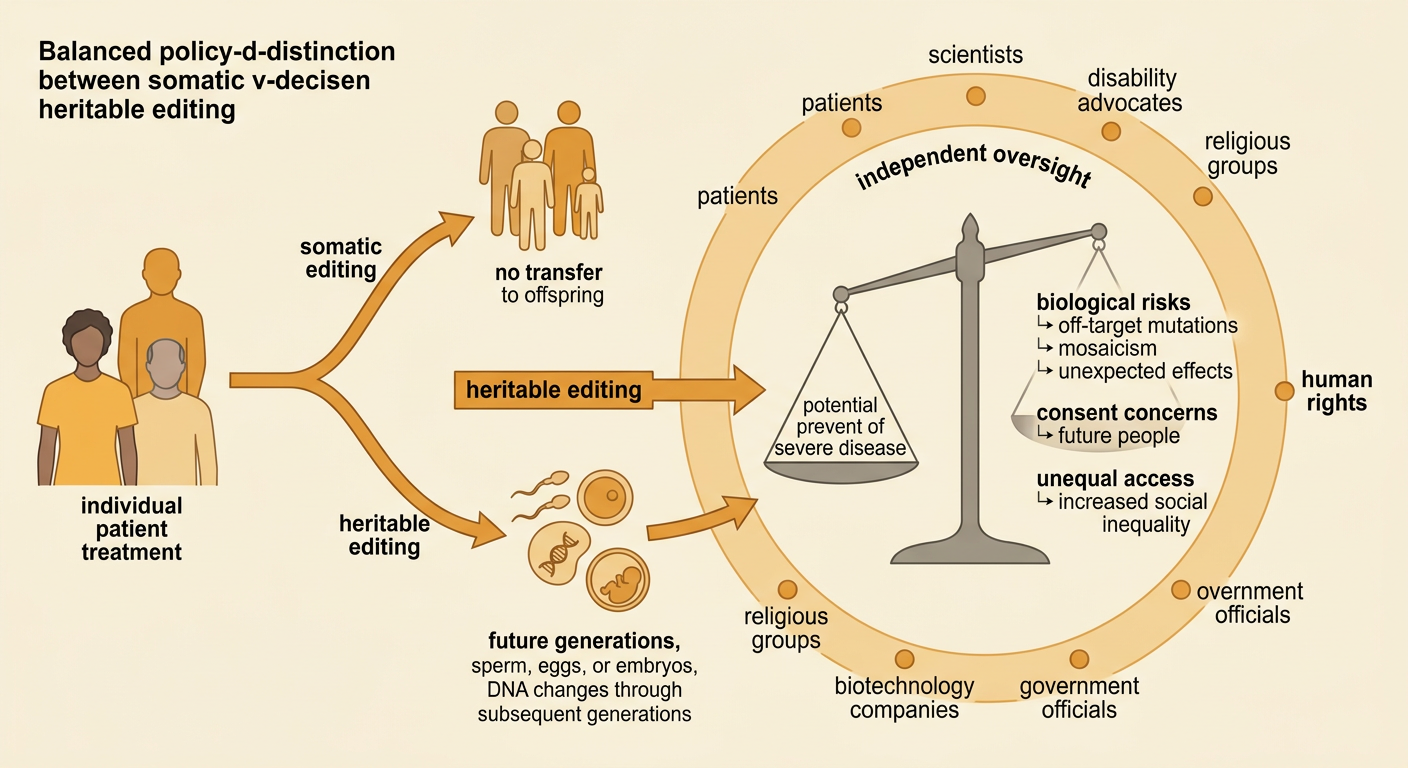
Heritable Editing: Benefits, Risks, and Policy
Heritable gene editing changes sperm, eggs, or embryos in ways that may pass to future generations. A possible benefit is preventing a severe single-gene disorder when safer reproductive options cannot achieve that goal. Risks include off-target mutations, mosaicism, unexpected effects of the intended change, and consequences that may appear only after many years or generations. Future people cannot consent to changes that affect them, and unequal access could deepen social inequality. In a public policy hearing, patients, scientists, disability advocates, religious groups, biotechnology companies, and government officials may weigh these concerns differently. An evidence-based policy might permit carefully monitored somatic editing, which affects only the treated person, while pausing clinical heritable editing until safety, medical necessity, oversight, transparency, and broad public agreement meet defined standards. Democratic decisions should consider scientific evidence together with human rights and competing public interests.