
Decompose Numbers Within 10
Students use counters and drawings to break a number within 10 into two smaller parts in multiple ways.
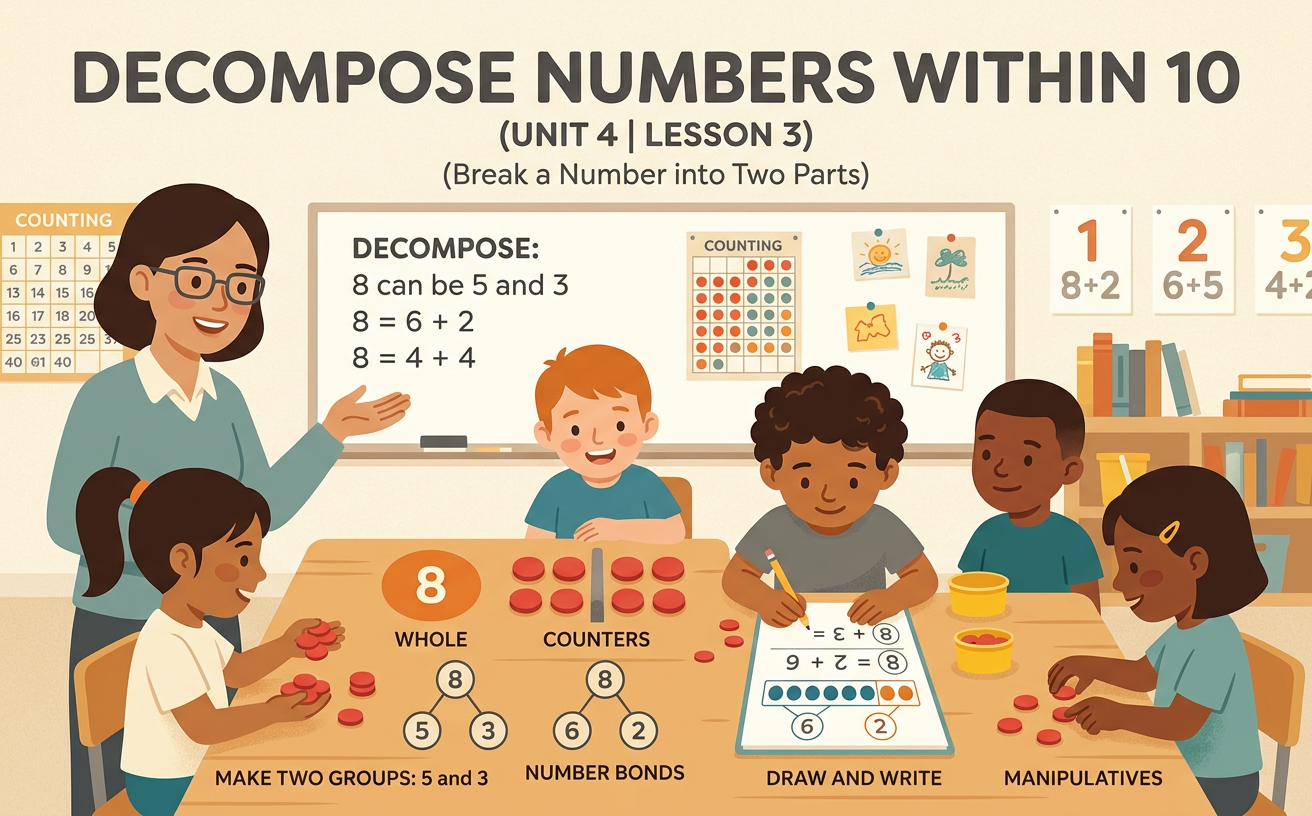
Illustrations are auto-generated and may be placeholders. They can be refreshed to match the narration.
Warm-Up with Number Pairs
A number pair is made of two parts that join to make one whole number. Hold up five fingers. Show two fingers on one hand and three fingers on the other hand. The two parts are 2 and 3. Together, they make 5. We can say, “Two and three make five.” Try another pair for 5. Show one finger on one hand and four fingers on the other hand. Now the parts are 1 and 4, but the whole is still 5. Look closely at each pair. The parts can change while the whole stays the same. Practice saying each number pair aloud: 2 and 3 make 5; 1 and 4 make 5.

Build a Number with Counters
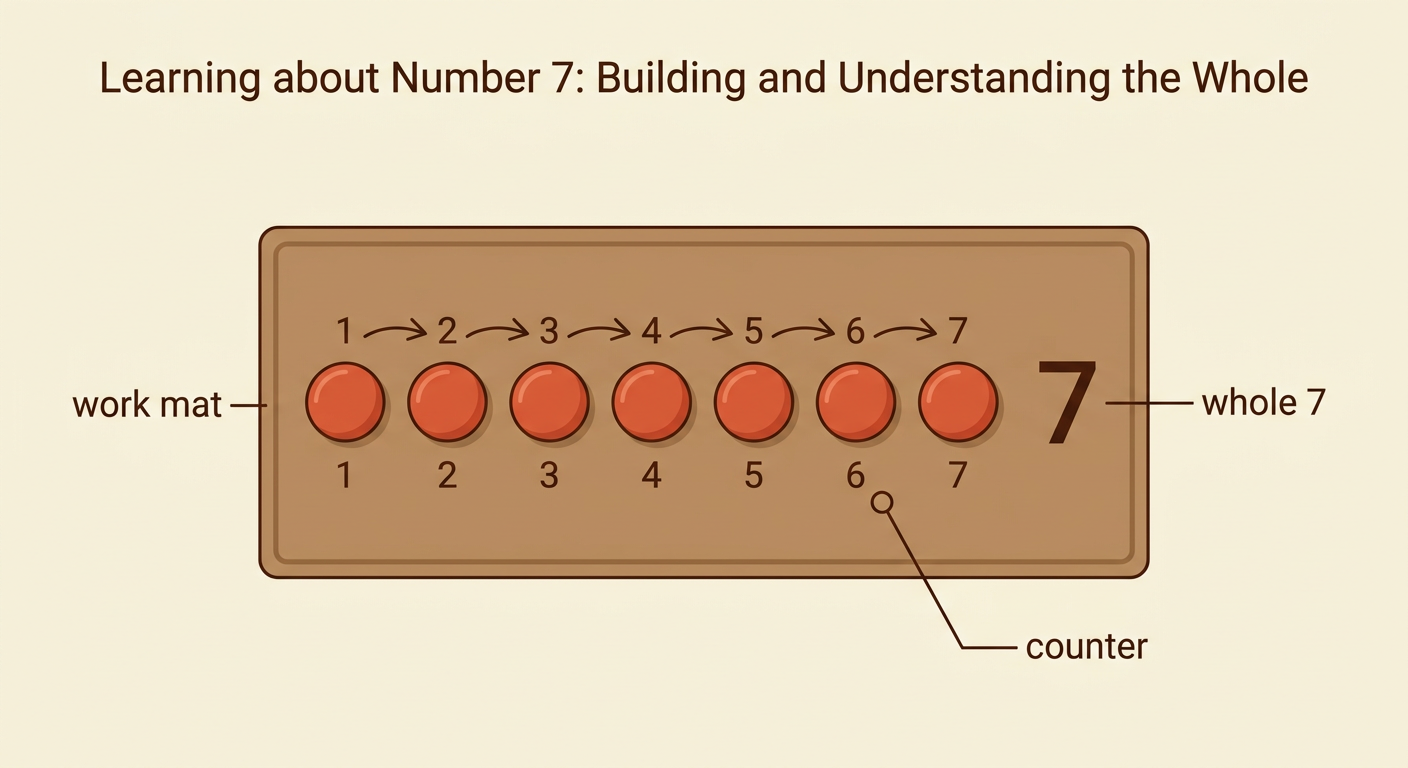
Counters help us see how many objects are in a number. Let us build the number 7. Place one counter at a time on a work mat. Count aloud as you place them: 1, 2, 3, 4, 5, 6, 7. Touch each counter once while you count. Stop when you have seven counters. The complete set is the whole, so the whole number is 7. Check the set by counting the counters again from left to right. You may arrange them in a row or in a group. Moving the counters does not change how many there are. As long as no counters are added or taken away, the whole remains 7.
Break the Set into Two Parts
Now break the set of seven counters into two smaller parts. Slide three counters to the left side of the mat. Slide the other four counters to the right side. Count the left part: 1, 2, 3. Count the right part: 1, 2, 3, 4. The two parts are 3 and 4. Push both parts back together and count all the counters. There are still 7 counters. We did not add or remove any counters; we only separated the whole. We can record the number pair with the equation 3 + 4 = 7. The plus sign means the parts are joined. The equal sign tells us that both sides show the same amount.

Find Another Way
The same whole number can be broken into parts in another way. Start with all seven counters again. This time, move two counters to the left and five counters to the right. Count each part carefully. The parts are 2 and 5, and together they still make 7. Record this way as 2 + 5 = 7. Compare it with 3 + 4 = 7. The pairs are different, but both equations have the same whole. Try one more way by making a group of 1 and a group of 6. This gives 1 + 6 = 7. Each time, check your work by joining the two groups and counting all seven counters.

Draw and Record Number Pairs
You can draw pictures to show number pairs. Let the whole number be 6. First, draw six circles. Color one circle red and five circles blue. The colors show two parts: 1 and 5. Write 1 + 5 = 6 under the drawing. Next, draw another set of six circles. Color two circles red and four circles blue. Write 2 + 4 = 6. For a third way, color three circles red and three circles blue. Write 3 + 3 = 6. Count every drawing to make sure it has six circles altogether. A clear drawing and a matching equation both show how the whole number 6 is decomposed into two smaller parts.
