
Decomposers: Nature’s Matter Recyclers
Students model how fungi, bacteria, and other decomposers break down dead organisms and return matter to the environment for reuse.
Illustrations are auto-generated and may be placeholders. They can be refreshed to match the narration.
What Happens to Dead Matter?
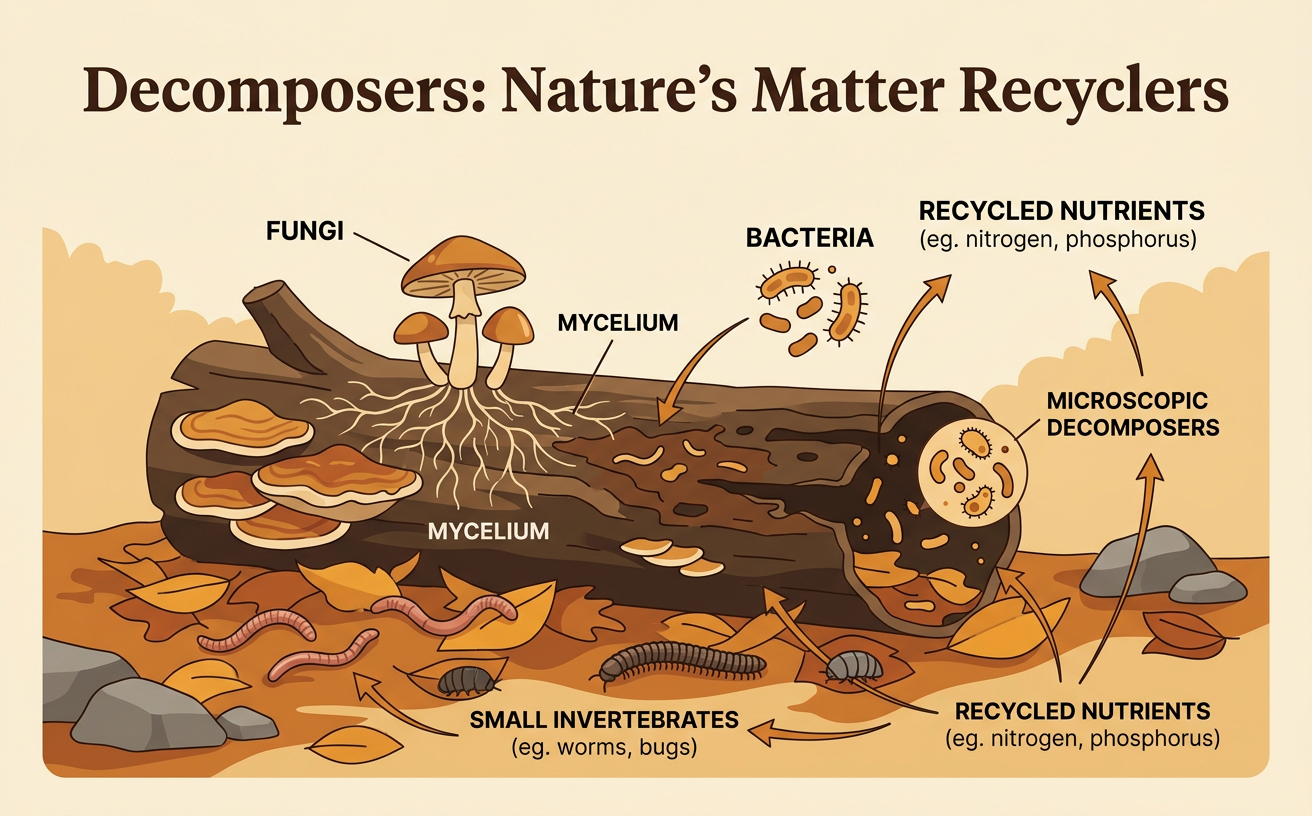
When a plant or animal dies, its matter does not vanish. The remains become dead organic matter, which contains carbon, water, and nutrients such as nitrogen and phosphorus. Fallen leaves, dead roots, animal remains, and waste all become part of this material. Imagine an oak leaf falling onto a forest floor. Rain softens it, small animals tear it into pieces, and microscopic organisms begin using it as food. Over time, the leaf changes into gases, substances in the soil, and matter inside living organisms. Some of its atoms may later become part of a new plant. This movement shows that matter is conserved: it changes form and location, but it continues to exist in the environment.

Meet the Decomposers
Decomposers are organisms that obtain energy by breaking down dead organic matter and wastes. Fungi and bacteria are the main decomposers in most ecosystems. A fungus may grow threadlike structures through a rotting log, while bacteria too small to see work on its damp surface. Earthworms, millipedes, and some insects are detritivores. They eat or shred dead material into smaller pieces, making more surfaces available to fungi and bacteria. Together, these organisms form a cleanup and recycling team. For example, mushrooms on a stump are the visible parts of fungi working throughout the wood. Decomposers do not create matter from nothing. They take in matter, use some to build their bodies, and release other matter back into the environment.

Breaking Down Organic Material
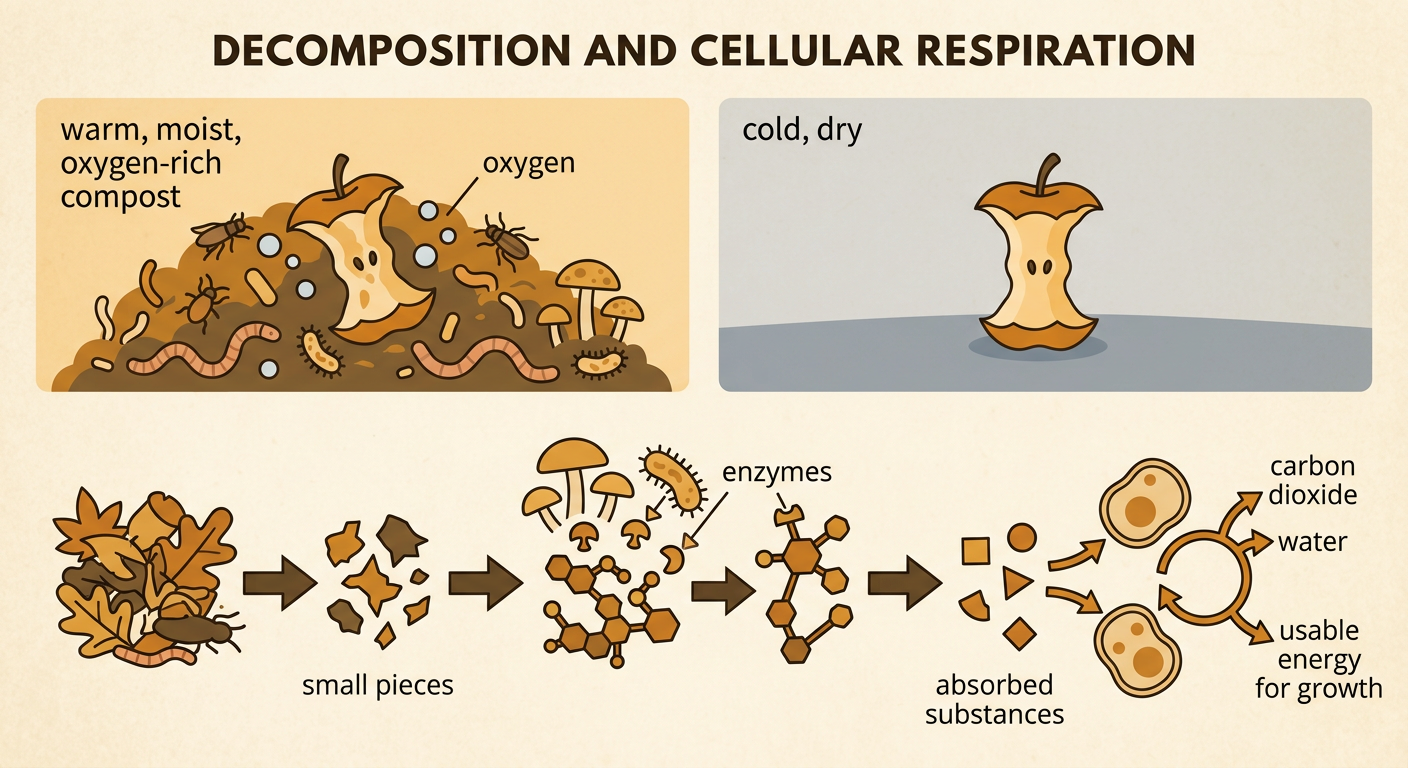
Decomposition happens in steps. First, detritivores and weather may break dead material into smaller pieces. Next, fungi and bacteria release special chemicals called enzymes onto the material. Enzymes break large organic molecules into smaller substances that decomposers can absorb. The organisms use some of this matter and energy to grow and carry out life processes. During cellular respiration, decomposers also release carbon dioxide and water. Warmth and moisture usually help decomposition happen faster because decomposers need suitable conditions. A damp apple core in a warm compost pile may soften and break down quickly. The same apple core would decompose much more slowly in a cold, dry place. Size, temperature, moisture, and oxygen can all affect the rate of decomposition.
Returning Nutrients to the Environment
As decomposers break down dead matter, they return materials to the soil, water, and air. Mineral nutrients, including forms of nitrogen and phosphorus, can remain in the soil or dissolve in water. Plant roots absorb these substances and use them to build new tissues. Decomposers also release carbon dioxide during cellular respiration. Plants take in carbon dioxide during photosynthesis and use its carbon to make sugars. For example, nutrients from a decomposed grass clipping may enter the soil, be absorbed by a tomato plant, and become part of a new leaf or tomato. Animals may then eat the plant, moving that matter again. Energy flows through an ecosystem and is eventually released as heat, but matter is repeatedly moved and reused.

Modeling the Matter Cycle
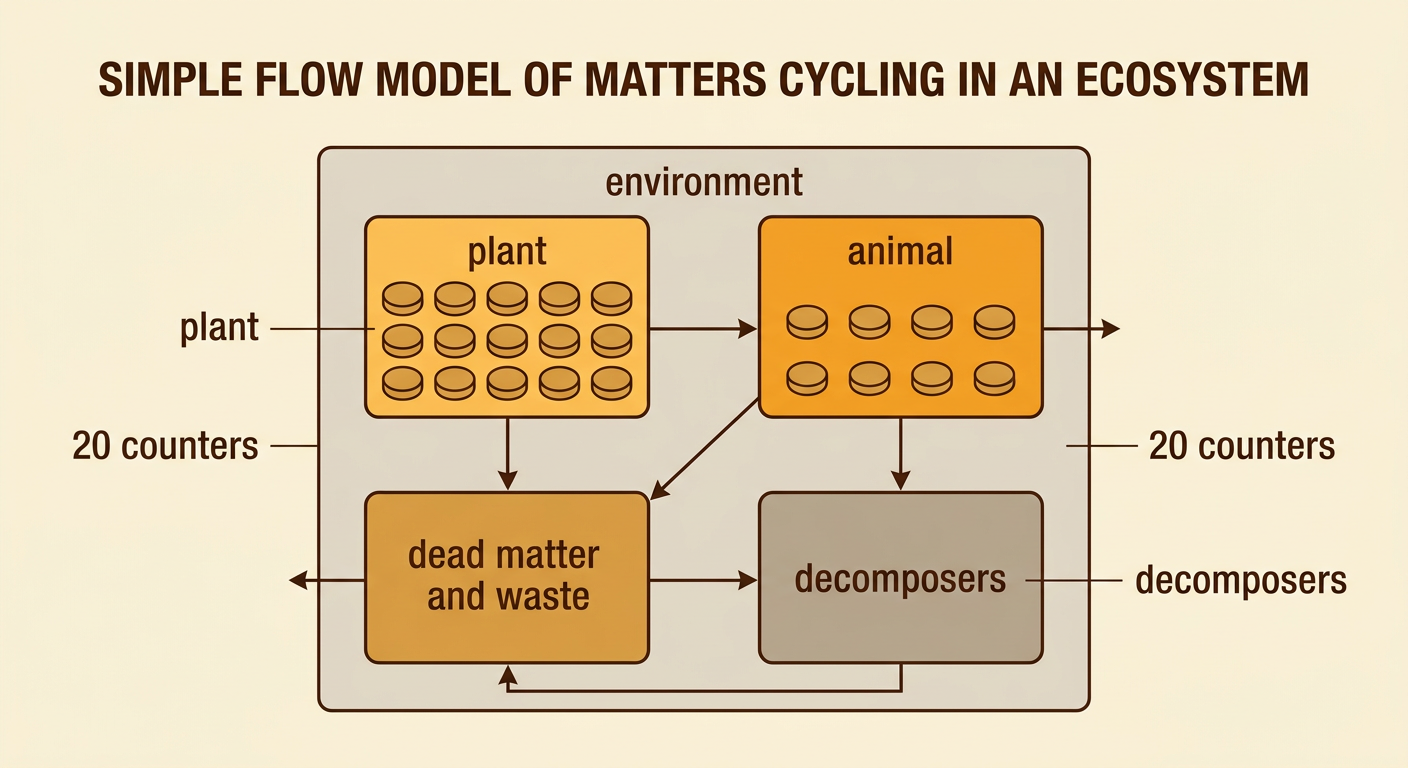
A model uses objects, numbers, and arrows to explain how matter moves. Begin with 20 counters representing units of matter in a plant. If an animal eats part of the plant, move 8 counters to the animal while 12 remain in the plant. Later, when plant parts, animal waste, or the animal itself become dead matter, move those counters to the dead-matter box. Decomposers take in the counters from that box. Then counters can move to decomposer bodies or to the environment as gases, water, and mineral nutrients. No counters should be thrown away because the model represents conservation of matter. Real ecosystems are more complex, but this model helps show the important relationships among organisms, decomposers, and the environment.
Composting and Human Communities
Composting is a human-managed form of decomposition. People collect food scraps, dry leaves, and grass clippings so decomposers can turn them into a dark, soil-like material called compost. A healthy compost pile needs a balance of moist green materials, dry brown materials, air, and water. Turning the pile adds oxygen and mixes its contents. For example, a school might compost fruit peels from the cafeteria and use the finished compost in a garden. This can reduce the waste sent to a landfill and return nutrients to local soil. Human choices also affect environmental systems: piles that are too wet may smell, and harmful materials can contaminate compost. Climate, available land, community rules, and transportation influence how people compost in different places.
