
Democracy, Disinformation, and Social Media Regulation
Students analyze evidence about online disinformation and compare policy responses while weighing free expression, public accountability, and democratic participation.

Illustrations are auto-generated and may be placeholders. They can be refreshed to match the narration.
Defining Disinformation
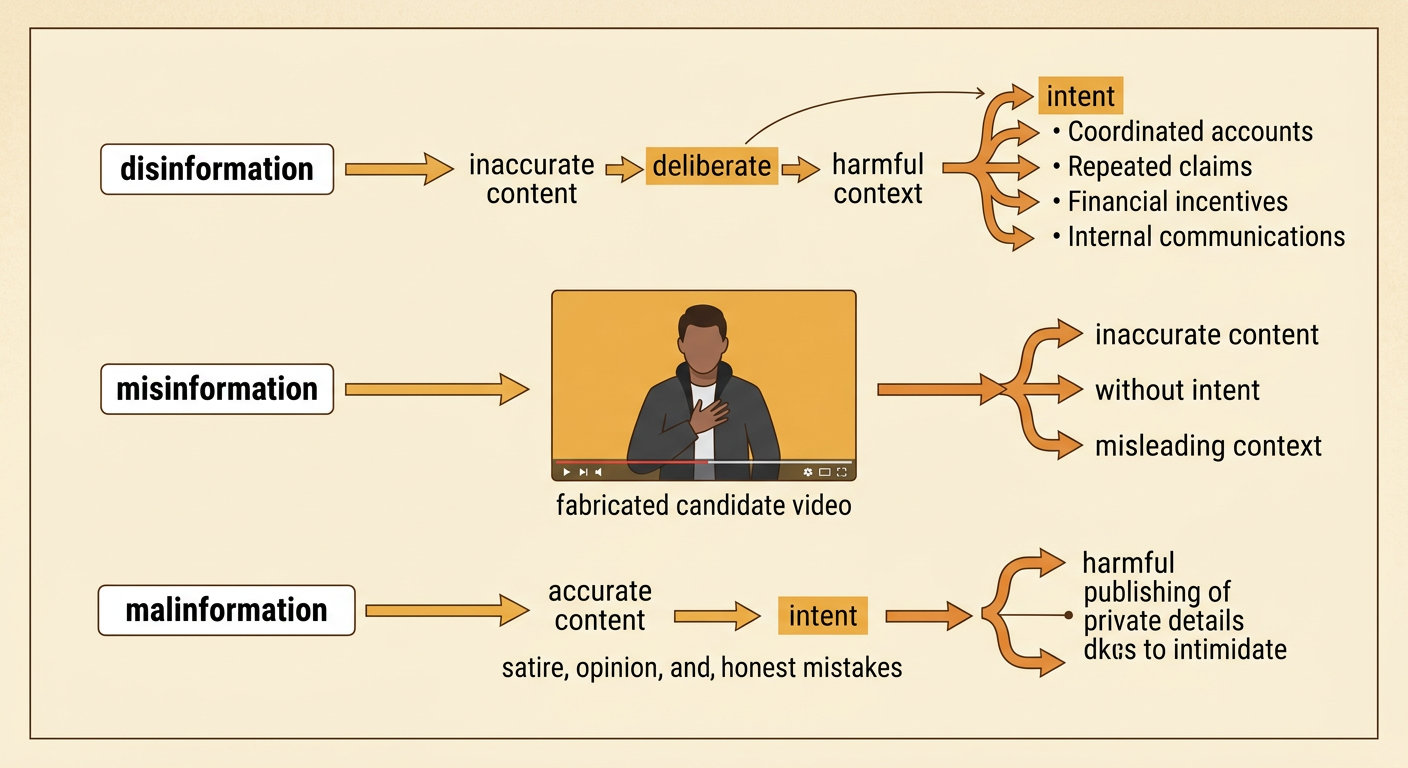
Disinformation is false or misleading content created or distributed deliberately to deceive. It differs from misinformation, which is inaccurate content shared without an intent to mislead. Malinformation uses genuine information in a misleading or harmful context, such as publishing private details to intimidate someone. Intent can be difficult to prove, so researchers examine evidence such as coordinated accounts, repeated false claims, financial incentives, and internal communications. For example, a fabricated video might falsely show a candidate admitting to a crime. A person who knowingly creates the video spreads disinformation; a voter who believes it and reposts it may spread misinformation. Satire, opinion, and honest mistakes are not automatically disinformation. Careful classification matters because an overly broad definition could suppress legitimate debate, while an overly narrow one could leave organized deception unaddressed.
Interpreting Evidence About Online Content
Evaluating online content requires combining sources in different formats, including posts, videos, survey results, platform reports, and independent research. Categorical data can be summarized in a two-way frequency table. Suppose researchers examine 200 posts: 40 are flagged as misleading and 160 are not. Of the flagged posts, 24 are shared and 16 are not; of the unflagged posts, 48 are shared and 112 are not. The relative sharing frequencies are 24 divided by 40, or 60 percent, for flagged posts and 48 divided by 160, or 30 percent, for unflagged posts. This sample shows an association between the flag category and sharing, but it does not prove that a label caused users to share. Researchers must also examine sampling methods, definitions, time periods, missing data, and possible automated accounts before drawing conclusions.

Government, Platforms, and Citizens
Government, social media platforms, and citizens have distinct but overlapping responsibilities in a democracy. Government can enforce laws, protect elections, release accurate public information, and require lawful transparency, but it must respect constitutional limits. Platforms can establish community rules, label content, adjust recommendation systems, publish data, and provide appeals. Citizens can verify sources, correct mistakes, report coordinated deception, and participate without harassing others. Each group also has interests and perspectives that affect its choices. For example, when a false rumor gives the wrong election date, election officials can publish the correct date, platforms can reduce the rumor's visibility and link to official information, and citizens can avoid reposting it. A candidate may favor rapid removal, while a civil liberties group may emphasize due process. Democratic accountability requires examining how these interests shape participation and policy.

Free Speech and Regulatory Trade-Offs
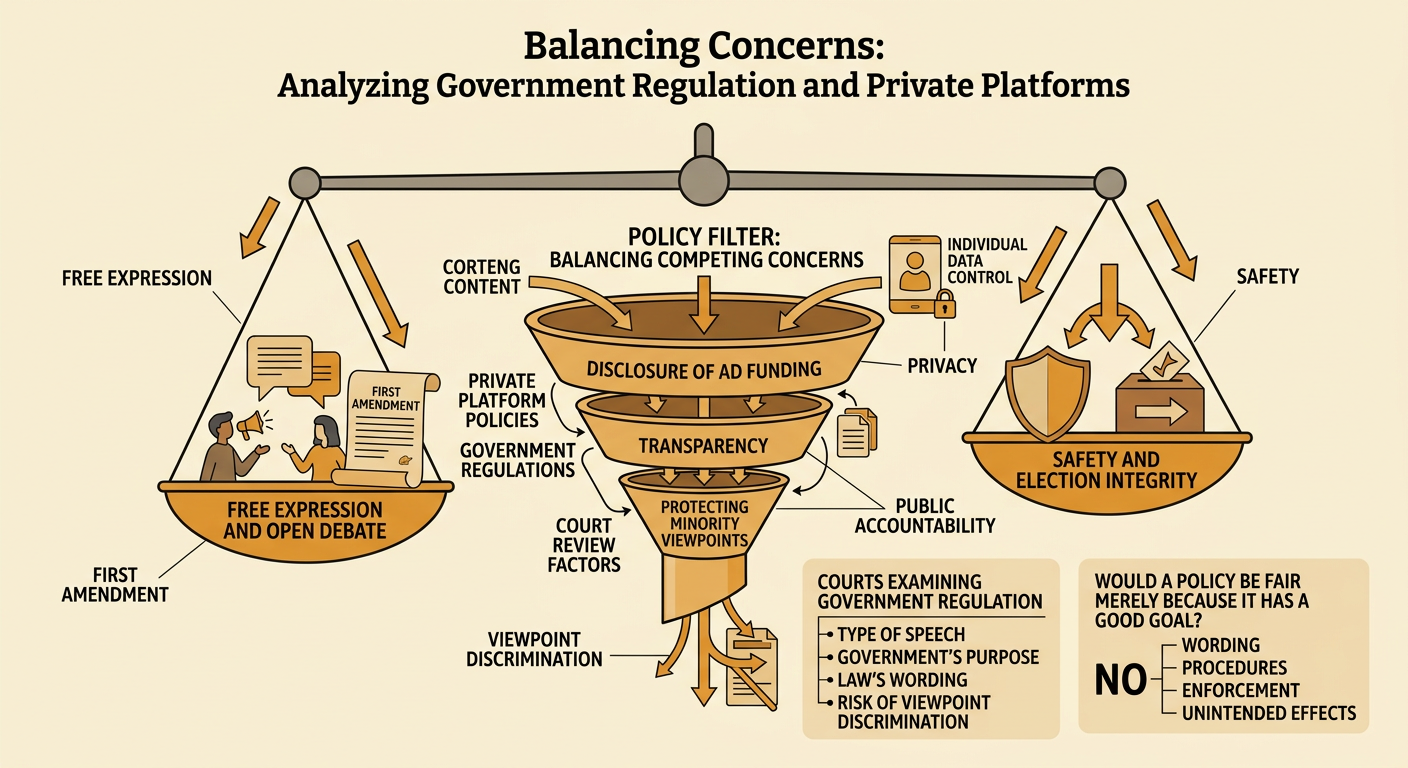
In the United States, the First Amendment generally restricts government action against speech; it does not require a private social media company to host every post. Even government regulation of speech is not judged by one simple rule. Courts consider factors such as the type of speech, the government's purpose, the law's wording, and the risk of viewpoint discrimination. Policies intended to reduce disinformation can therefore produce trade-offs among safety, free expression, privacy, fairness, and public accountability. For example, a law requiring platforms to disclose who paid for online political advertisements may improve transparency without banning the message. However, a vague rule requiring removal of all “harmful falsehoods” could encourage platforms to suppress satire, disputed claims, or minority viewpoints. Effective policies should use clear definitions, notice, appeals, independent oversight, and regular review to reduce errors and prevent abuse.
Comparing Policy Options
Policy choices can be compared through prioritized criteria rather than a single goal. Consider three options: public media-literacy programs, platform transparency and independent audits, and mandatory removal of defined false content. An illustrative decision matrix weights free expression at 30 percent, effectiveness at 30 percent, accountability at 25 percent, and feasibility at 15 percent. On a five-point scale, media literacy might score 5, 3, 3, and 4, producing 3.75. Transparency and audits might score 4, 4, 5, and 3, producing 4.10. A removal mandate might score 2, 4, 3, and 2, producing 2.85. These scores are not facts; they represent judgments that must be supported with evidence. Changing the weights or evidence may change the result. Decision makers should also test unintended effects, such as unequal enforcement, excessive compliance costs, or reduced access for smaller communities.

Evidence-Based Civic Recommendation
An evidence-based civic recommendation should state a clear claim, cite reliable evidence, explain trade-offs, and address affected perspectives. For example, a student might recommend platform transparency requirements and independent audits, combined with media-literacy education, rather than a broad government removal mandate. The student could cite comparative data on sharing patterns, research on recommendation systems, constitutional analysis, and testimony from election officials, platforms, journalists, and civil liberties advocates. The recommendation should include safeguards: public reporting, privacy protection, notice and appeals, access for qualified researchers, and penalties for falsified reports. It should also propose a limited pilot, measurable outcomes, and a review date. Outcomes might include reduced reach of demonstrably false election information, appeal reversal rates, and differences across demographic groups. Acknowledging uncertainty and personal interests strengthens civic reasoning because it shows why reasonable people may prioritize democratic values differently.
