
Describe How Characters Respond to Events
Students describe a character’s traits, feelings, and actions and explain how the character responds to a major event or challenge.
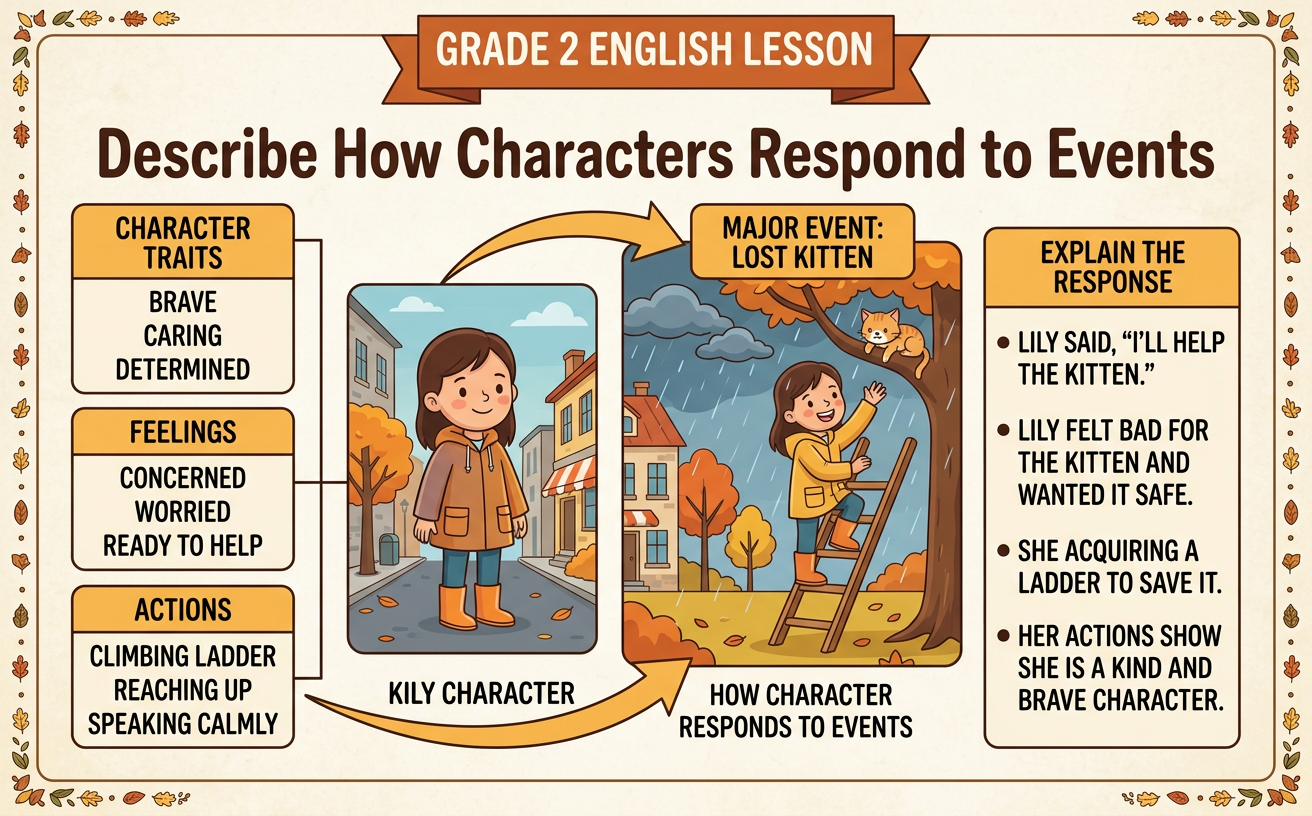
Illustrations are auto-generated and may be placeholders. They can be refreshed to match the narration.
Identify the Main Character
The main character is the person or animal the story is mostly about. This character takes part in the most important events. To find the main character, ask: Who appears often? Who has a problem or goal? Whose actions move the story forward? Imagine a story about Maya entering a kite-flying contest. Maya chooses a kite, practices flying it, and faces a problem when its string breaks. Other people may help her, but the story follows Maya’s experience. Therefore, Maya is the main character. The title or pictures may give you clues, but use details from the whole story to decide. Remember that the main character is not always the first character named. Focus on whom the story follows most closely.
Notice Traits and Feelings
A trait describes what a character is usually like, such as brave, patient, kind, or curious. A feeling tells how the character feels at a certain moment, such as happy, worried, angry, or proud. Traits often stay the same for much of a story, but feelings can change quickly. In the kite story, Maya practices again and again, even when the wind is weak. Her actions show that she is determined. When her kite string breaks before the contest, she feels worried and disappointed. Later, she may feel hopeful after thinking of a solution. Look at the character’s words, thoughts, actions, and facial expressions for clues. Do not simply guess a trait or feeling. Explain which story detail helped you identify it.
Find the Major Challenge
A major challenge is an important problem that the character must face. It affects what happens next and usually requires the character to make a choice or take action. Small details are not always major challenges. For example, Maya’s shoelace coming untied is a minor problem if she quickly ties it. Her kite string breaking before the contest is a major challenge because she cannot fly the kite unless she fixes it. To find the major challenge, ask: What stands in the character’s way? Why does it matter? How does it change the story? Notice signal words such as but, suddenly, or unfortunately. The challenge may come from another character, nature, a mistake, or a difficult situation. State the challenge clearly in one sentence.
Examine the Character’s Response
A character’s response is what the character feels, says, thinks, or does after an event or challenge. Look for actions that happen because of the challenge. When Maya’s kite string breaks, she first feels disappointed. Then she takes a deep breath and examines the string. She asks her grandfather for advice, finds stronger string, and repairs the kite. These actions show that Maya responds calmly and keeps trying. Her response also supports the trait determined. To explain a response, connect the event to the character’s reaction. You might say, “When the string breaks, Maya feels worried, but she asks for help and fixes it.” Do not tell only what happened. Explain how the character reacted and what that reaction shows about the character.
Support Ideas With Evidence
Evidence is a detail from the story that proves an idea about a character. Evidence can come from the character’s words, thoughts, feelings, or actions. First, state your idea. Next, give a specific story detail. Then explain how the detail supports your idea. For example: “Maya is determined. The story says that she searches for stronger string and repairs her kite instead of quitting. This action shows that she keeps working when she faces a challenge.” The detail about repairing the kite is stronger evidence than saying, “Maya is nice,” because it directly supports the trait determined. You may quote exact words from the story or retell the detail in your own words. Always make sure your evidence matches the idea you are explaining.