Describe Positions with Location Words
Students use words such as above, below, beside, in front of, behind, and next to to describe the position of objects in their environment.
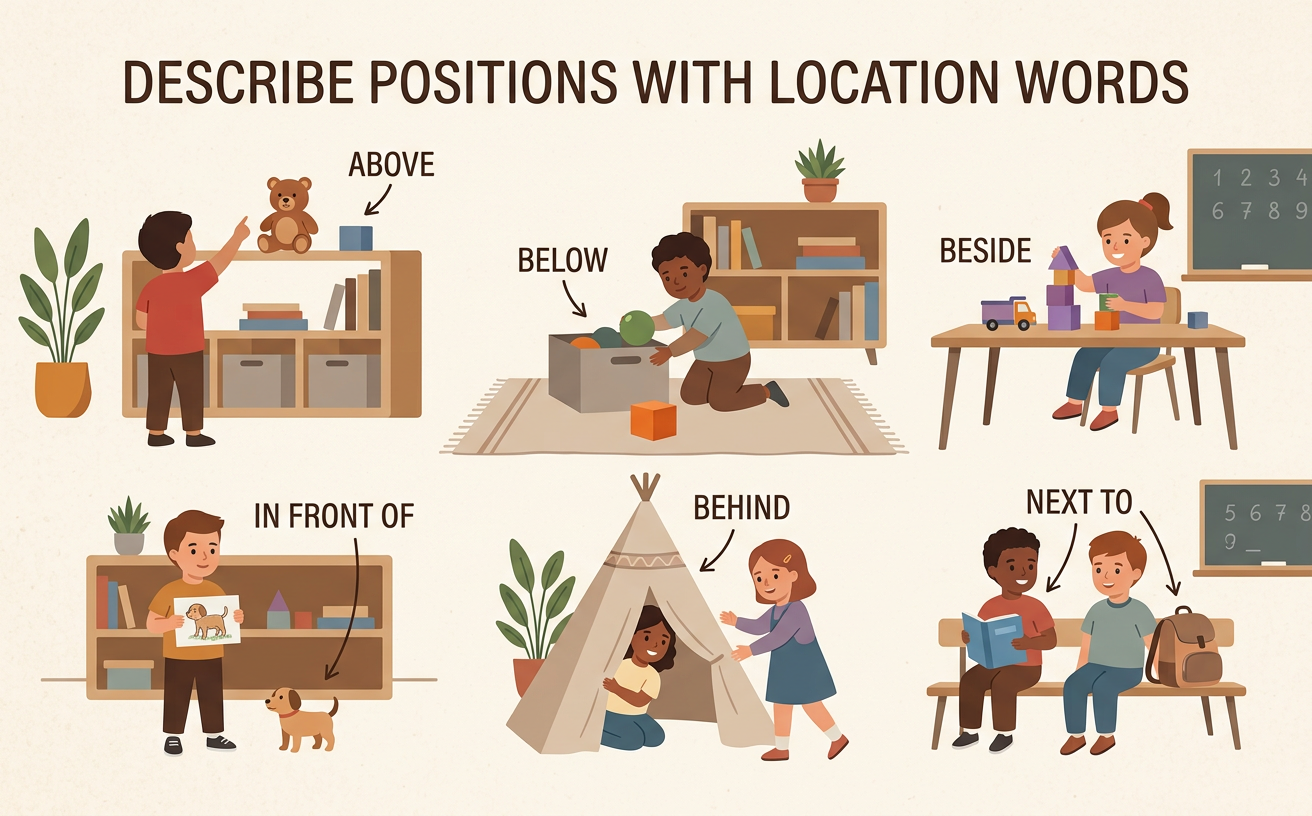
Illustrations are auto-generated and may be placeholders. They can be refreshed to match the narration.
Introduce Location Words
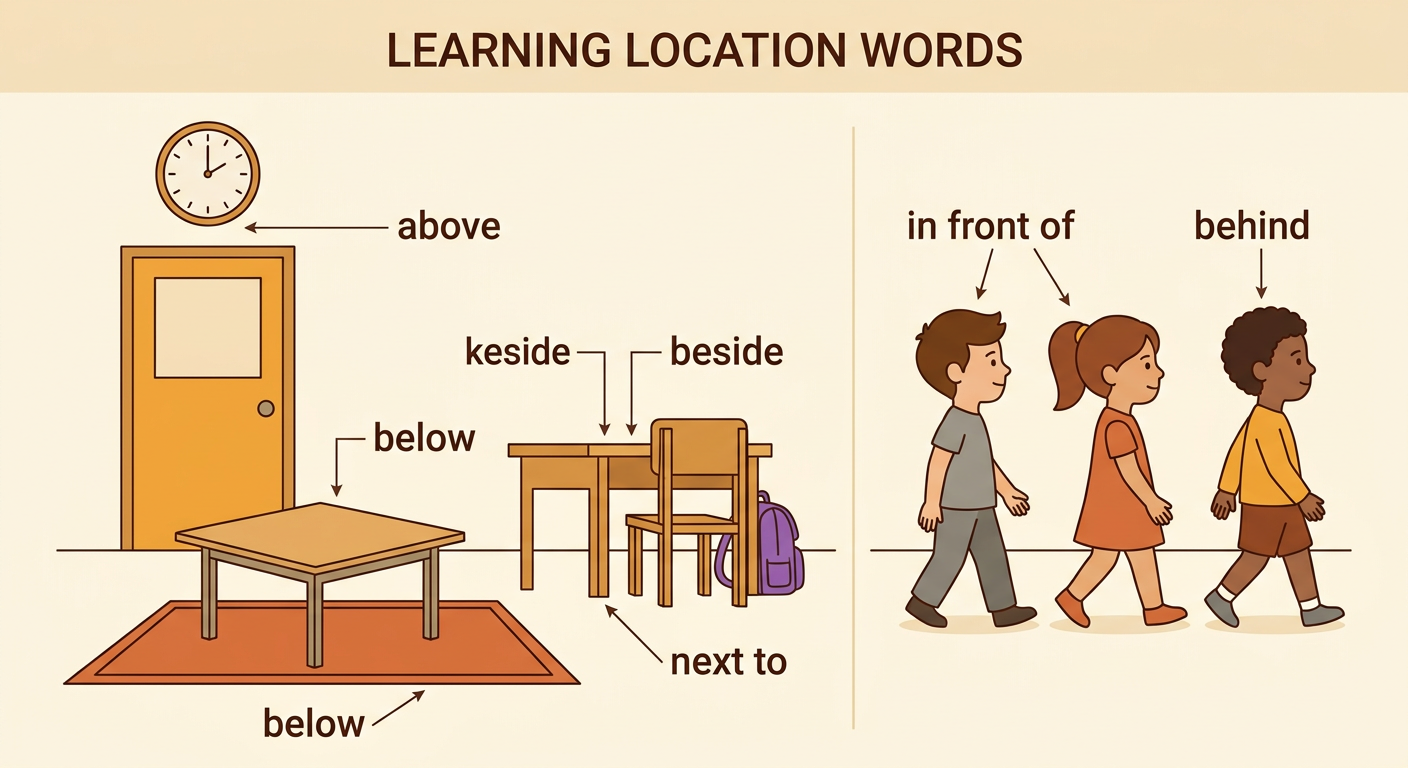
Location words tell where one object is compared with another object. Look around the classroom. A clock may be above the door. A rug may be below a table. A chair may be beside a desk. The word next to also means that something is close by the side of something else. We can say, “The chair is next to the desk.” An object in front of another object is closer to the direction we are looking or moving. An object behind another object is at its back. Location words help us give clear directions and describe what we see. Always name both objects so your listener knows what you mean.
Model Object Positions
We can use shapes and toys to model positions. Place a yellow triangle above a blue square. The square is below the triangle. Put a red circle beside the square. The circle is also next to the square because it is close to the square’s side. Now imagine a toy train and a wagon facing and moving to the right. If the train comes first, the train is in front of the wagon. The wagon is behind the train. Notice that we can describe the same pair in two ways. If the triangle is above the square, then the square is below the triangle. The correct location word depends on which object we name first.

Place Objects by Direction
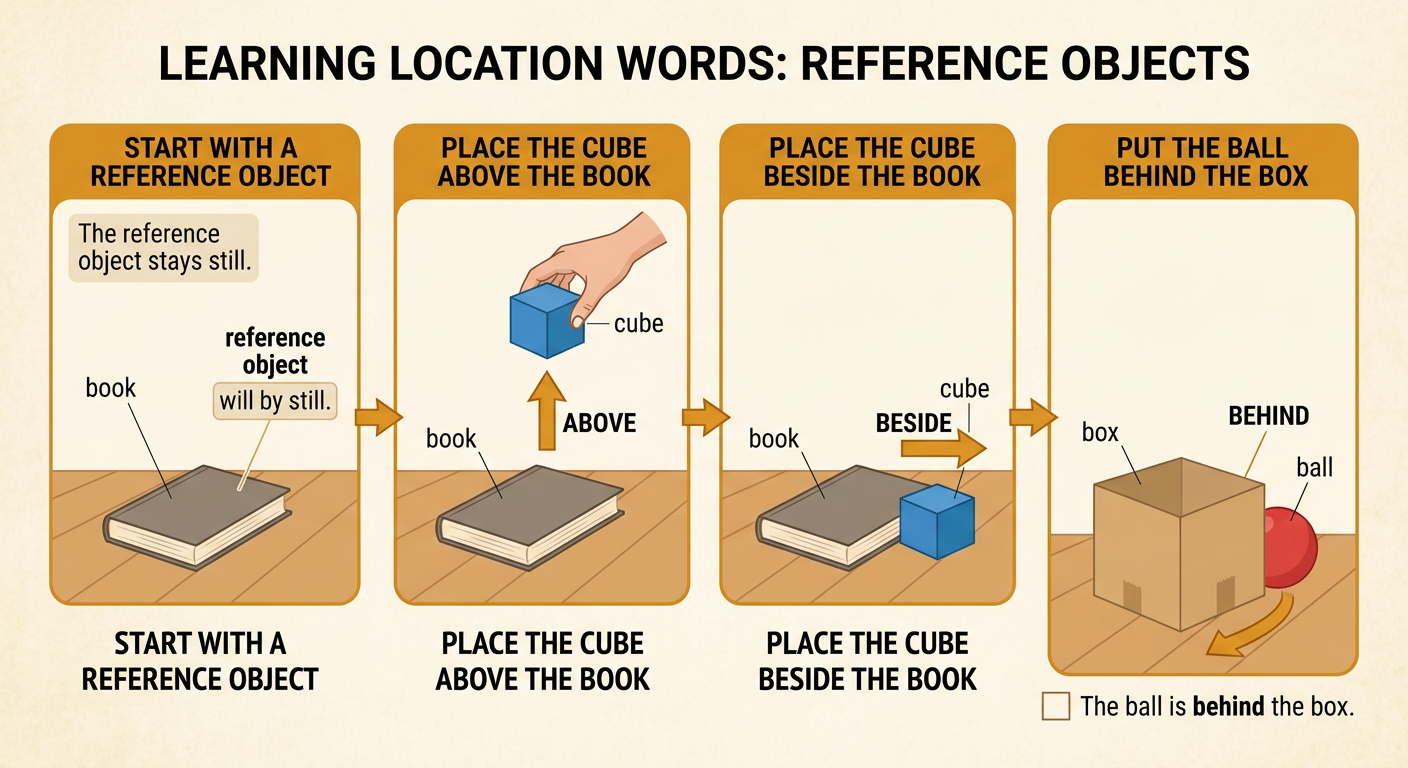
Listen carefully to a direction before moving an object. First, find the object that will stay in place. This is your reference object. Then place the other object where the location word tells you. For example, set a book on the floor. If the direction says, “Place the cube above the book,” hold the cube higher than the book. If the direction says, “Place the cube beside the book,” move it close to one side. Try another direction: “Put the ball behind the box.” Place the ball at the back of the box. After you move each object, check its position and say the complete sentence aloud. This helps you connect the action with the location word.
Describe Where Objects Are
To describe a position, look closely and choose one object as a reference. Then say where another object is compared with it. Use a complete sentence such as, “The star is above the rectangle.” You can often make a second sentence by reversing the objects: “The rectangle is below the star.” In a playground picture, you might say, “The ball is next to the bench,” or “The child is in front of the slide.” More than one true description may be possible. A tree could be beside the slide and behind the child at the same time. Be sure your sentence names the object, uses a location word, and names the reference object. Clear descriptions help others find exactly what you see.

Check Understanding
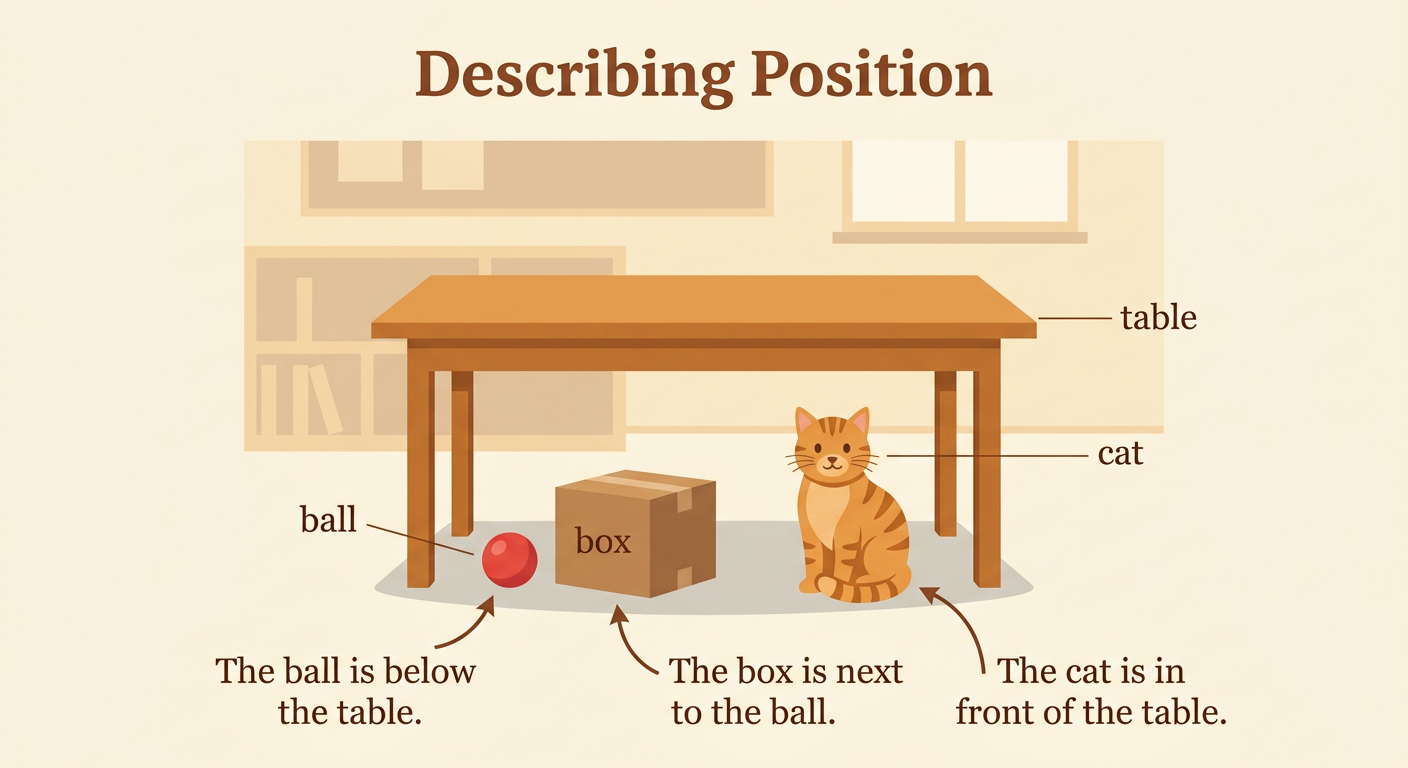
Now check what you know about location words. Look at a picture with a cat, a table, a ball, and a box. The cat is on the floor in front of the table. The ball is below the table. The box is next to the ball. Ask yourself these questions: What is in front of the table? What is below the table? What is next to the ball? Answer with complete sentences: “The cat is in front of the table. The ball is below the table. The box is next to the ball.” Finally, choose two objects near you and describe their positions. Check that you named both objects and used above, below, beside, in front of, behind, or next to correctly.