
Describing Motion with Kinematics
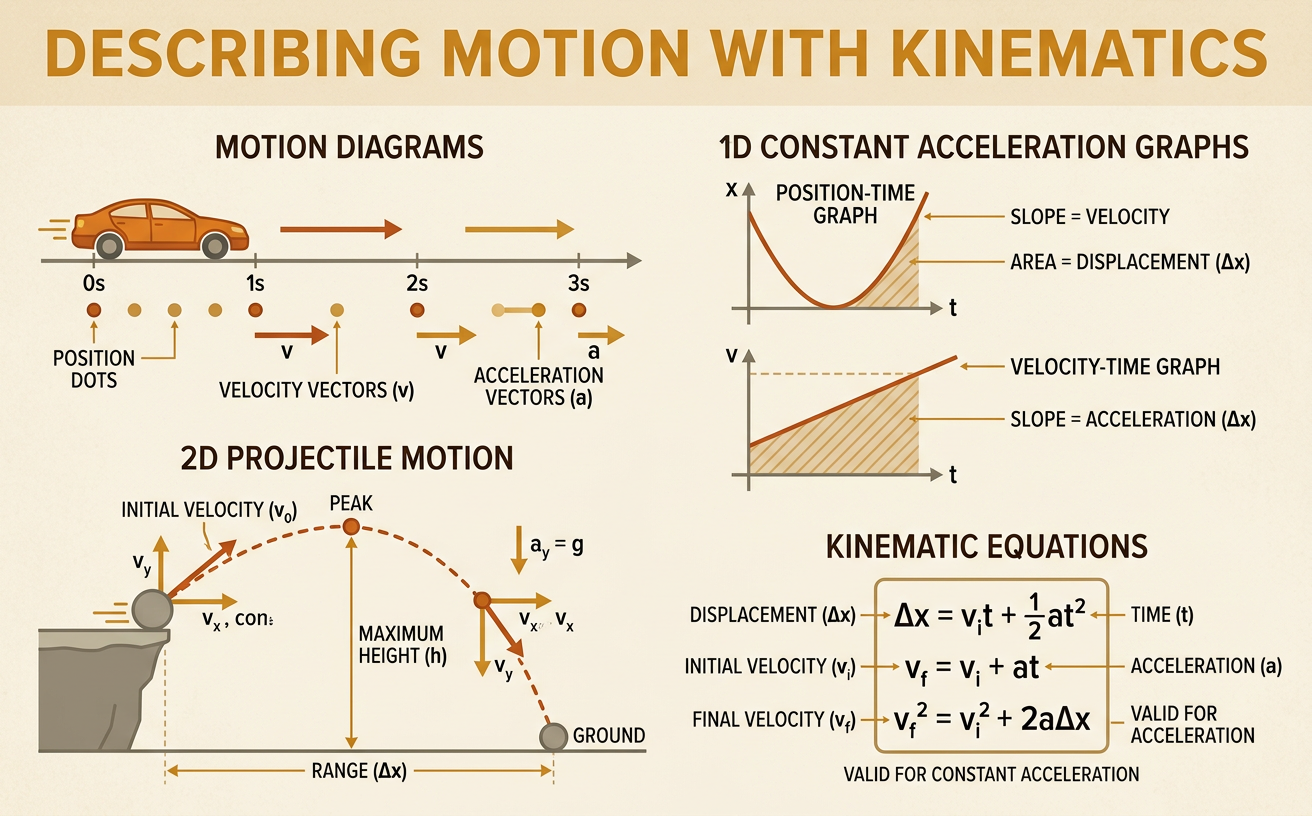
Students use motion diagrams, graphs, vectors, and equations to describe one- and two-dimensional motion with constant acceleration.
Illustrations are auto-generated and may be placeholders. They can be refreshed to match the narration.
Reference Frames and Position
Motion is described relative to a reference frame, which includes an origin, coordinate axes, and a chosen positive direction. An object’s position tells where it is compared with the origin. In one dimension, position can be written as x = +5 m or x = −3 m. The sign indicates the side of the origin, not how far the object has traveled. In two dimensions, a position vector has horizontal and vertical components. For example, suppose a student stands 4 m east and 3 m north of a flagpole chosen as the origin. Using east as positive x and north as positive y, the student’s position is (4 m, 3 m). A person using a different origin would assign different coordinates, although both observers could agree on the student’s motion after accounting for their reference frames.
Distance and Displacement
Distance is the total length of the path an object travels, so it is a scalar and is always nonnegative. Displacement is the change in position from the initial point to the final point, so it is a vector with magnitude and direction. Displacement is calculated as Δx = xfinal − xinitial in one dimension. Suppose a runner moves 100 m east and then 40 m west. The runner’s distance is 140 m because both parts of the path are included. The displacement is 60 m east because the final position is 60 m east of the starting point. Distance and displacement are equal in magnitude only when an object travels in one direction along a straight path without reversing. In two dimensions, displacement is the straight-line vector connecting the initial and final positions, regardless of the route followed.
Velocity and Acceleration
Average velocity is displacement divided by elapsed time: vavg = Δx/Δt. Because velocity is a vector, it describes both speed and direction. Instantaneous velocity gives the velocity at one particular moment. Acceleration describes how velocity changes over time and is calculated as aavg = Δv/Δt. An object accelerates when its speed changes, its direction changes, or both. For example, a car traveling east increases its velocity from 10 m/s to 22 m/s in 4 s. Its average acceleration is (22 − 10)/4 = 3 m/s² east. If the car is moving east but has acceleration directed west, its eastward velocity decreases. In two-dimensional motion, velocity and acceleration can be separated into independent x- and y-components. A projectile, for example, has horizontal velocity while gravitational acceleration acts vertically downward.
Interpreting Motion Graphs
Motion graphs represent the same movement in different ways. On a position-time graph, the slope equals velocity. A straight rising line shows constant positive velocity, while a curve that becomes steeper shows increasing velocity. On a velocity-time graph, the slope equals acceleration, and the signed area between the graph and the time axis equals displacement. On an acceleration-time graph, the signed area equals the change in velocity. Consider an object whose velocity increases uniformly from 0 m/s to 12 m/s during 4 s. The velocity-time graph is a straight rising line, so the acceleration is 12/4 = 3 m/s². The displacement is the triangular area under the line: one-half times 4 s times 12 m/s, or 24 m. Portions below a time axis represent negative velocity or negative signed area, not automatically slowing down.
Constant-Acceleration Equations
When acceleration is constant, position, displacement, velocity, acceleration, and time are related by several kinematic equations. Useful forms are v = v0 + at, Δx = v0t + ½at², v² = v0² + 2aΔx, and Δx = ½(v0 + v)t. Choose an equation containing the known quantities and the desired unknown, and assign signs according to the coordinate system. For example, a bicycle starts at 2 m/s and accelerates at 1.5 m/s² for 4 s. Its final velocity is v = 2 + (1.5)(4) = 8 m/s. Its displacement is Δx = (2)(4) + ½(1.5)(4²) = 20 m. For two-dimensional projectile motion, apply the equations separately to x and y. Neglecting air resistance, horizontal acceleration is zero and vertical acceleration is −9.8 m/s² when upward is positive.