
Describing Shapes and Objects by Position
Students use spatial words to describe where objects and shapes are located in the classroom, pictures, and simple arrangements.

Illustrations are auto-generated and may be placeholders. They can be refreshed to match the narration.
Above and Below
Position words explain where one object is compared with another object. Above means higher than something, while below means lower than something. Look around the classroom for examples. A clock may be above the whiteboard, and a bookshelf may be below a window. Place a triangle card above a circle card and ask students to describe both positions. They can say, “The triangle is above the circle,” and, “The circle is below the triangle.” Both statements describe the same arrangement from different viewpoints. Students can follow directions by placing a cube above a square on a work mat. Using the named objects in each sentence makes the position clear.
Beside and Next To
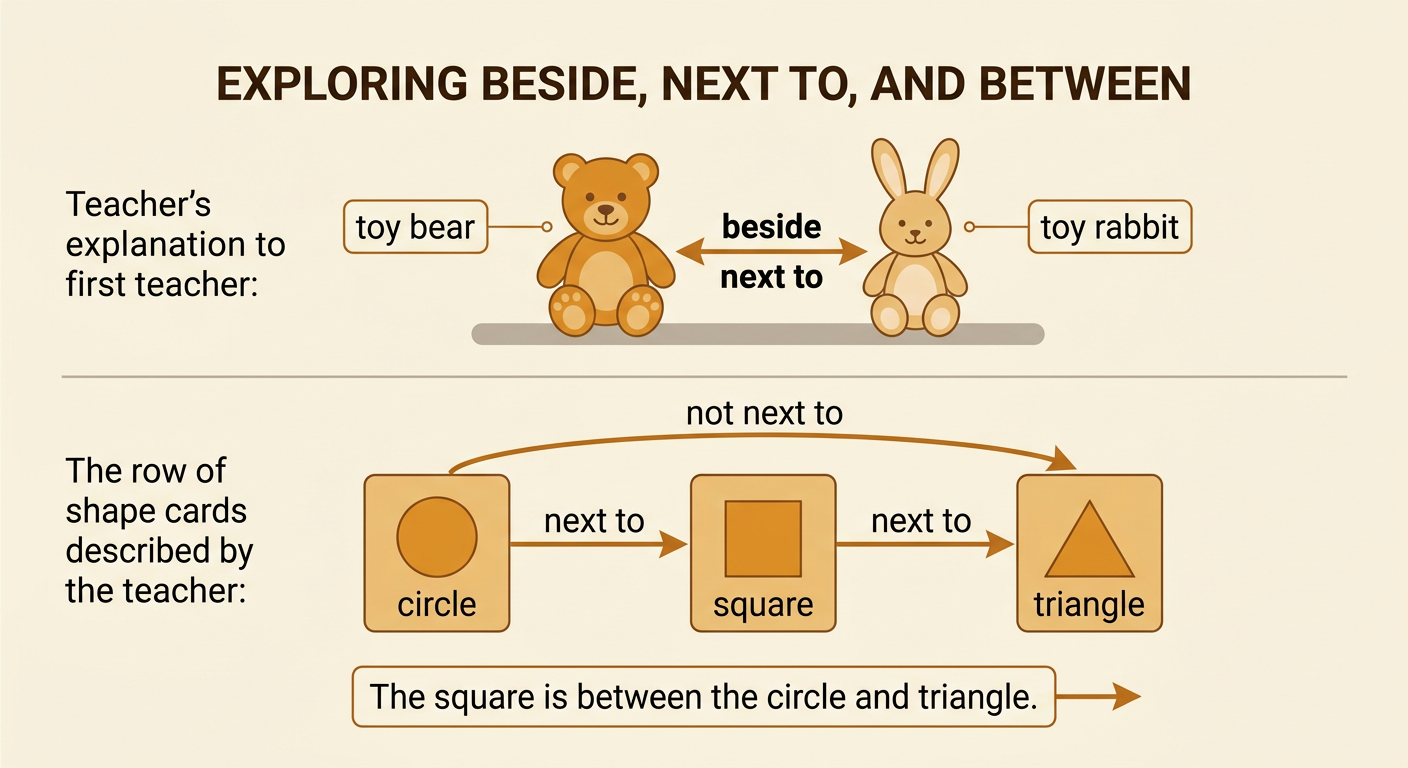
Beside and next to mean that objects are near each other on the same side-to-side level. Seat a toy bear beside a toy rabbit. Students can say, “The bear is next to the rabbit,” or, “The rabbit is beside the bear.” These position words usually work in either direction because each object is beside the other. Arrange three shape cards in a row: circle, square, triangle. The square is next to both the circle and the triangle, but the circle is not next to the triangle because the square is between them. Students can place classroom objects beside one another and explain the arrangement with a complete sentence.
In Front Of and Behind
In front of and behind describe positions from front to back. Place a small toy dog in front of a block tower. The tower is behind the dog. Turn the arrangement so all students can see that the words depend on which object is closer to the front. A classroom line provides another example. If Maya stands before Luis in line, Maya is in front of Luis, and Luis is behind Maya. Students can act out directions such as standing behind a chair or placing a cube in front of a book. Ask them to name both relationships so they understand that one arrangement can be described in two connected ways.
Following and Giving Position Directions
Position words help people give clear directions. Create a simple scene with a box, a cup, a ball, and shape cards. Give one direction at a time, such as, “Put the ball beside the cup,” or, “Place the square below the box.” Students should move the object and repeat a sentence describing its new location. Then allow students to give directions to a partner. For example, one student might say, “Put the triangle above the circle and place the star next to the triangle.” The partner follows the directions and checks the arrangement. If the scene does not match, students can clarify the position words. This activity connects listening, speaking, geometry, and spatial reasoning.