Design with Purpose: Criteria, Constraints, and Better Solutions
Students apply an iterative engineering design process to define a real-world problem, identify measurable criteria and constraints, propose solutions, and use evidence to improve a design.
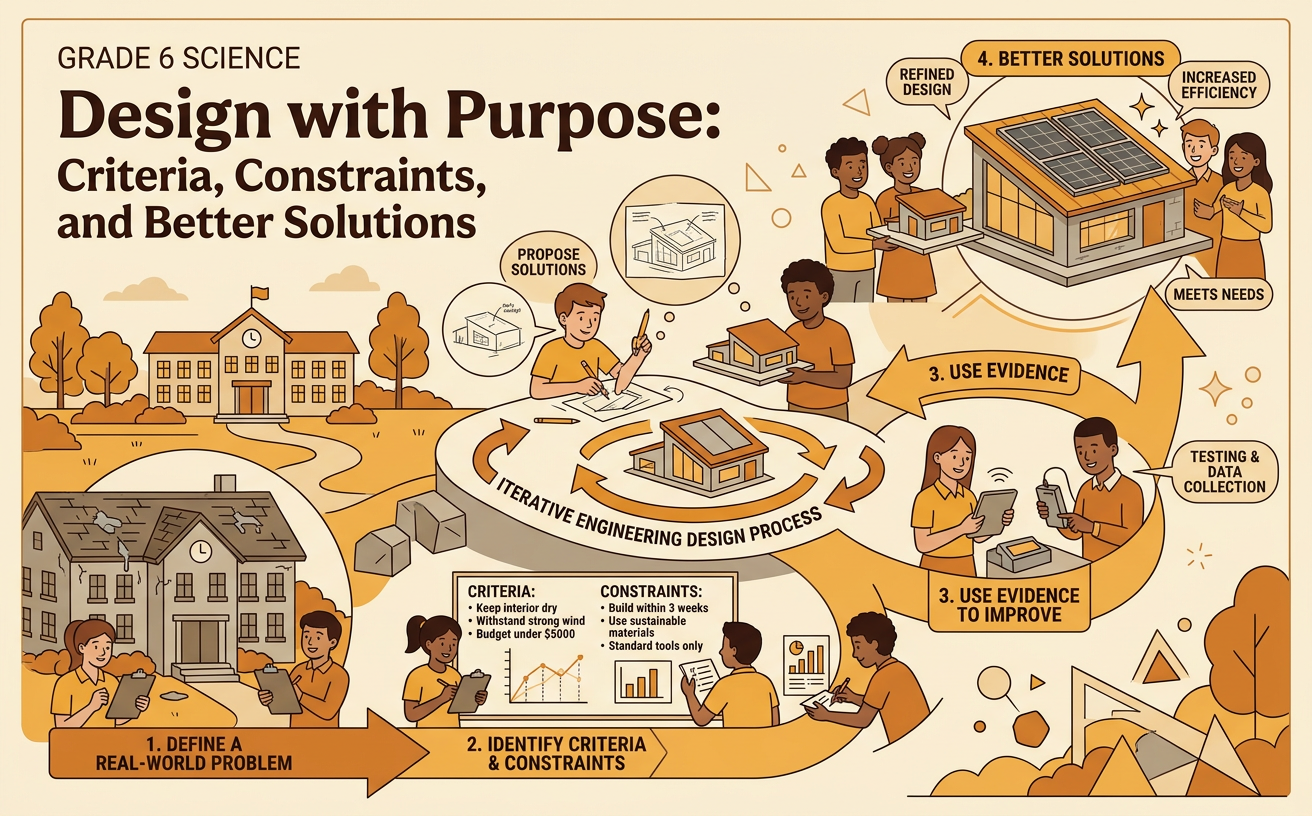
Illustrations are auto-generated and may be placeholders. They can be refreshed to match the narration.
Problems Engineers Can Solve
Engineers solve problems by designing products, systems, and processes that meet human needs. They do not begin by choosing a favorite invention. They first study what is happening, who is affected, and why the problem matters. For example, students may have too little shade in a school courtyard during lunch. This problem can be examined from several perspectives. Science helps explain sunlight and heat. Mathematics helps measure area, time, and cost. Social studies helps identify how students, staff, neighbors, and school leaders may be affected. Research can also reveal environmental and safety concerns. Some parts of a problem may require changes in behavior or policy as well as a physical design. Engineers use this information to decide whether a shade structure, planted trees, a schedule change, or a combination of solutions could help.

Define the Need
A clear problem definition describes the current situation, the desired situation, and the people who need help. It should be based on evidence rather than guesses. For the courtyard example, students could record temperatures and shaded areas at several times, survey classmates, study a map of the space, and interview the facilities manager. They might also use reliable sources about sun exposure, local weather, and accessible walkways. The research question could be, “How can we increase shade in the courtyard during lunch without blocking movement or damaging the building?” Notes from several sources should be compared because one source may be incomplete or biased. A precise need statement might say, “Students need a safe, affordable way to increase midday shade in the main seating area.” This statement identifies users and a need without assuming that one particular design is best.

Set Measurable Criteria and Constraints
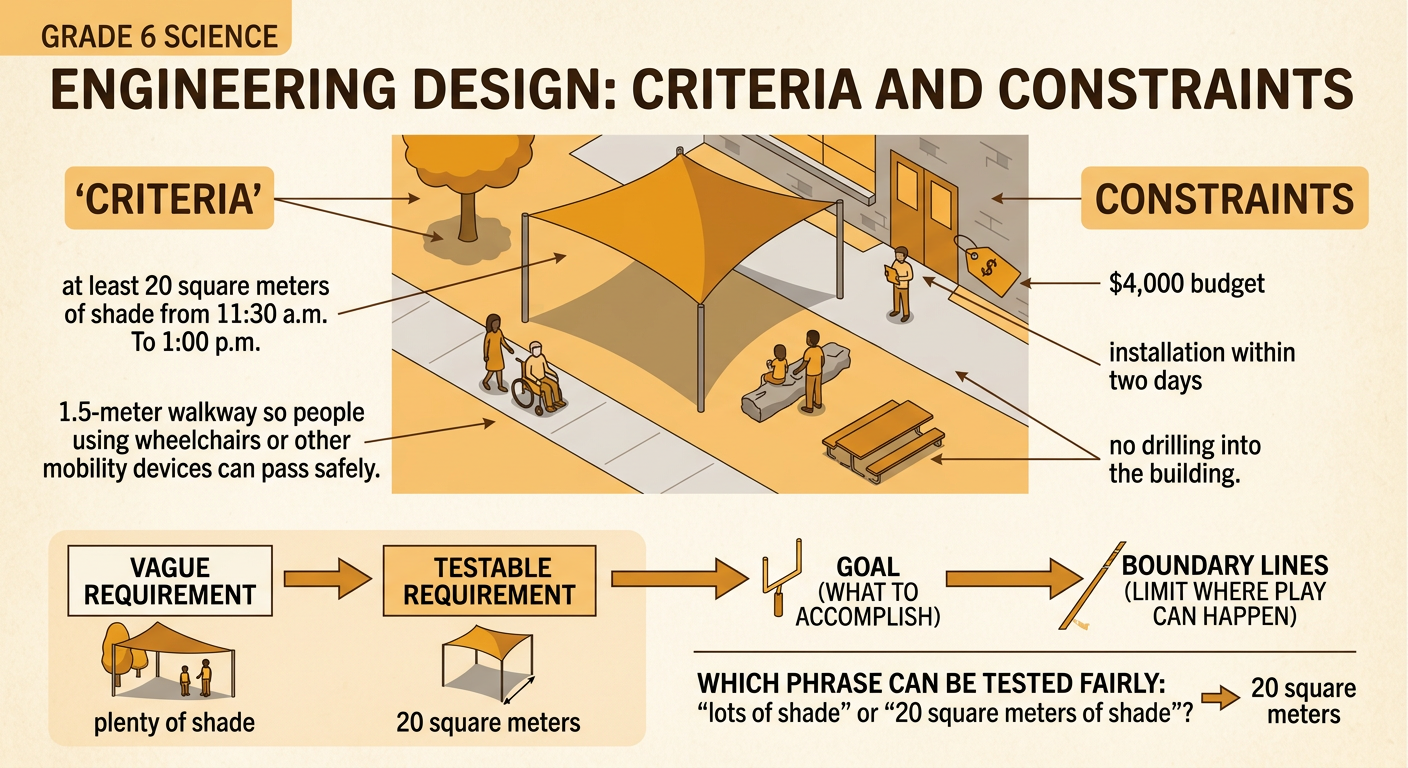
Criteria are the results a successful solution should achieve. Constraints are limits the design must follow. Both should be specific and measurable so different designs can be compared fairly. For a courtyard shade project, one criterion might be to shade at least 20 square meters of seating from 11:30 a.m. to 1:00 p.m. Another might be to keep an accessible walkway at least 1.5 meters wide. Constraints could include a total cost of $4,000 or less, no drilling into the school building, and installation within two days. Measurements and units matter: “provides plenty of shade” is vague, while “shades 20 square meters” can be tested. Some requirements create trade-offs. A larger canopy may provide more shade but cost more and experience greater wind force. Engineers reason with quantities to balance performance, safety, cost, time, and environmental effects.
Imagine and Compare Solutions
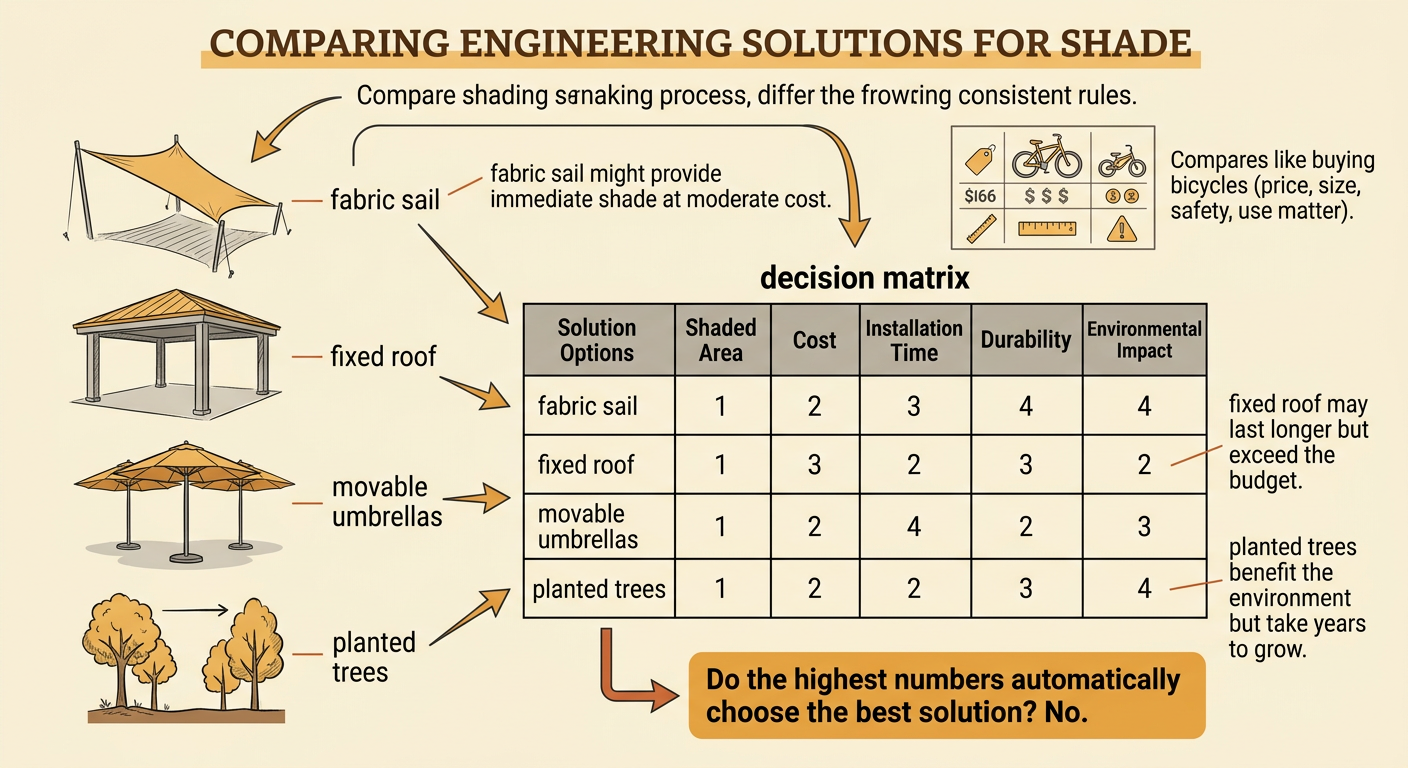
Engineers usually imagine several solutions before selecting one to develop. For courtyard shade, possible solutions might include a fabric sail, a fixed roof, movable umbrellas, or newly planted trees. Each option should be sketched and checked against the same criteria and constraints. A decision matrix can organize evidence. Students might rate each option from 1 to 4 for shaded area, cost, installation time, durability, and environmental impact. Important criteria can receive greater weight, but the scoring rules must be explained. A fabric sail may provide immediate shade at moderate cost, while trees offer environmental benefits but need years to grow. A fixed roof may be durable but exceed the budget. Numbers help compare options, but they do not make the decision automatically. Engineers must also consider stakeholder concerns, maintenance needs, safety information, and uncertainty in the available evidence.
Plan, Test, and Gather Evidence
After choosing a promising idea, engineers create a plan detailed enough for someone else to follow. A courtyard canopy plan could include a scale drawing, dimensions, materials, connection points, estimated cost, and test procedures. Students might build a 1:20 scale model, place it under a lamp that represents the midday Sun, and measure the model’s shaded area on a grid. A fan can provide a consistent airflow test while students measure how far the canopy bends. Variables should be controlled: use the same lamp position, fan setting, distance, and measurement method for every trial. Repeat tests and record numerical data in a table. Models provide useful evidence, but they do not prove that a full-size structure is safe. Actual construction requires appropriate materials, local weather data, building rules, and review by qualified adults or professionals. Test results should be compared directly with the established criteria and constraints.

Improve Through Iteration
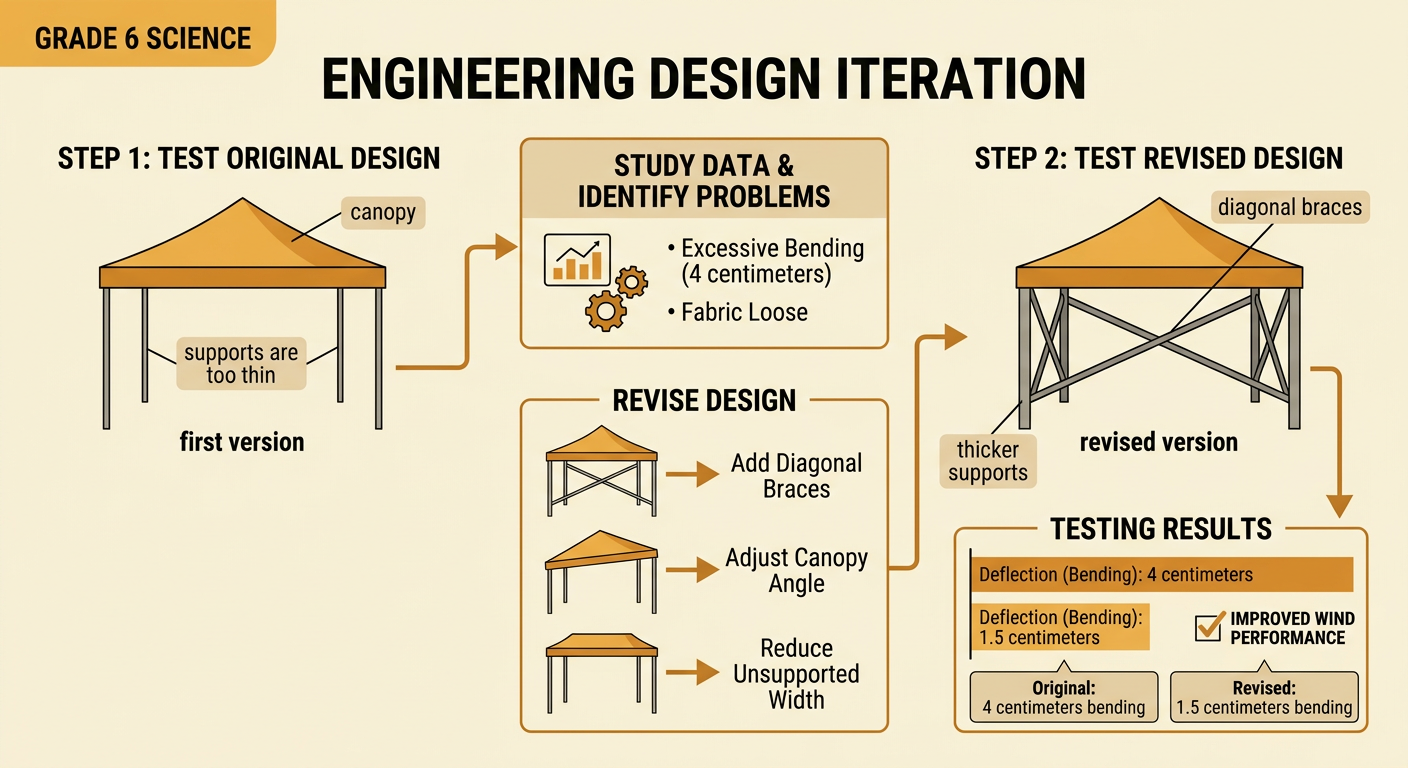
Iteration means using evidence to revise a design, test it again, and continue improving it. Suppose the first canopy model shades enough area but bends too far during the fan test. Students should not simply call it a failure. They can examine their data and identify a likely cause, such as supports that are too thin or fabric that is too loose. A second version might add diagonal braces, change the canopy angle, or reduce unsupported width. The team then repeats the same tests so the results can be compared fairly. If bending decreases from 4 centimeters to 1.5 centimeters while shaded area stays above the target, the revision is supported by evidence. However, added braces may increase cost or block part of a walkway, creating a new trade-off. Engineers document each change, explain why it was made, and decide whether further improvement is needed.