
Designing a Fault-Tolerant Computer Network
Students simulate link failures in star, ring, and mesh networks, then use evidence about reliability, cost, and redundancy to recommend a topology.

Illustrations are auto-generated and may be placeholders. They can be refreshed to match the narration.
Network Nodes, Links, and Paths
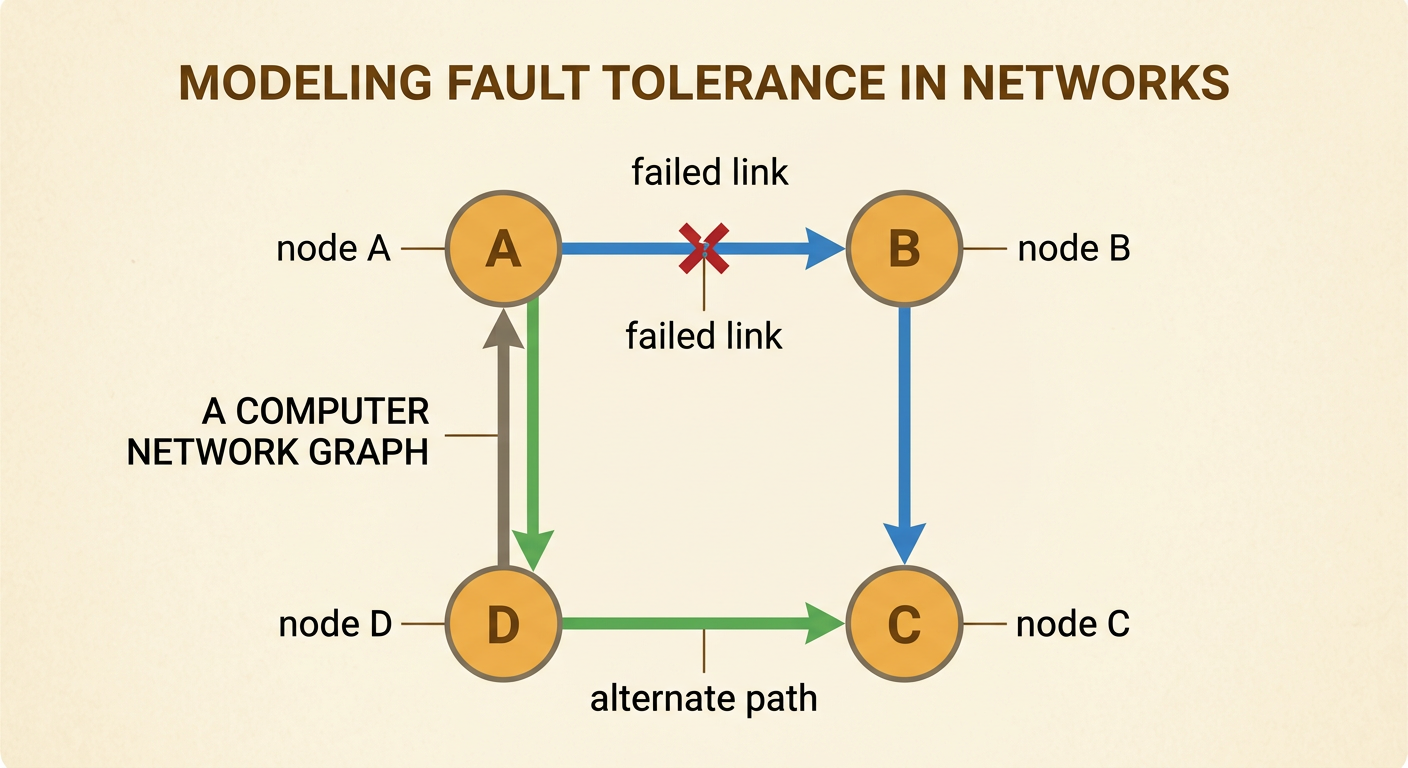
A computer network can be modeled as a graph. Each device, router, or switch is a node, and each wired or wireless connection is a link. A path is a sequence of links that carries data from one node to another. Networks are more fault-tolerant when data can use an alternate path after a link fails. For example, suppose nodes A, B, C, and D are connected in a square. Data can travel from A to C through B or through D. If link A–B fails, the A–D–C path still works. This model simplifies details such as transmission speed, but it helps engineers analyze connectivity. When drawing a network, identify the nodes, count the links, and trace every possible path between important devices.
Comparing Common Topologies
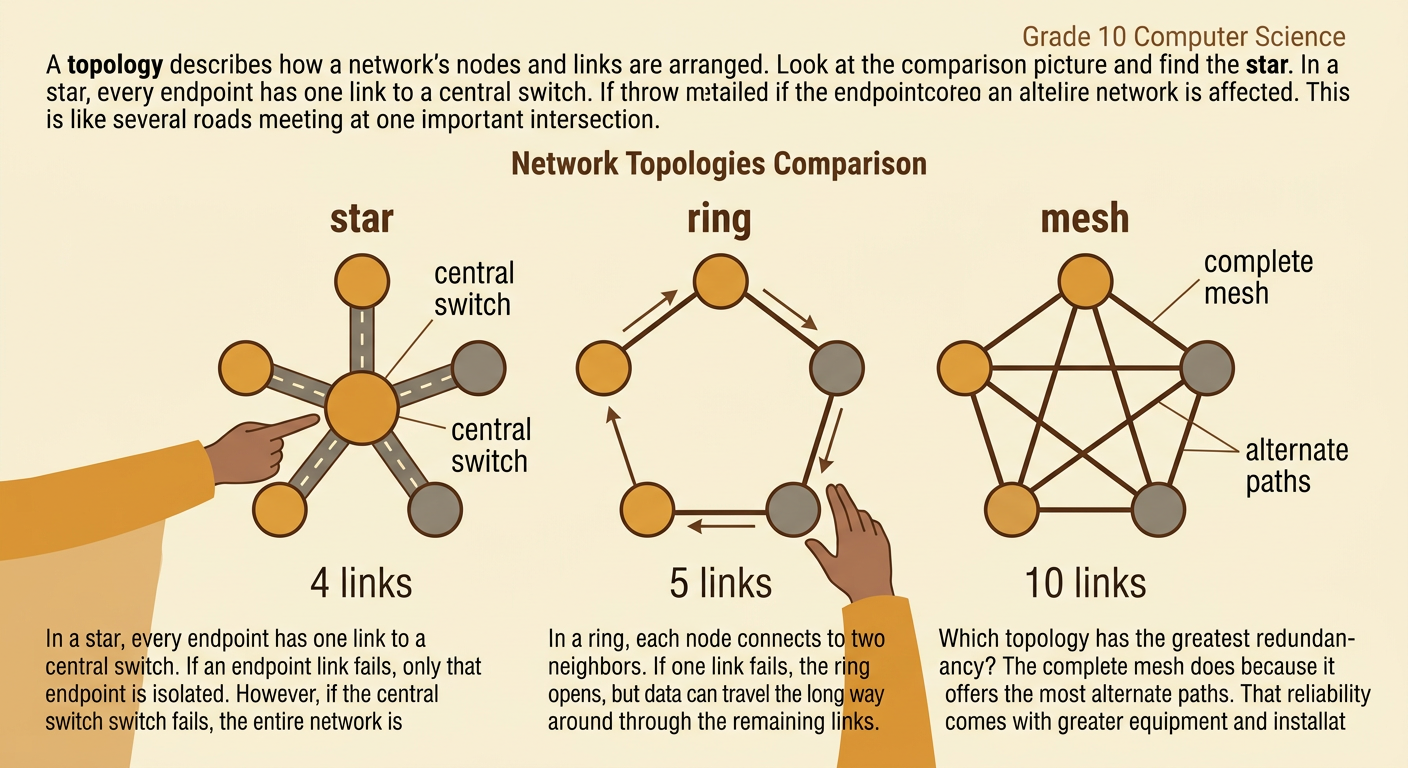
A topology describes how a network’s nodes and links are arranged. In a star, every endpoint connects to one central switch. A failed endpoint link isolates only that endpoint, but failure of the central switch affects the entire network. In a ring, each node connects to two neighbors. A single failed link opens the ring, yet all nodes remain connected through the remaining links. A mesh provides several links and alternate paths among nodes. A complete mesh connects every pair of nodes, offering high redundancy at high cost. For five nodes, a star needs 4 links, a ring needs 5, and a complete mesh needs 10. A school computer lab might favor a star because it is inexpensive, while an emergency communications network might justify a mesh because continued service is more important than minimizing cost.
Simulating Link Failures
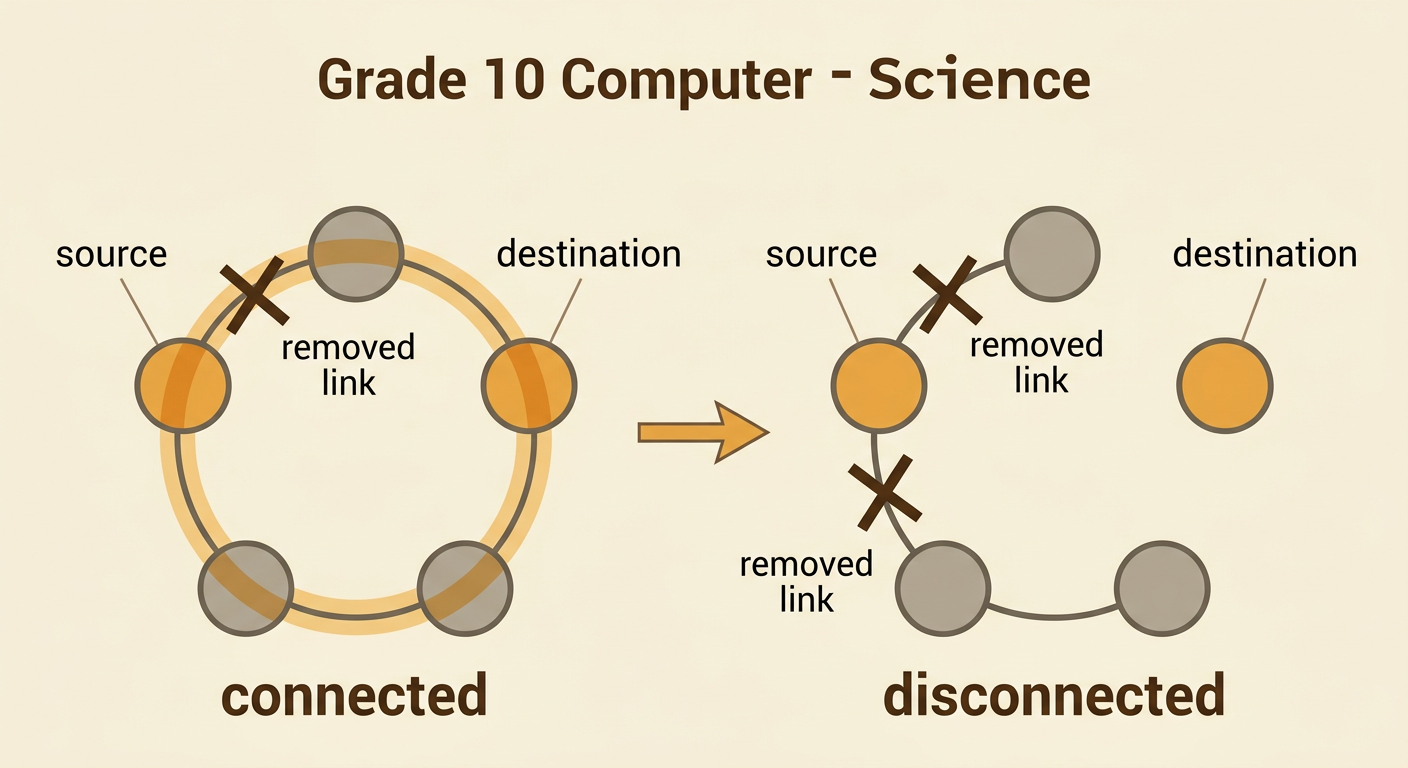
A failure simulation tests how a topology responds when links stop working. First, draw the network and choose a source and destination. Next, remove one link by crossing it out. Trace the remaining links to determine whether every node can still communicate with every other node. Record the result, restore the link, and repeat for each possible failure. With five nodes, every single-link failure in a star isolates one endpoint, while every single-link failure in a ring leaves one route connecting all nodes. A complete mesh also remains connected after any one link fails. Then test two-link failures. Removing two links from a ring separates it into two path segments, but a five-node complete mesh remains connected after any two link failures. Use the same procedure for every topology so the comparison is fair and repeatable.
Measuring Reliability and Cost
Reliability can be measured as the fraction of tested failure cases in which all nodes remain connected. Divide the number of connected outcomes by the total number of trials. For example, if a ring remains connected in all 5 of its single-link failure trials, its measured reliability is 5 ÷ 5, or 100 percent. Under the same strict measure, a five-node star scores 0 ÷ 4 because each failed spoke disconnects one node. Cost can be modeled by assigning a price to each link and network device. If each link costs $100, the links for a star cost $400, a ring costs $500, and a complete mesh costs $1,000, before device costs are added. Engineers may also measure performance, repair time, and the importance of specific nodes. A useful comparison table makes these criteria and trade-offs visible.

Recommending a Network Design
A strong recommendation states a clear claim, applies prioritized criteria, and supports the claim with evidence. Imagine a small hospital needs five network nodes, requires continued communication after any one link failure, and has a link budget of $700. A star costs only $400, but it fails the reliability requirement because any failed spoke isolates a node. A complete mesh provides excellent redundancy, but its $1,000 link cost exceeds the budget. The ring costs $500 and remained fully connected in every single-link failure trial, so it best satisfies the stated priorities. The recommendation should also acknowledge limitations: two failed ring links can divide the network, and failed network devices may create additional risks. Evidence can come from the topology model, simulation results, cost calculations, and stakeholder requirements. If the priorities or available budget change, the preferred design may change as well.
