Determining an Unknown Acid Concentration by Titration
Students use a balanced neutralization equation, titration data, and mole ratios to calculate the unknown concentration of an acid and connect the result to water-quality decisions.

Illustrations are auto-generated and may be placeholders. They can be refreshed to match the narration.
Acid–Base Neutralization
An acid–base neutralization occurs when an acid reacts with a base to produce water and a salt. The acid supplies hydrogen ions, H+, while the base supplies hydroxide ions, OH−. These ions combine in a one-to-one ratio to form H2O. For example, hydrochloric acid reacts with sodium hydroxide according to HCl + NaOH → NaCl + H2O. Sodium and chloride ions remain in the solution as dissolved sodium chloride. The equation shows that every atom is conserved: one sodium, one chlorine, one oxygen, and two hydrogen atoms appear on each side. If the amount of NaOH needed to neutralize an HCl sample is measured, the original amount of HCl can be determined. This relationship makes neutralization useful for analyzing an acidic water sample with an unknown concentration.

Titration Setup and Endpoint
In a titration, a solution with a known concentration, called the titrant, is added carefully to a measured volume of an unknown solution. First, rinse and fill a buret with 0.1000 M NaOH, remove air bubbles from the tip, and record the initial buret reading. Use a volumetric pipet to transfer 25.00 mL of the unknown HCl sample into an Erlenmeyer flask. Add two or three drops of phenolphthalein and place the flask under the buret. While swirling continuously, release NaOH rapidly at first and then one drop at a time near the endpoint. The endpoint is the first faint pink color that remains throughout the solution for about 30 seconds. Suppose the final reading shows that 18.60 mL of NaOH was delivered. Eye protection is required, and spills should be rinsed according to laboratory instructions.

Balanced Equation and Mole Ratio
Calculations must begin with a balanced chemical equation because its coefficients give the reacting mole ratio. For this titration, the equation is HCl(aq) + NaOH(aq) → NaCl(aq) + H2O(l). Each coefficient is 1, so 1 mole of HCl reacts with 1 mole of NaOH. The mole ratio can therefore be written as 1 mol HCl divided by 1 mol NaOH. At the endpoint, the measured moles of NaOH are used to infer the moles of HCl originally present in the flask. This mathematical relationship also supports conservation of atoms and mass. The reactants contain one sodium atom, one chlorine atom, one oxygen atom, and two hydrogen atoms per reaction unit, and the products contain the same totals. Coefficients must never be changed merely to make a desired calculation work.

Calculating the Unknown Concentration
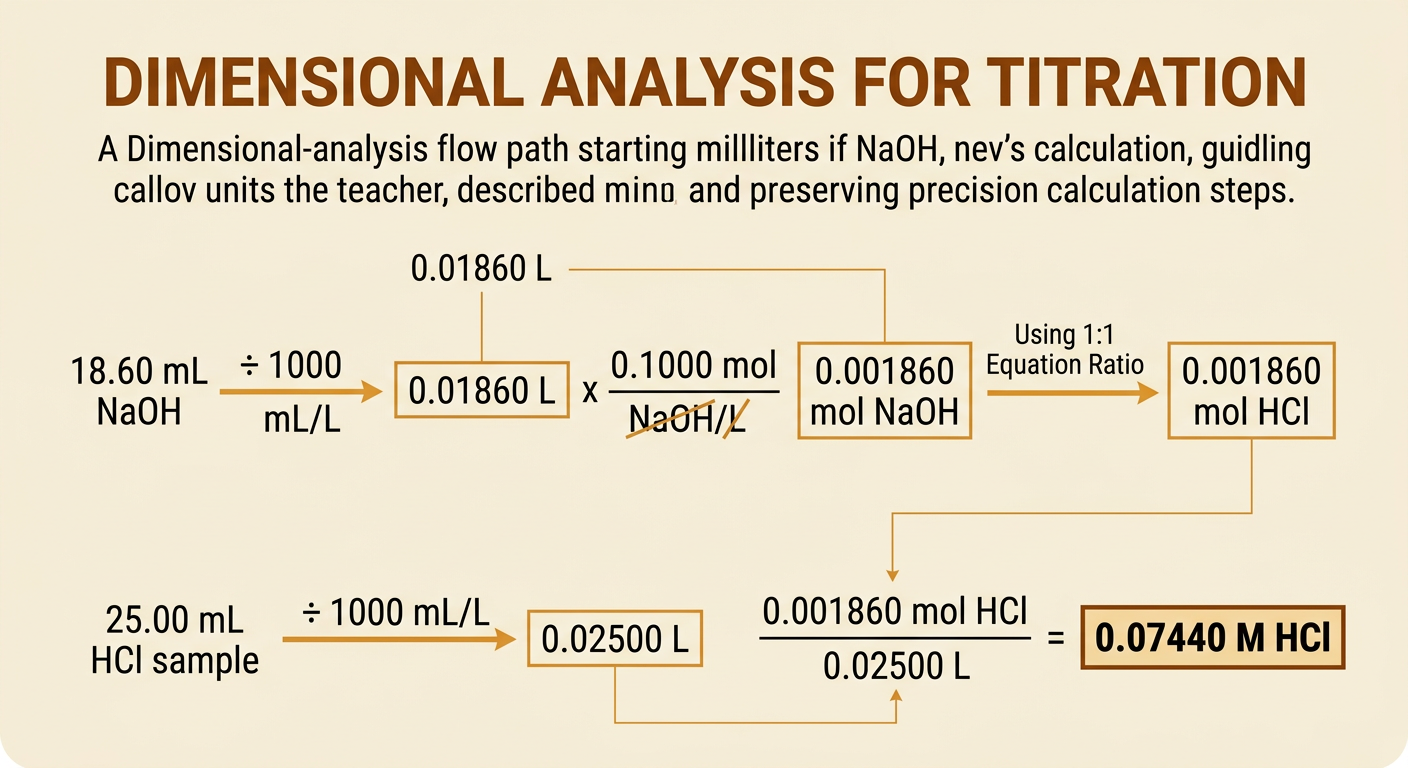
Use units to organize the calculation and check each step. Convert the delivered NaOH volume to liters: 18.60 mL × 1 L/1000 mL = 0.01860 L. Next, calculate moles of base: 0.1000 mol NaOH/L × 0.01860 L = 0.001860 mol NaOH. The liters cancel, leaving moles. Because the balanced equation gives a 1:1 ratio, the sample contained 0.001860 mol HCl. Convert the acid sample volume: 25.00 mL = 0.02500 L. Finally, divide moles by volume: 0.001860 mol HCl ÷ 0.02500 L = 0.07440 mol/L HCl. Thus, the unknown concentration is 0.07440 M HCl. The final unit, moles per liter, confirms that the result represents molar concentration. Consistent significant figures reflect the precision of the measured volumes and known titrant concentration.
Interpreting Results for Water Quality
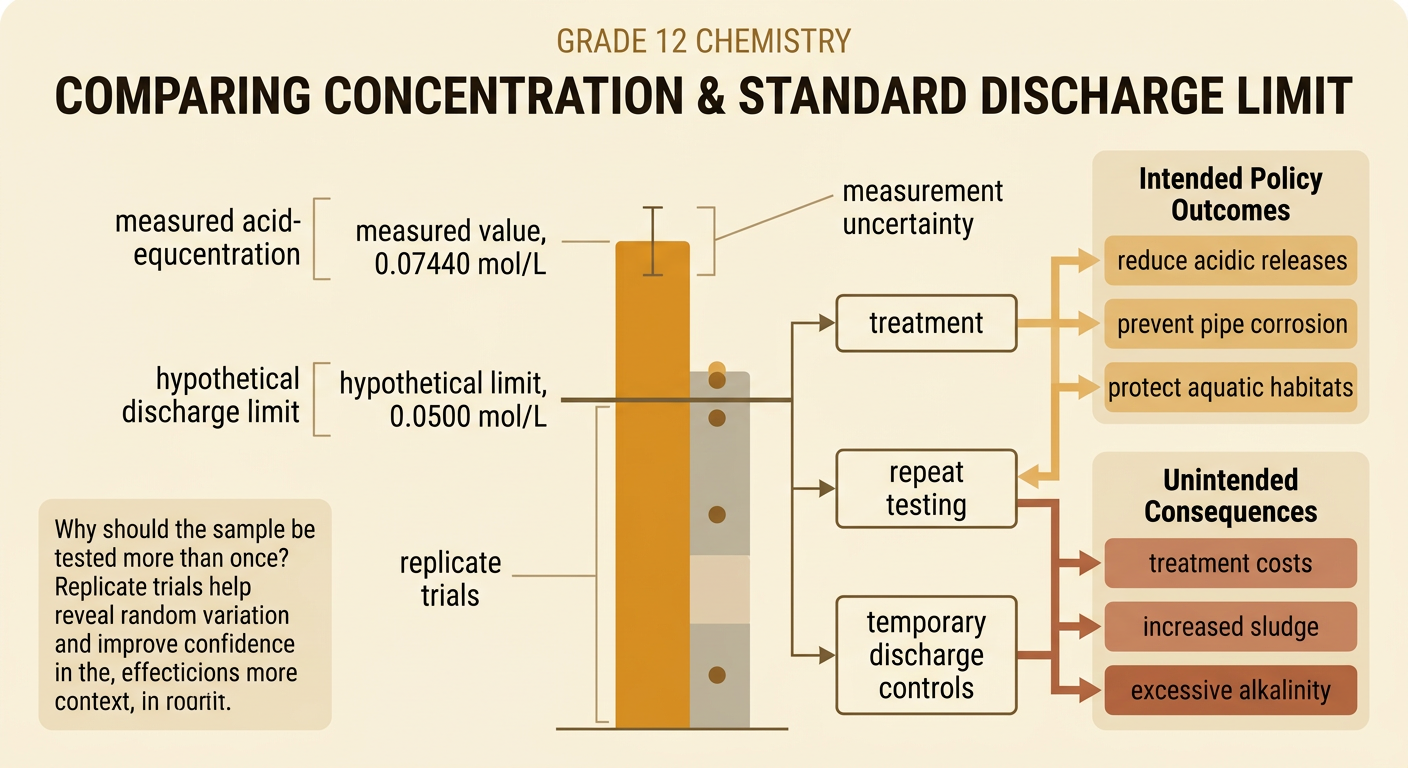
A concentration result becomes useful when it is compared with a clearly defined water-quality standard and considered with other evidence. Suppose a local agency proposes a hypothetical discharge limit of 0.0500 mol/L acid equivalent for an industrial outlet. The measured value, 0.07440 mol/L HCl, exceeds that limit, supporting a decision to require treatment, repeat testing, or temporary discharge controls. The intended outcome is to reduce acidic releases that could damage pipes or aquatic habitats. Possible unintended consequences include treatment costs, increased sludge production, or replacing acidity with excessive alkalinity if too much base is added. Policymakers should also consider measurement uncertainty, replicate trials, pH, buffering capacity, and the identities of other dissolved substances. One titration result should inform a decision, not replace a complete assessment. Effective policy balances environmental protection, reliable evidence, practical treatment options, and consequences for affected communities.