
Determining Central Ideas and Writing Objective Summaries
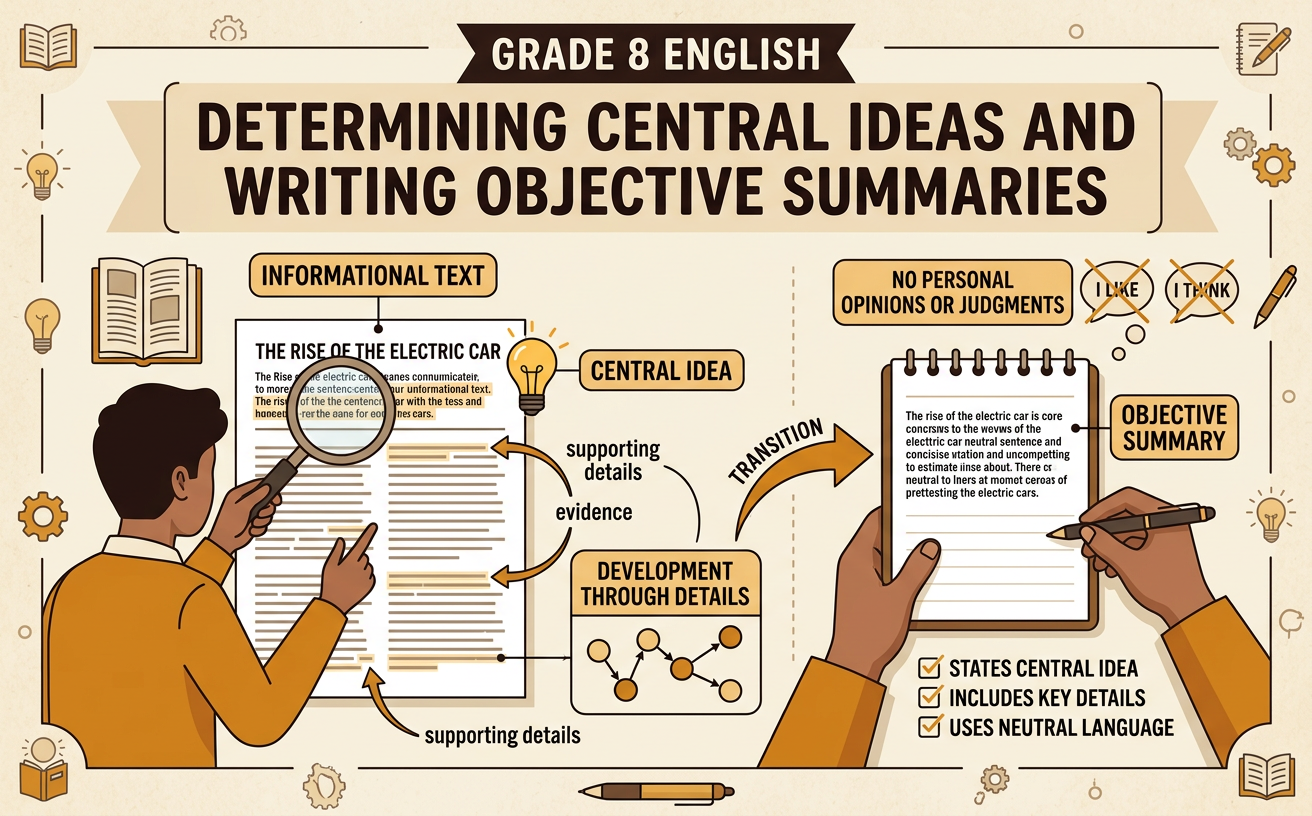
Students determine an informational text's central idea, trace its development through supporting details, and write an objective summary without personal opinions.
Illustrations are auto-generated and may be placeholders. They can be refreshed to match the narration.
Central Idea Versus Topic
A topic is the broad subject of an informational text, usually expressed in a word or short phrase. A central idea is the most important point the author communicates about that topic. For example, the topic of a passage might be urban trees. Its central idea could be: Planting trees in cities improves residents’ lives by cooling neighborhoods, cleaning the air, and providing green spaces. Unlike the topic, the central idea is a complete statement that can connect many parts of the text. To determine it, ask, “What does the author want readers to understand about this topic?” Check whether your answer is supported throughout the text rather than by only one sentence or example. A title or heading may suggest the topic, but readers must examine the entire text to identify its central idea.

Identifying Key Supporting Details
Key supporting details are facts, examples, explanations, or statistics that directly develop the central idea. Important details answer questions such as how, why, when, or with what result. Less important details may be interesting, but they are not necessary for understanding the author’s main point. Suppose a text argues that urban trees improve city life. A study showing that shaded streets can be cooler supports the idea directly. An explanation that leaves trap some airborne particles also supports it. However, a detail describing the color of a park bench does not explain how trees benefit a city. Test each detail by asking, “Does this information help prove, explain, or illustrate the central idea?” Select evidence from different parts of the text, and avoid choosing several details that all repeat the same point.

Tracing the Central Idea's Development
Authors develop a central idea across a text rather than presenting all of it at once. To trace that development, notice what each section adds. At the beginning of a passage about urban trees, the author might introduce the problem of high temperatures in cities. Next, the author may explain how tree shade and water released from leaves help cool the air. Later, statistics from several neighborhoods might show the effect of tree cover. The conclusion may broaden the idea by recommending tree planting as part of city planning. These parts work together: the problem creates a need, the explanation shows how trees help, the evidence demonstrates results, and the conclusion shows the idea’s significance. Track the order of these additions and explain how each supporting idea clarifies, strengthens, or extends the central idea.

Separating Evidence from Opinion
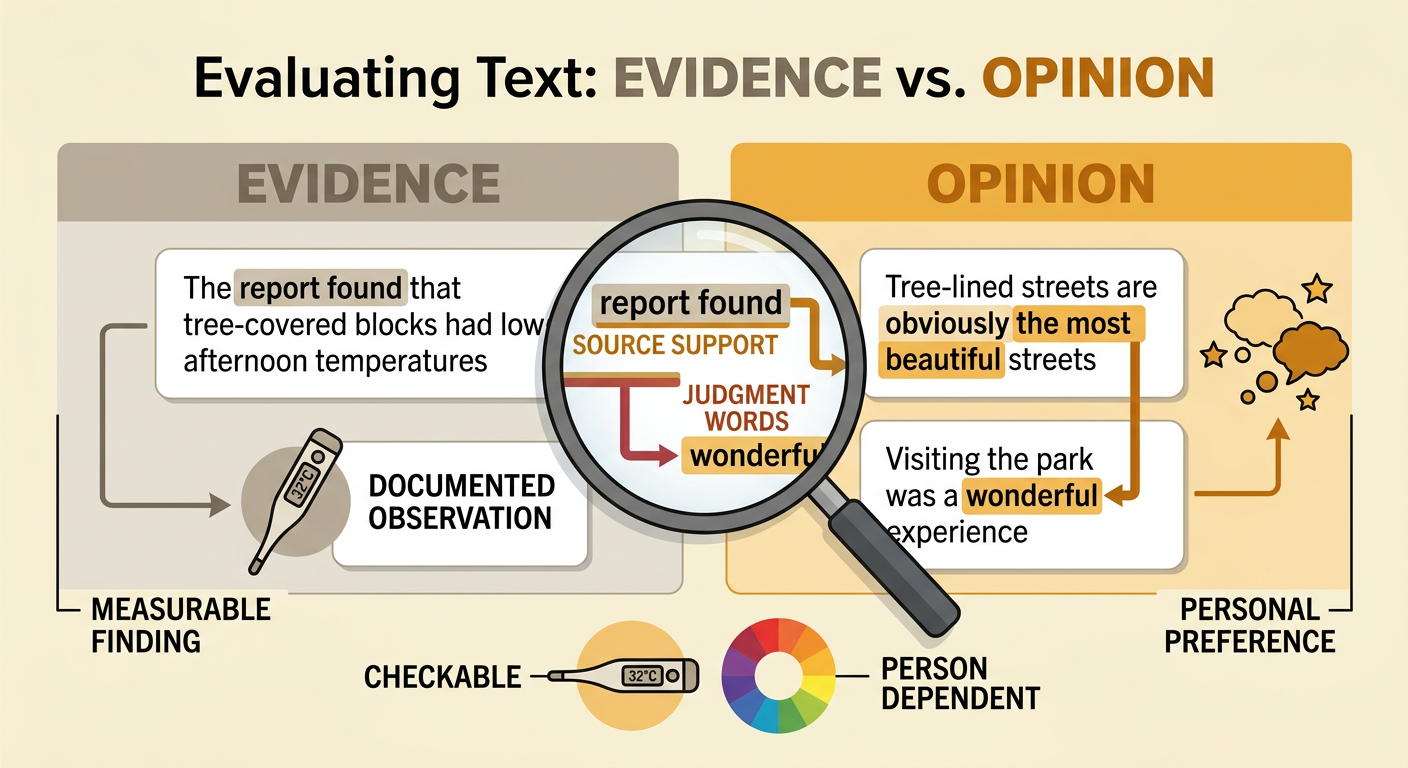
An objective reading separates text-based evidence from personal opinion. Evidence is information the author provides, such as facts, data, examples, quotations, or documented observations. Opinion expresses a belief, preference, or judgment that may not be proven. For example, “The report found that tree-covered blocks had lower afternoon temperatures” is evidence because it reports a measurable finding. “Tree-lined streets are obviously the most beautiful streets” is an opinion because beauty depends on personal preference. Words such as best, worst, wonderful, boring, and obviously can signal judgment, although readers must always consider context. When analyzing or summarizing a text, describe what the author states and supports. Do not add whether you agree, how the text made you feel, or what you personally believe should happen.
Writing an Objective Summary
An objective summary briefly explains the central idea and its most important supporting details without adding opinions or minor information. First, read the entire text and state the central idea in your own words. Next, select details that show how the idea develops from beginning to end. Then connect them in a logical order using precise, neutral language. Do not copy long sentences, include every example, or comment on whether the text is interesting or convincing. For example: “The article explains that urban trees improve city environments. Trees provide shade and help reduce temperatures, while their leaves can remove some pollutants from the air. Research comparing neighborhoods supports these benefits, and the article concludes that tree planting can contribute to healthier city planning.” This summary identifies the central idea, includes key evidence, and accurately represents the author’s message without personal judgment.
