Determining Theme and Writing an Objective Summary
Students identify a literary text’s central theme, trace how it develops through key details, and write a concise, objective summary.
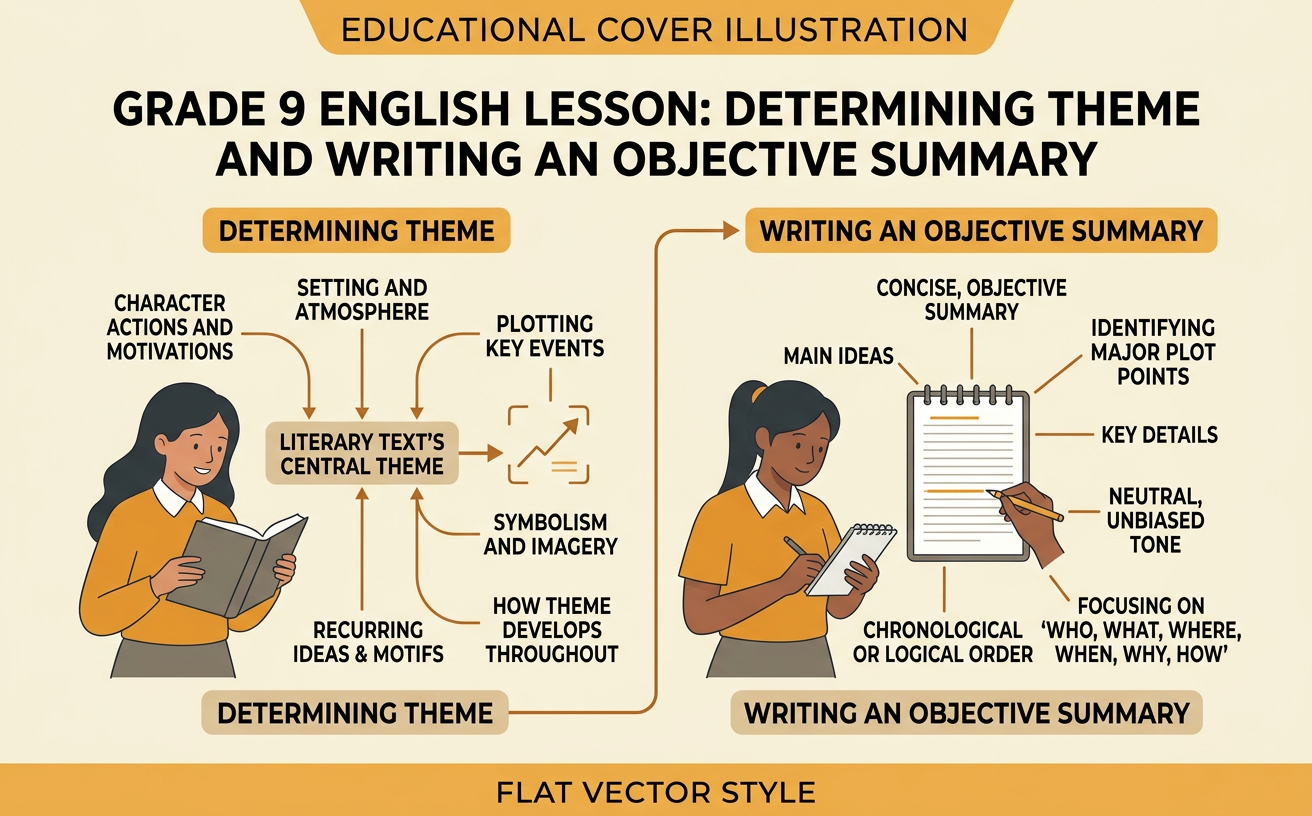
Illustrations are auto-generated and may be placeholders. They can be refreshed to match the narration.
Theme Versus Topic
A topic is a broad subject that a text explores, such as friendship, courage, freedom, or loss. A theme is a complete statement about what the text suggests concerning that topic. Themes are usually not stated directly, so readers infer them from characters, conflicts, settings, and outcomes. For example, in an imaginary story called “The Last Lantern,” Maya wants to win a dangerous nighttime race alone. After she stops to help an injured rival, both runners safely reach the finish. The topic might be competition or kindness. A theme could be “Helping others can be more valuable than achieving personal victory.” Avoid using a single word as a theme. Also avoid turning the theme into a rule that must be true in every situation. A strong theme statement expresses a thoughtful, text-supported idea about life or human behavior.

Finding the Central Idea
To find a literary text’s central theme, look for patterns rather than relying on one isolated detail. Ask what the main character wants, what conflict blocks that goal, what choices the character makes, and what changes by the ending. Repeated images, dialogue, and contrasts may also reveal an important message. In “The Last Lantern,” Maya begins by refusing help because she believes winning proves independence. During the race, she must choose between passing an injured rival and stopping to help. Her decision costs her first place, but the crowd honors her courage and compassion. These connected details support the theme that a person’s character matters more than a victory. Test a possible theme against the entire story. If it fits only one scene or ignores the ending, revise it until it accounts for the text as a whole.

Tracing Theme Development
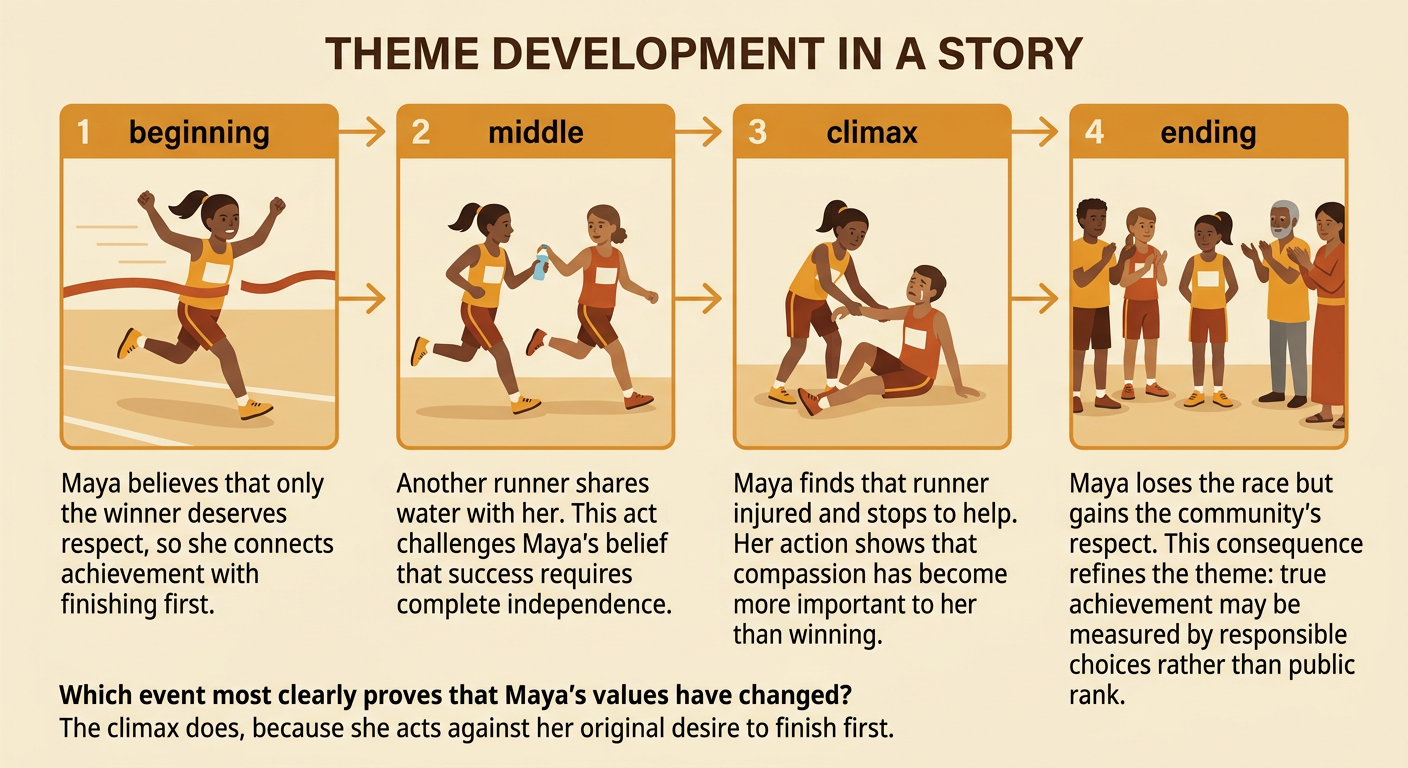
A theme develops as events and details add meaning to it. Trace this development by examining the beginning, middle, climax, and ending. At the beginning of “The Last Lantern,” Maya says that only the winner deserves respect, introducing her belief that success means finishing first. In the middle, another runner shares water with her, challenging her belief in complete independence. At the climax, Maya finds that runner injured and chooses to stop. Her action demonstrates that compassion has become more important to her than winning. At the end, Maya loses the race but earns the community’s respect, refining the theme: true achievement may be measured by responsible choices rather than public rank. Notice that the theme does not simply appear at the end. It emerges through Maya’s original belief, is shaped by conflict, and is clarified by the consequences of her decision.
Separating Analysis from Opinion
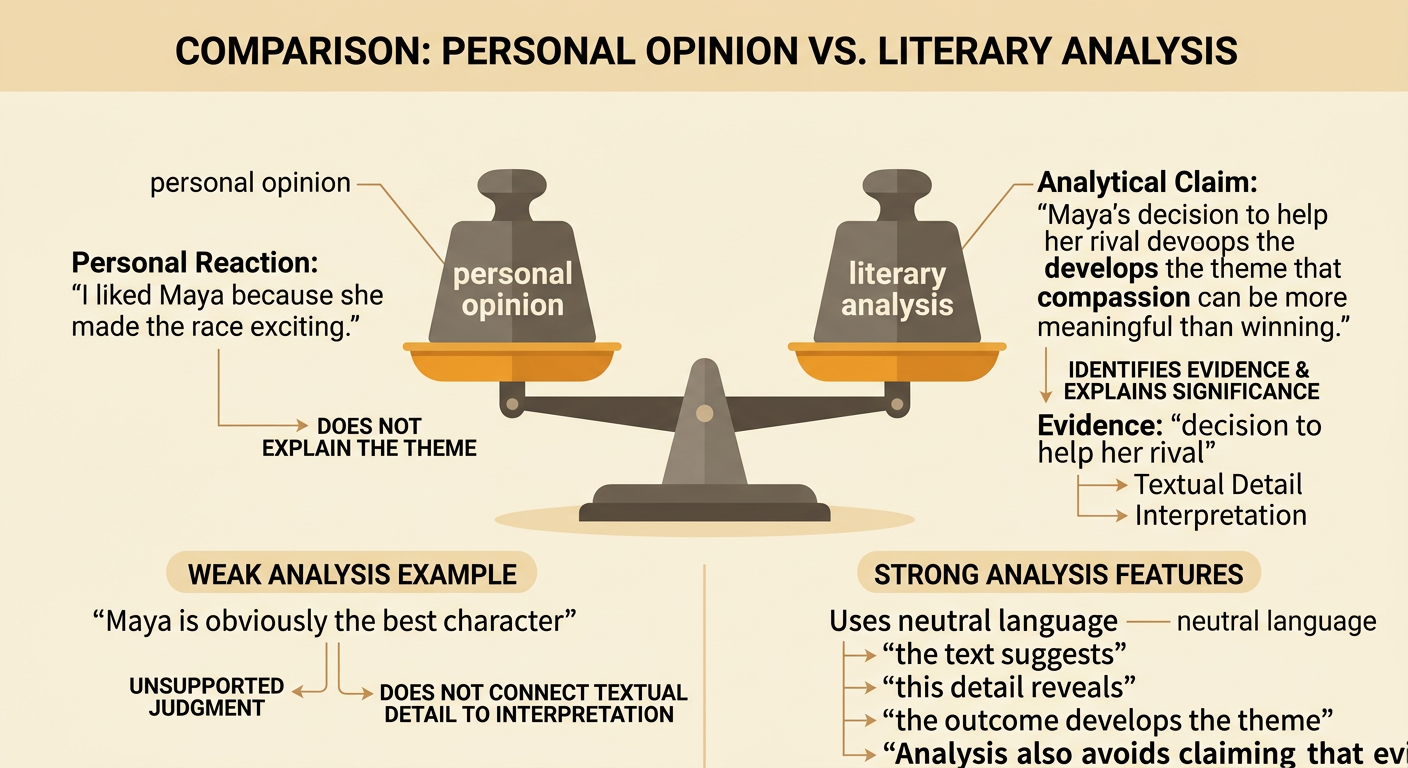
Literary analysis explains what a text means and supports the explanation with relevant evidence. Personal opinion states an individual preference or feeling. An opinion about “The Last Lantern” might be, “I liked Maya because she made the race exciting.” That comment may be sincere, but it does not analyze the theme. An analytical statement would be, “Maya’s decision to help her rival develops the theme that compassion can be more meaningful than winning.” This claim identifies a textual detail and explains its significance. Use neutral language such as “the text suggests,” “this detail reveals,” or “the outcome develops the theme.” Avoid unsupported statements such as “Maya is obviously the best character” or “everyone should act exactly like her.” Strong analysis remains focused on the text, connects evidence to an interpretation, and does not depend on whether the reader personally liked the story.
Writing an Objective Summary
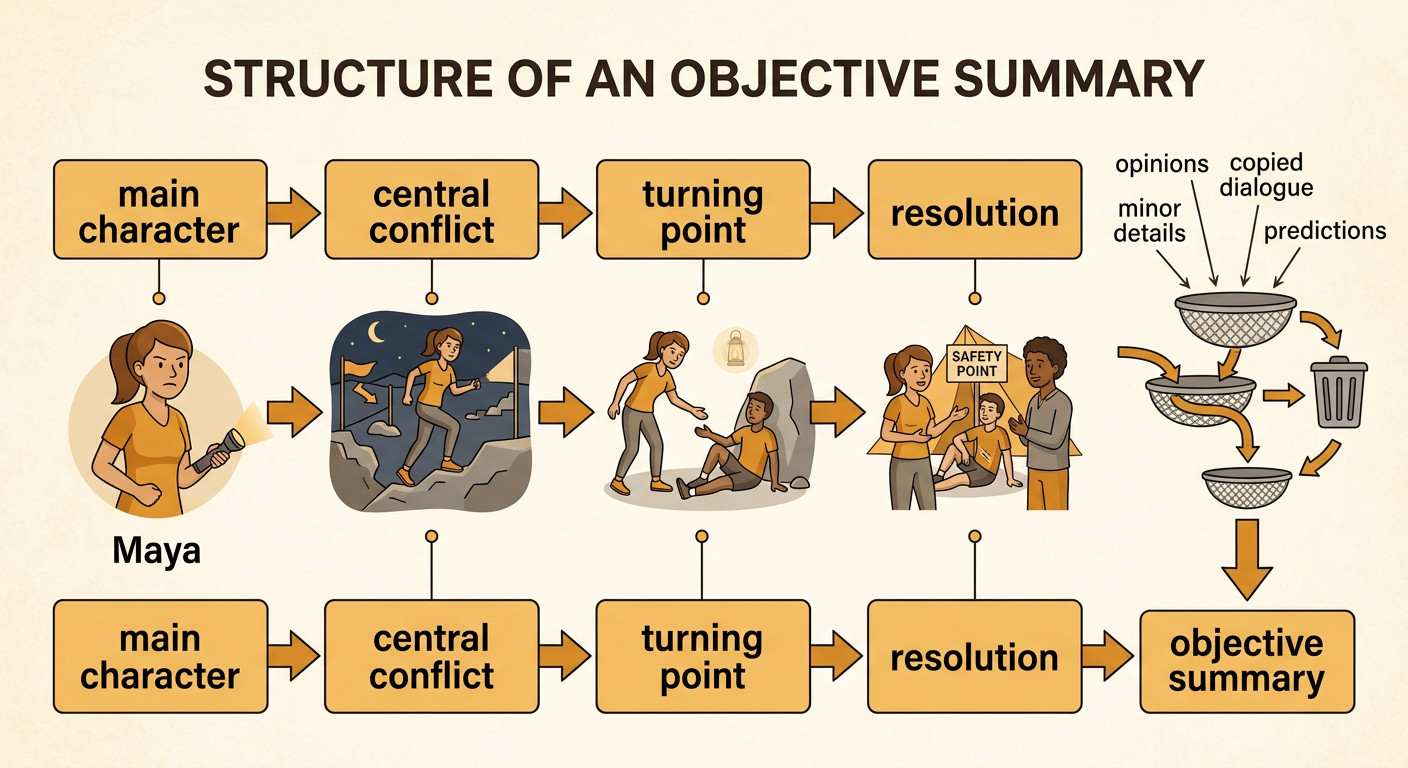
An objective summary gives the most important events and ideas without personal judgments, unnecessary details, or copied dialogue. Begin by identifying the main character, central conflict, major turning point, and resolution. Present events in a logical order and use your own words. For example: “In ‘The Last Lantern,’ Maya enters a nighttime race determined to prove that she can succeed alone. After another runner helps her, Maya later finds that runner injured near the finish. She gives up her chance to win and helps the runner reach safety. Although Maya does not finish first, the community respects her compassionate choice.” This summary includes the central conflict, key decision, and outcome. It excludes minor details about the race route, personal comments about Maya, and predictions about what happens later. After drafting, check that every sentence is accurate, necessary, concise, and neutral. A summary should represent the text fairly rather than evaluate it.