Did a New Substance Form?
Students mix safe household substances, observe signs such as gas production and temperature change, and use evidence to decide whether new substances formed.
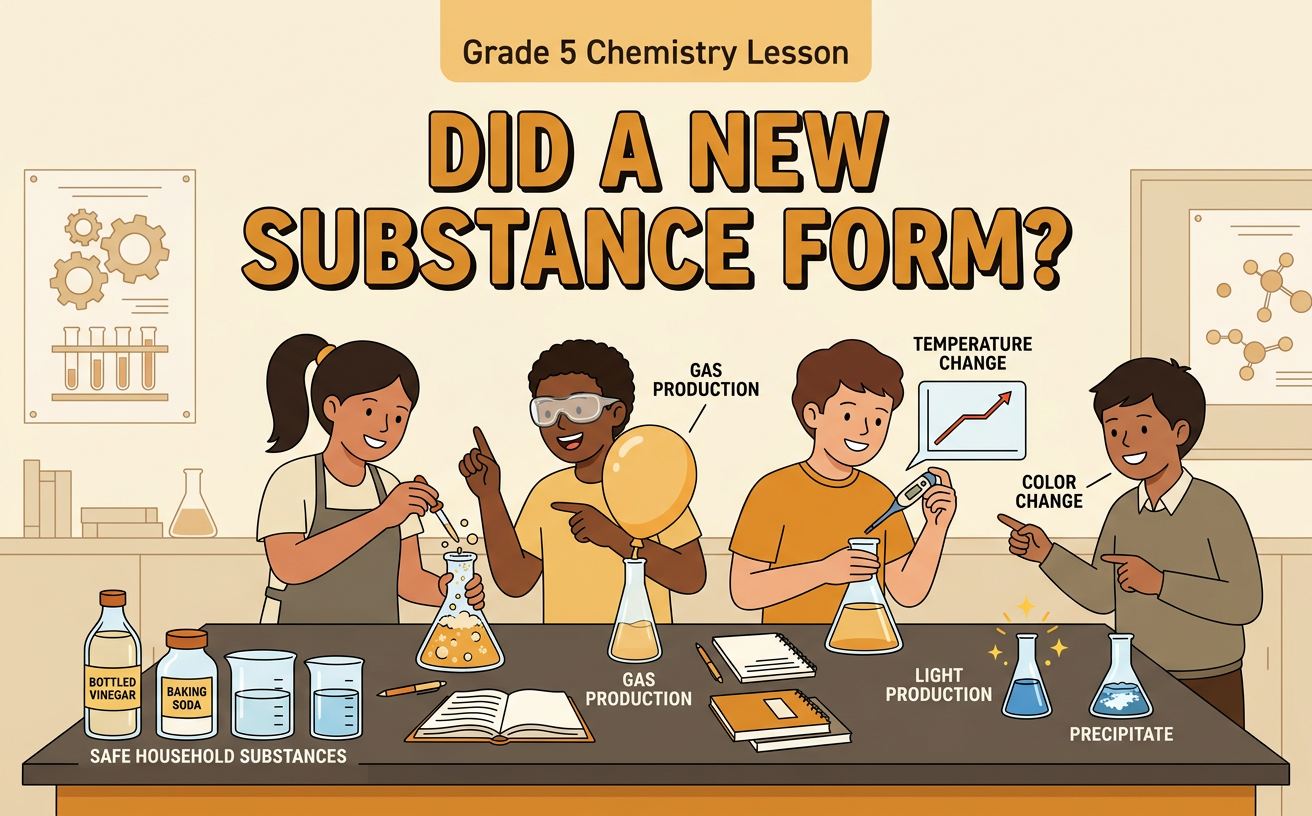
Illustrations are auto-generated and may be placeholders. They can be refreshed to match the narration.
Predict the Result of Mixing
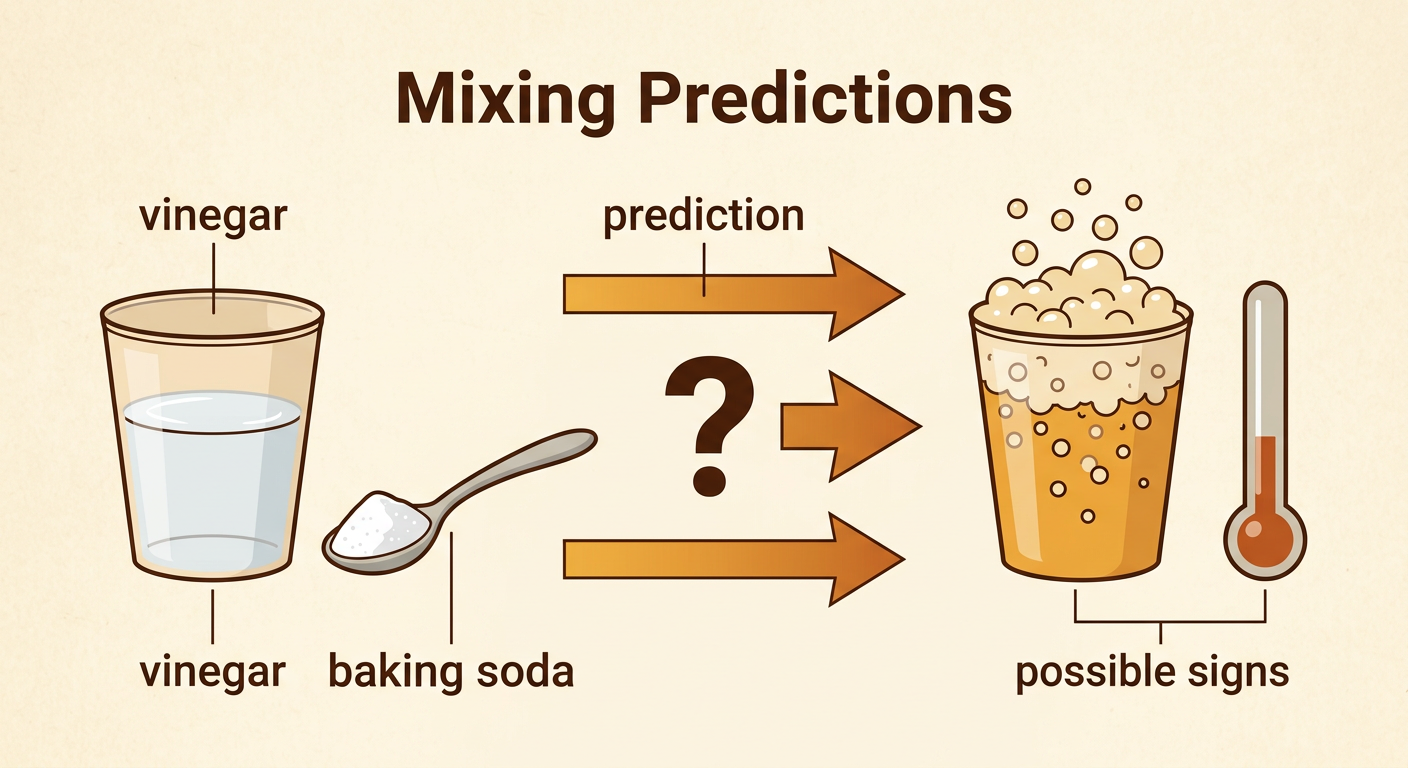
Before mixing substances, make a prediction about what might happen. A prediction is a reasonable idea based on what you already know, but it is not proof. First, observe the substances separately. Vinegar is a clear liquid with a strong smell. Baking soda is a white powder. Think about possible signs of change, such as bubbles, a temperature change, a new odor, or a new solid. For example, you might predict, “When vinegar and baking soda are mixed, bubbles will form because I have seen this mixture fizz before.” You might also predict that the cup will feel cooler. Record the amounts you plan to use so the investigation can be repeated fairly. After mixing, compare your observations with your prediction.
Mix Vinegar and Baking Soda Safely
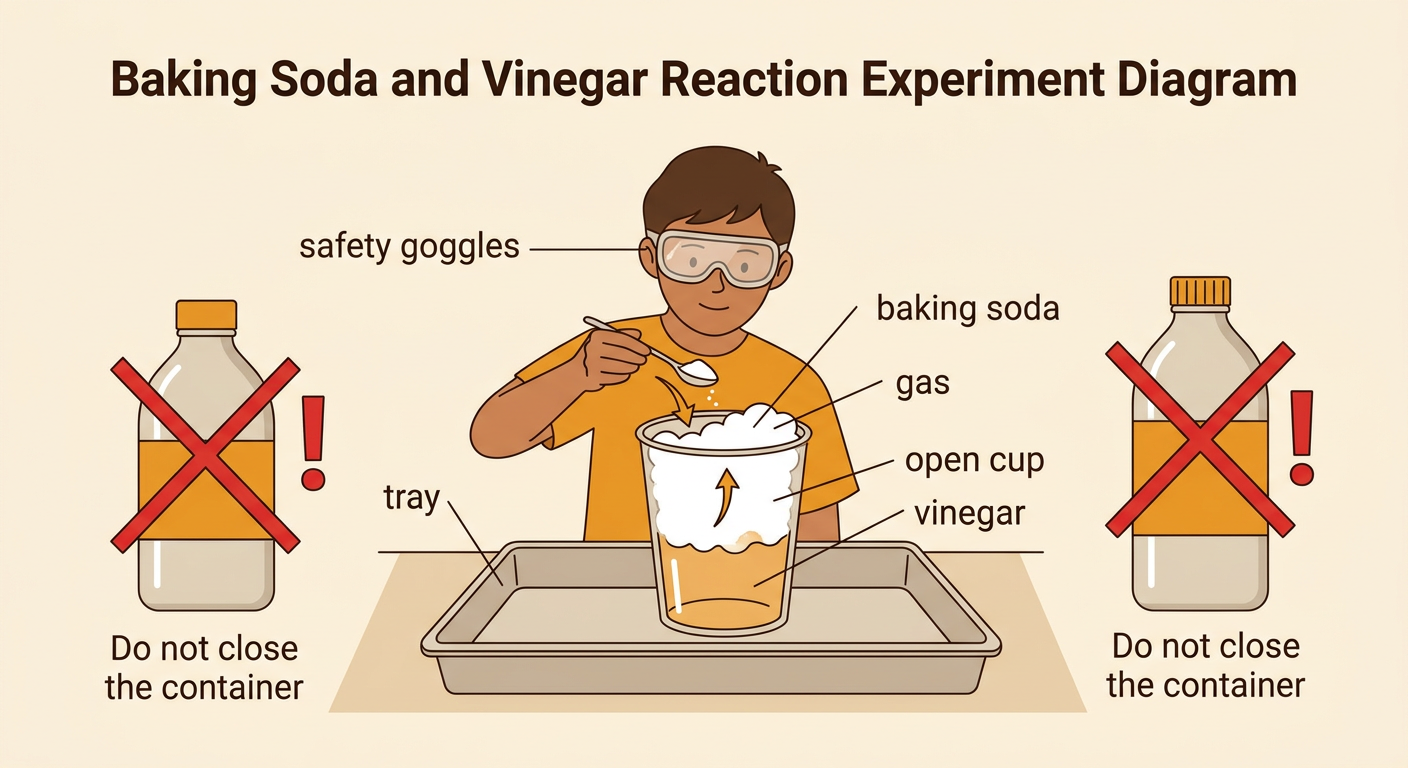
Wear safety goggles and work on a tray or protected surface. Do not taste any substance, and avoid touching your eyes or face during the investigation. Place a small open cup on the tray and measure two tablespoons of vinegar into it. Record the vinegar’s starting temperature. Measure one teaspoon of baking soda with a clean, dry spoon. Slowly add the baking soda to the vinegar while keeping your face away from the cup. Watch without leaning over the mixture. For example, the mixture may quickly foam and rise, so the cup should not be filled near the top. Never seal this reaction in a container because the gas can build pressure. When the investigation is finished, follow your teacher’s directions for cleanup and wash your hands.
Record Evidence of Change
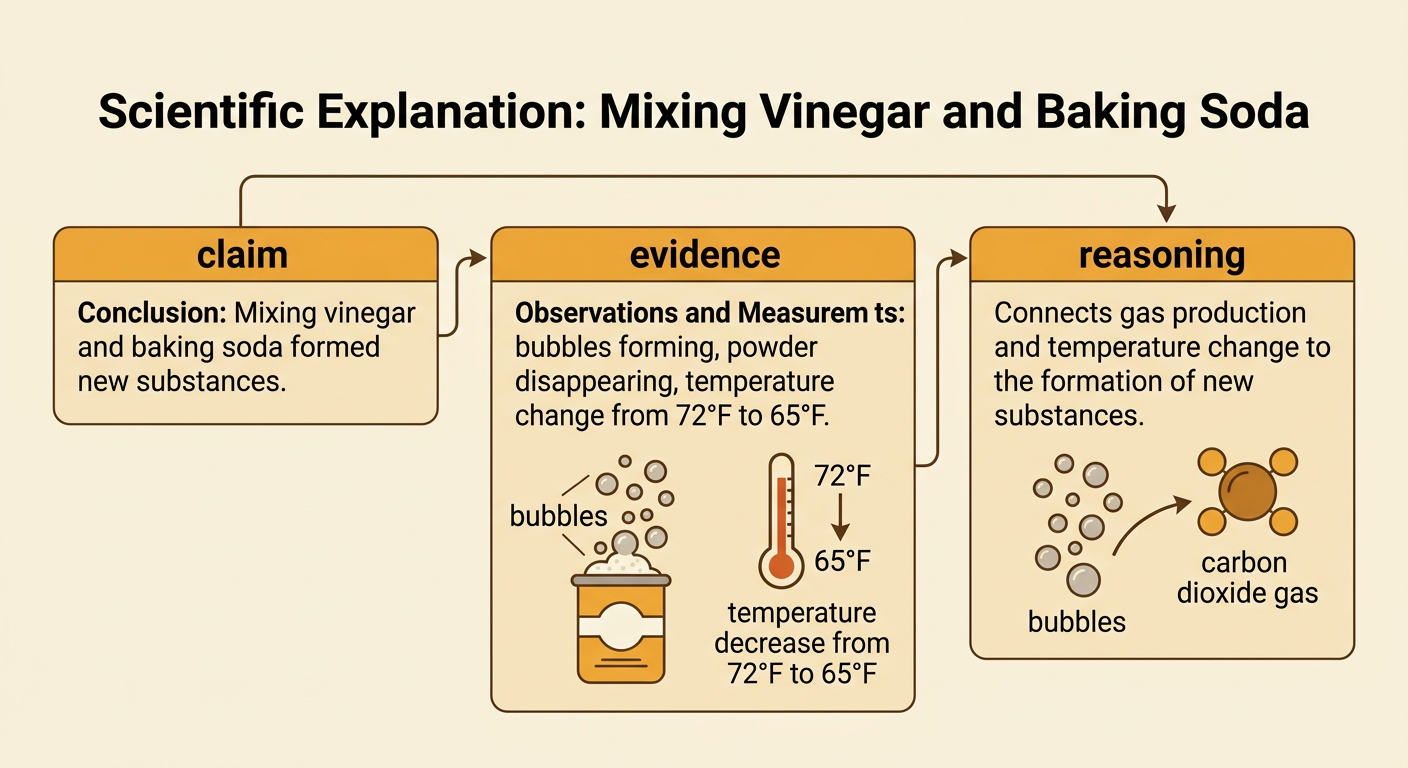
Careful observations provide evidence about what happened during mixing. Make a table with columns for before mixing, during mixing, and after mixing. Record only what you can observe or measure, not what you assume. Before mixing, note that the vinegar is a clear liquid and the baking soda is a white solid. During mixing, you may observe rapid fizzing, many bubbles, and foam. Use a thermometer to compare the starting and lowest temperatures. For example, a mixture that changes from 72°F to 65°F has decreased by 7°F. After the bubbling slows, you may see a mostly clear liquid with no baking soda powder remaining. Bubbles show that a gas was produced, while the lower temperature shows that energy was transferred during the change. Both observations are useful evidence.

Decide Whether New Substances Formed
Use several observations together to decide whether mixing produced new substances. A change in shape or size alone, such as crushing a solid, does not show that a new substance formed. In the vinegar and baking soda investigation, the strongest evidence is the production of a gas that was not present before mixing. The bubbles contain carbon dioxide gas. The reaction also produces water and sodium acetate, which remains dissolved in the liquid. A temperature decrease supports the conclusion that a reaction occurred, but temperature change alone is not always enough. For example, ice melting becomes warmer but is still water. Here, gas production, temperature change, and the disappearance of the starting powder provide a connected set of evidence. Therefore, the evidence supports the claim that new substances formed.

Write an Evidence-Based Explanation
Write an explanation with a claim, evidence, and reasoning. Begin with a claim that answers the investigation question. Next, include specific observations and measurements in the order they occurred. Finally, explain why the evidence supports the claim. For example: “Mixing vinegar and baking soda formed new substances. Right after the baking soda was added, the mixture produced many bubbles, and its temperature decreased from 72°F to 65°F. The bubbles showed that carbon dioxide gas formed, even though neither starting substance was a gas. The temperature change provided more evidence that a reaction occurred. Therefore, the observations support the conclusion that new substances formed.” Use accurate science words, complete sentences, and relevant details. Do not say only that the mixture changed; explain what changed and why that evidence matters.