Dissolve or Settle? Mixing Materials with Water
Students mix salt and sand with water, observe what happens, and classify each material according to whether it dissolves or settles.
Illustrations are auto-generated and may be placeholders. They can be refreshed to match the narration.
Ask What Happens in Water
Water can be mixed with many materials. Our question is: What happens when salt and sand are added to water? We will use our eyes to gather observations. An observation is something we notice. We can look at the water, the salt, and the sand before and after mixing. Salt has tiny white grains. Sand has small grains that may be tan, brown, black, or white. For example, when a spoonful of sand is dropped into water, we can watch whether the grains stay where we can see them. We will compare the materials fairly by using clear cups with the same amount of water. We will not taste any materials. Careful observations will help us answer our question.

Predict for Salt and Sand
Before we mix, we can make a prediction. A prediction tells what we think may happen. It does not have to be correct. Look closely at the salt and sand. Ask yourself: Will the grains seem to disappear into the water, or will they sink and collect at the bottom? You might predict, “I think the salt will dissolve because its grains are very small.” You might also predict, “I think the sand will settle because I have seen sand at the bottom of a puddle.” Tell a partner your ideas. Listen while your partner speaks, and take turns. We can record each prediction with a picture or a mark on a class chart. Later, we will compare our predictions with our observations.

Mix and Observe
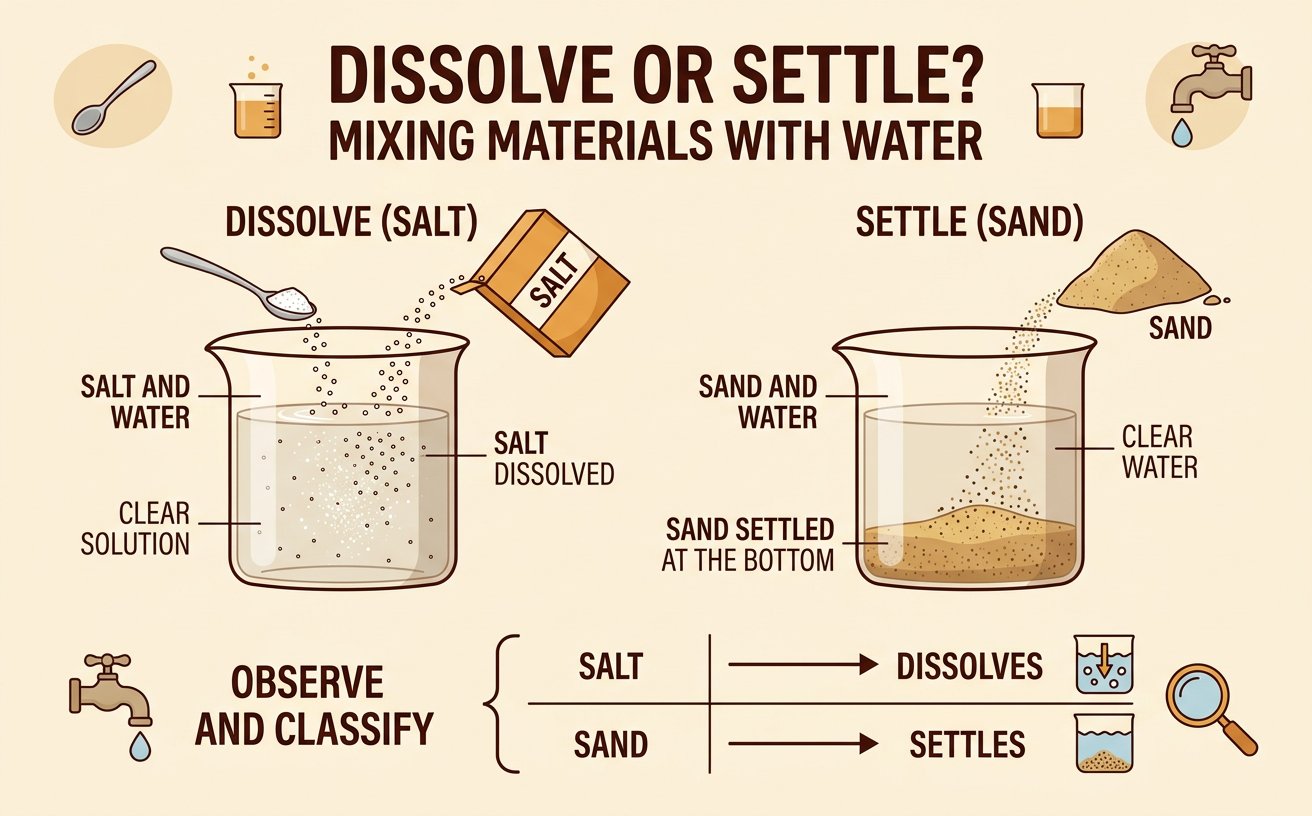
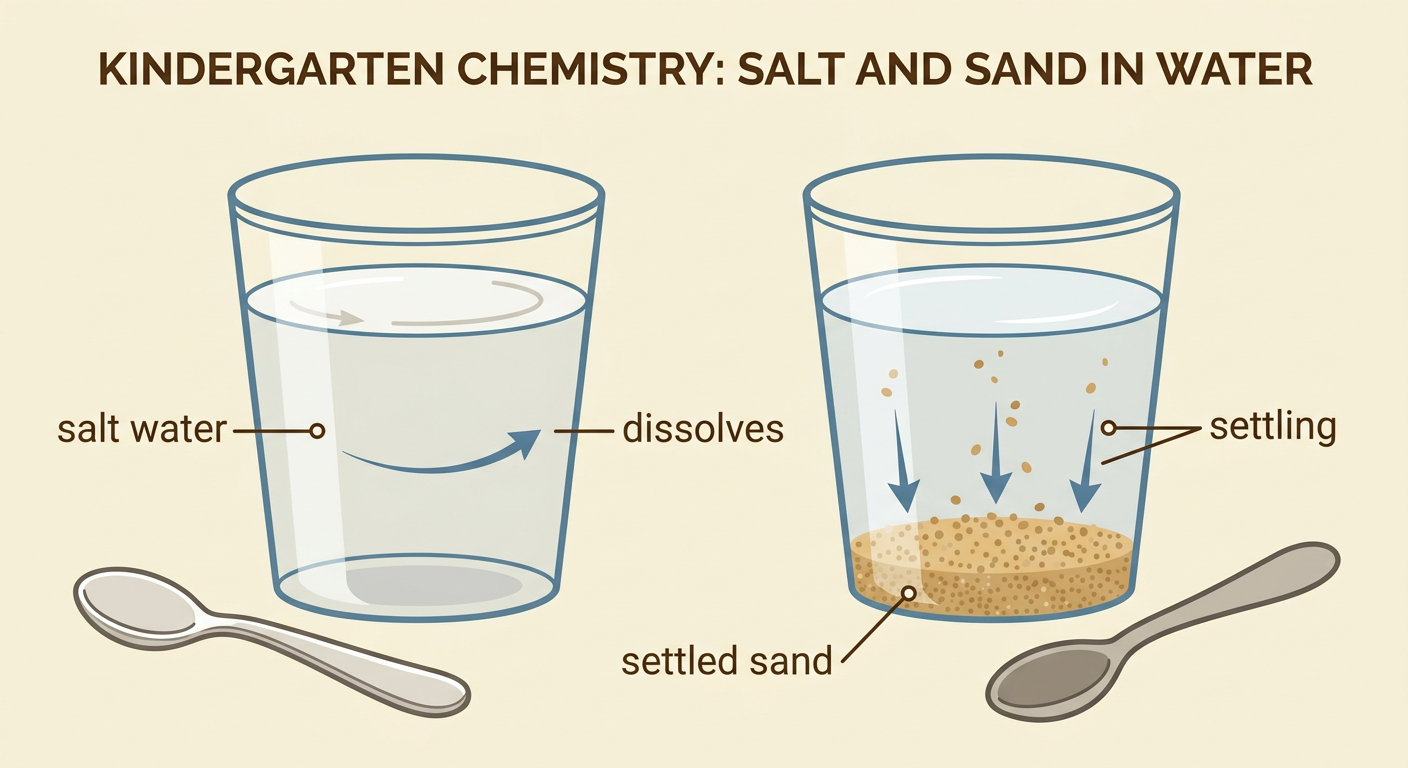
Put one small spoonful of salt into the first cup of water. Stir slowly with a clean spoon. Watch the salt grains. After enough stirring, the grains are no longer visible because the salt dissolves and spreads through the water. The salt is still in the water even though we cannot see it. Next, put one small spoonful of sand into the second cup. Stir it with a different clean spoon. The water may look cloudy while the sand moves. Stop stirring and wait. The sand grains sink and collect at the bottom. This is called settling. Look from the side of each cup and describe what you see. Do not taste the water. A teacher or adult should help prevent spills and handle cleanup.
Classify: Dissolves or Settles
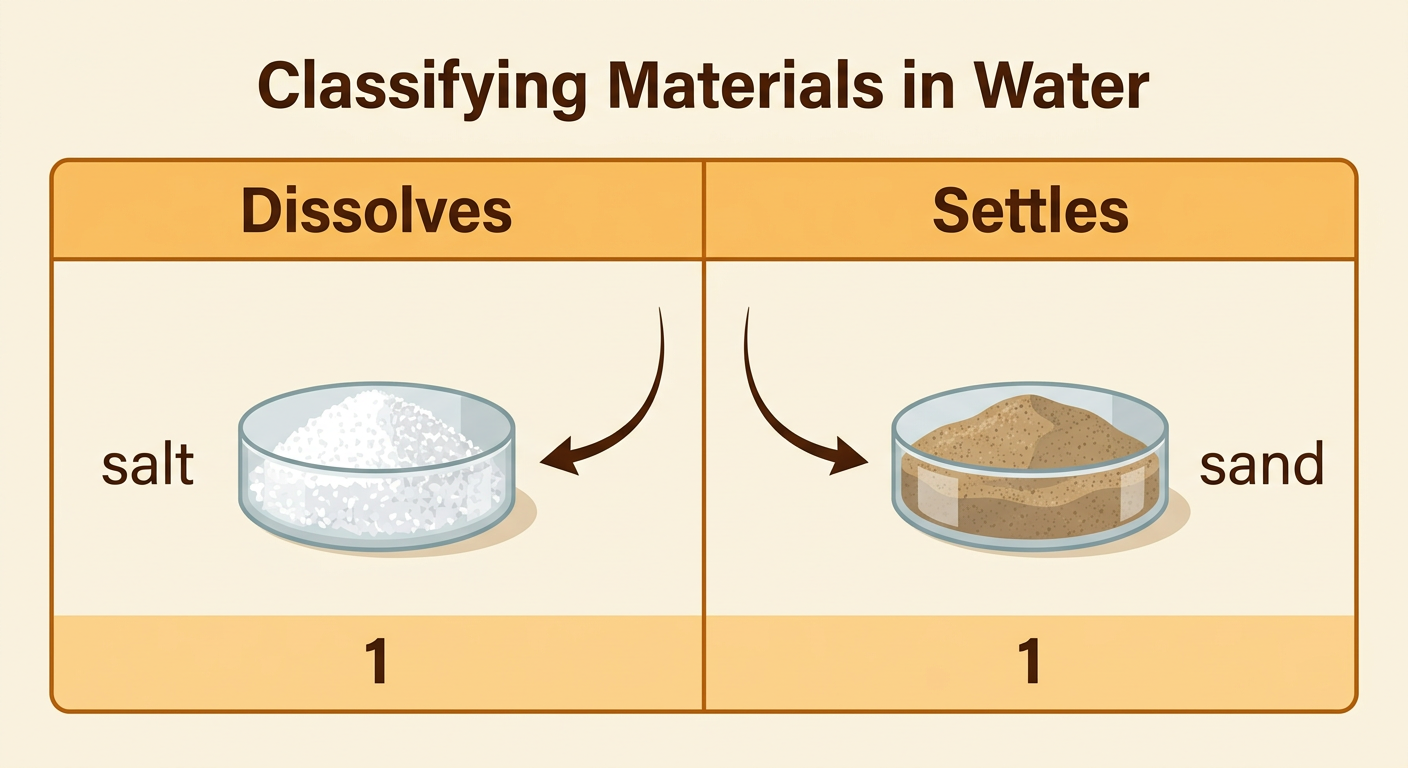
Now classify the materials by what you observed. To classify means to put things into groups using a shared property. Make two groups called Dissolves and Settles. Place the salt picture in the Dissolves group because the salt grains became too small to see and spread through the water. Place the sand picture in the Settles group because the sand grains remained visible and collected at the bottom. Count the materials in each group. There is one material in the Dissolves group and one material in the Settles group. We can say, “Salt dissolves in water. Sand settles in water.” This classification is based on what happened in our test, not on a guess. If we test more materials later, we can add them to the correct group.
Share Evidence and Review
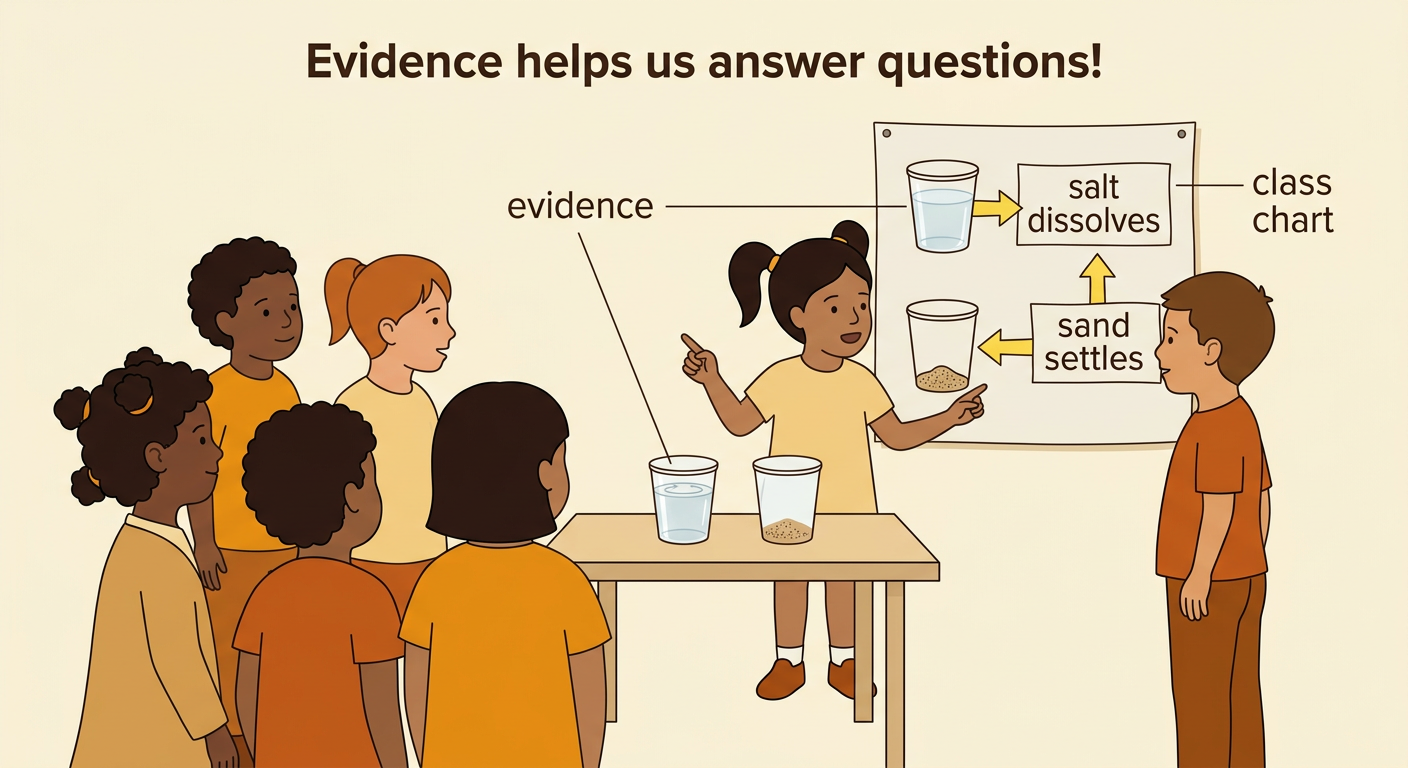
Evidence is an observation that helps answer a question. Share what you saw with the class. You can say, “My evidence is that I could not see the salt grains after stirring, so I classified salt as dissolving.” You can also say, “My evidence is that the sand collected at the bottom, so I classified sand as settling.” Listen to classmates and compare their observations with yours. A drawing, a class chart, and the cups are also sources that can help us remember what happened. Review the results: salt dissolves in water, and sand settles in water. Dissolving does not mean the salt is gone. It remains mixed throughout the water. Settling means the sand stays as visible grains and gathers at the bottom after the water becomes still.