Divide Whole Numbers Using Place Value
Students use place-value reasoning and equations to divide up to four-digit dividends by one-digit divisors and interpret remainders.

Illustrations are auto-generated and may be placeholders. They can be refreshed to match the narration.
Review Division Vocabulary
Division separates a total into equal groups or finds how many equal groups can be made. In 156 ÷ 3 = 52, the dividend is 156, the number being divided. The divisor is 3, the number of equal groups. The quotient is 52, the amount in each group. You can connect division to multiplication: because 3 × 52 = 156, you know that 156 ÷ 3 = 52. Sometimes division leaves a remainder. For example, 158 ÷ 3 = 52 remainder 2 because 3 × 52 = 156 and 2 are left. A remainder must always be less than the divisor. If it were 3 or more in this example, another group of 3 could be made.

Model Place-Value Sharing
Place value helps you divide a large number in manageable parts. To find 936 ÷ 3, represent 936 as 9 hundreds, 3 tens, and 6 ones. Share the 9 hundreds equally among 3 groups. Each group receives 3 hundreds. Next, share the 3 tens, giving each group 1 ten. Finally, share the 6 ones, giving each group 2 ones. Each group contains 3 hundreds, 1 ten, and 2 ones, which is 312. Therefore, 936 ÷ 3 = 312. This works because 936 can be decomposed as 900 + 30 + 6. Dividing each part by 3 gives 300 + 10 + 2. Place-value blocks or a drawing can make each sharing step easy to see.

Record Quotient Digits
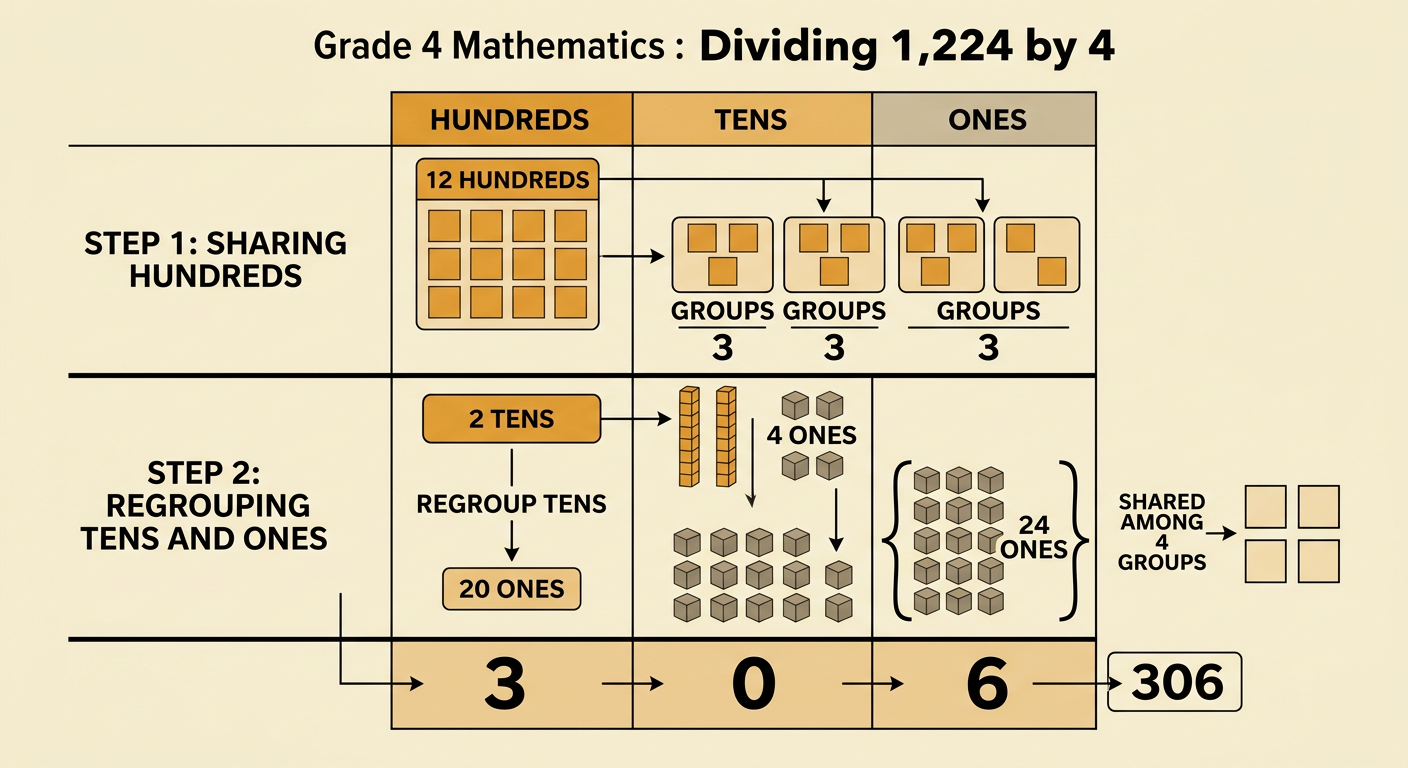
Write each quotient digit in the place that matches the amount being shared. Consider 1,224 ÷ 4. First, view 1,224 as 12 hundreds, 2 tens, and 4 ones. Sharing 12 hundreds among 4 groups gives 3 hundreds in each group, so write 3 in the hundreds place. The 2 tens cannot be shared equally among 4 groups, so each group gets 0 tens. Write 0 in the tens place. Regroup the 2 tens as 20 ones. Together with the 4 ones, there are 24 ones. Sharing 24 ones among 4 groups gives 6 ones per group. Write 6 in the ones place. The quotient is 306, so 1,224 ÷ 4 = 306. The zero is important because it holds the tens place.
Interpret Remainders
A remainder is the amount left after making as many equal groups as possible. For 1,035 ÷ 4, the quotient is 258 remainder 3 because 4 × 258 = 1,032 and 3 remain. How you use the remainder depends on the situation. If 1,035 stickers are packed in sheets of 4, you can fill 258 sheets and have 3 stickers left. If 1,035 students must ride in buses that each hold 4 students, 258 buses are not enough because 3 students still need seats. You must use 259 buses. In some problems, you report the remainder. In others, you increase the quotient by one or use only the complete groups. Always read the question carefully and explain what the remainder means in the context.

Check with Multiplication
Use multiplication to check a division answer. Multiply the divisor by the quotient, and then add the remainder. The result should equal the dividend. Suppose you find 2,317 ÷ 5 = 463 remainder 2. First multiply 5 × 463. Break 463 into 400 + 60 + 3. Then 5 × 400 = 2,000, 5 × 60 = 300, and 5 × 3 = 15. Add these products to get 2,315. Now add the remainder: 2,315 + 2 = 2,317. This matches the dividend, so the division is correct. The checking equation is 5 × 463 + 2 = 2,317. Also confirm that the remainder, 2, is less than the divisor, 5. Both checks must be true.

Independent Practice
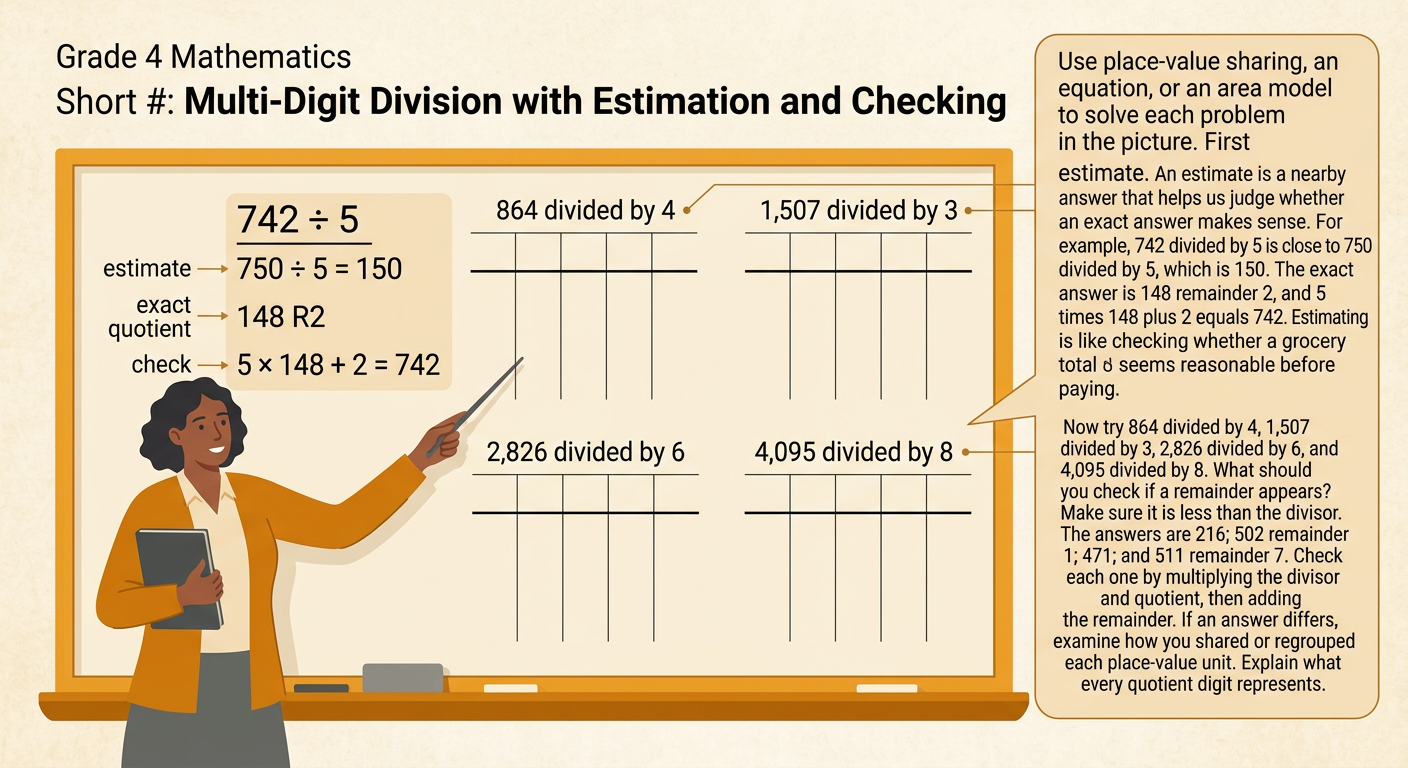
Solve each problem using place-value sharing, an equation, or an area model. Record each quotient and any remainder. Try 864 ÷ 4, 1,507 ÷ 3, 2,826 ÷ 6, and 4,095 ÷ 8. Before calculating, estimate so you know whether your answer is reasonable. For example, 742 ÷ 5 is close to 750 ÷ 5, or 150. Exact division gives 148 remainder 2 because 5 × 148 + 2 = 742. Use the same checking method for every practice problem. The answers are 216; 502 remainder 1; 471; and 511 remainder 7. If your answer differs, examine how you shared or regrouped each place-value unit. Make sure every remainder is less than its divisor and explain what each digit in your quotient represents.